Within a week of opening, “The Devil Wears Prada 2” grossed an astonishing 72 percent of the total box office earned by the original film. In part, this is because the sequel is fun and features fabulous stars in fabulous clothes traipsing through Milan and New York. These cities might even qualify as co-stars, so lovingly does the camera sweep over them. Viewers can gorge themselves on the Duomo di Milano’s spires, a Leonardo da Vinci mural, the gleaming mosaics of the Galleria Vittorio Emanuele II, Manhattan’s night skyline or the white granite steps of the Metropolitan Museum of Art.
The film’s success, then, disproves the assumption that sequels always lose out to originals in any comparison. This sequel insists, in fact, on the pleasures of comparison. And this may be the real key to its popularity.
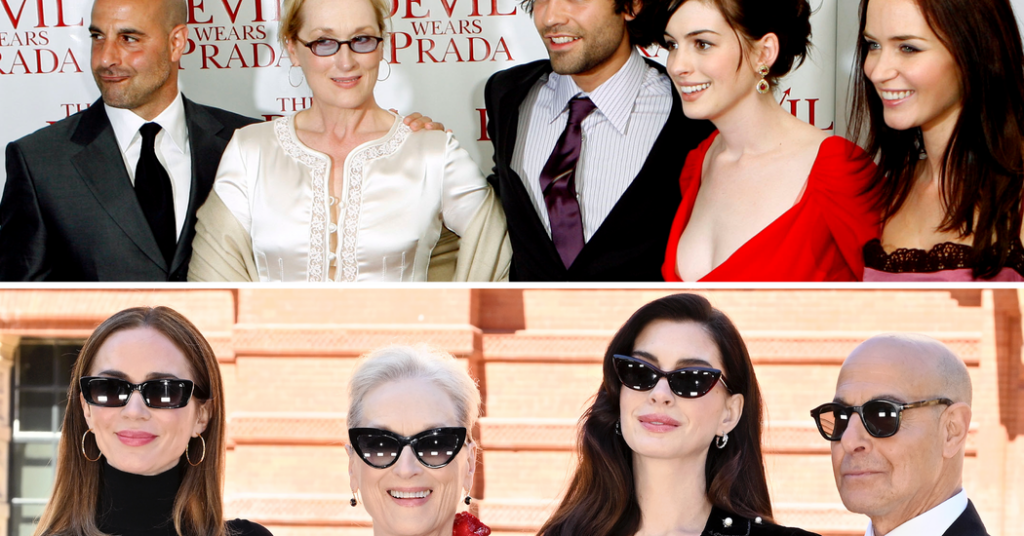
First, we are encouraged to compare the “before” and “after” versions of the cast. Although we might not admit it, we can’t help comparing the glamour trio of Meryl Streep, Anne Hathaway and Emily Blunt to their earlier iterations of 20 years ago. After all, the “Devil Wears Prada” franchise is about beauty and fashion — of course we want to look! (At my local theater, the usual previews were replaced with clips from Streep’s and Hathaway’s earlier movies. This promotional gimmick primed the audience to compare the actresses’ former and current selves.)
Such curiosity and comparison are natural; they underlie the fraught allure of high school and college reunions. Let’s face it, we’re all dying to know how — or if — everyone has held up over time. A friend once told me she had only two possible reactions when encountering long-lost acquaintances: “Whew!” (a sigh of relief) or “Oh my God!” (“I do not recognize this person!).
I can report that all returning cast members fall into the “Whew” category. The three lead actresses all look close to how they looked back in 2006. Hathaway and Blunt, both 43, remain as slinky and wide-eyed as they were as ingénues of 23. And Streep, 76, remains a marvel of piercing blue gaze, porcelain skin and cut-glass bone structure. (Stanley Tucci may be the least changed of all, looking virtually identical to his younger self.)
But, isn’t it wrong to talk about women’s looks? Isn’t that ignoble and sexist? Why should anyone need to look younger than their years? And what about the damaging, expensive rituals such enduring beauty can require? What about the virtues of aging naturally and respecting the changes brought by time? Yes, I’m with you.
And yet. We must admit that there’s an underlying contradiction in our culture, which this film brings center stage.
Whether we approve or not, whether it seems high-minded or not, we love to admire and be amazed by beauty, especially when it comes to Hollywood stars. We want them to remain untouched, or nearly, by time. And when they oblige us — using whatever techniques necessary to maintain their right-angled jawlines, taut cheekbones and un-gray hair — part of us is reassured and uplifted. Our monuments have been preserved.
And that is the point. A glamorous star is a human being, but also a kind of cultural monument, an exceptional category that includes architecture and artworks. It is certainly not wrong to love the unchanging beauty of those things, right? And since those things figure so prominently in “The Devil Wears Prada 2,” the film implicitly suggests that our appreciation for high culture is not so different from our appreciation of beautiful Hollywood stars or, for that matter, our fascination with haute couture, five-star hotels, celebrity cameos (Lady Gaga! Donatella!) and lavish parties, all of which swirl together onscreen.
By likening these glossy, more ephemeral pleasures to the gravitas of its historic and highbrow backdrops, the film suggests an equivalence among them. This ingeniously absolves us from guilt, freeing us to gape and swoon at all of these cultural pleasures at once, from cathedrals to catwalks. (The new Costume Institute exhibition at the Met, “Costume Art,” does much the same thing, placing modern fashions “in dialogue” with serious, sometimes ancient art objects. A Rudi Gernreich monokini is paired, for example, with a 2,000-year-old statue wearing an oddly similar garment.)
This pattern extends to the plotline, which is all about watching the noble heroine, Andy Sachs (Anne Hathaway), try to save the fictional Runway magazine from the ravages of TikTok culture and a hostile takeover by a clueless tech billionaire (Justin Theroux). Preserving Runway is presented as a virtuous goal, the defense of something classic against low-culture vulgarians. To love Runway and all it represents, then, is to stand with the glories of civilization against crassness and ignorance.
Driving home this point, “The Devil Wears Prada 2” even gives Runway’s editor, Miranda Priestly, a new, ultrahigh-culture husband — a classical violinist, played by Kenneth Branagh, an actor of impeccable highbrow bona fides.
The irony here is that, for Andy, Runway wasn’t always such a symbol of cultural virtue. In the original film, Andy starts out disdaining fashion and wanting to be a “serious” writer. That film ends with her leaving to pursue more high-minded journalism. In the sequel, Andy returns to Runway only after losing her more “serious” job, and she has to acclimate herself again to the world of stilettos, fetching hats and Hamptons weekends. She does this swiftly, her wardrobe and makeup growing more glamorous as the film progresses.
Her glow-up is delicious to watch, but it in no way compromises her lofty principles. Andy triumphs in the end: She finds a billionaire fairy godmother (the tech bro’s ex-wife, played by another glamour icon, Lucy Liu) who uses some of her divorce settlement to save the magazine. Glitter and gravitas, old-world print journalism and tech-world profits, all wind up melding seamlessly.
Like “The Devil Wears Prada,” this sequel is about the challenge of balancing the love of things considered superficial — physical beauty, youth, fashion, pop culture and luxury — with the need for seriousness, integrity, virtue and principles. And it’s about the guilt or ambivalence involved in these choices.
In the first film, Hathaway’s character embodied this struggle, ultimately giving away her Chanel to hunker down and write about public policy. Twenty years later, “The Devil Wears Prada 2” smooths away her need to choose — and by extension our own. Like a shot of moral Botox, it relaxes — temporarily — our own struggle with the contradictions that plague us.
Rhonda Garelick writes the Face Forward column for The Times’s Style section. She is the founding director of the Interdisciplinary Institute for Public Humanities at Hofstra University, where she is also the John Cranford Adams Distinguished Professor of Literature.
The post The Pleasure of ‘The Devil Wears Prada 2’ Is in the Comparisons appeared first on New York Times.