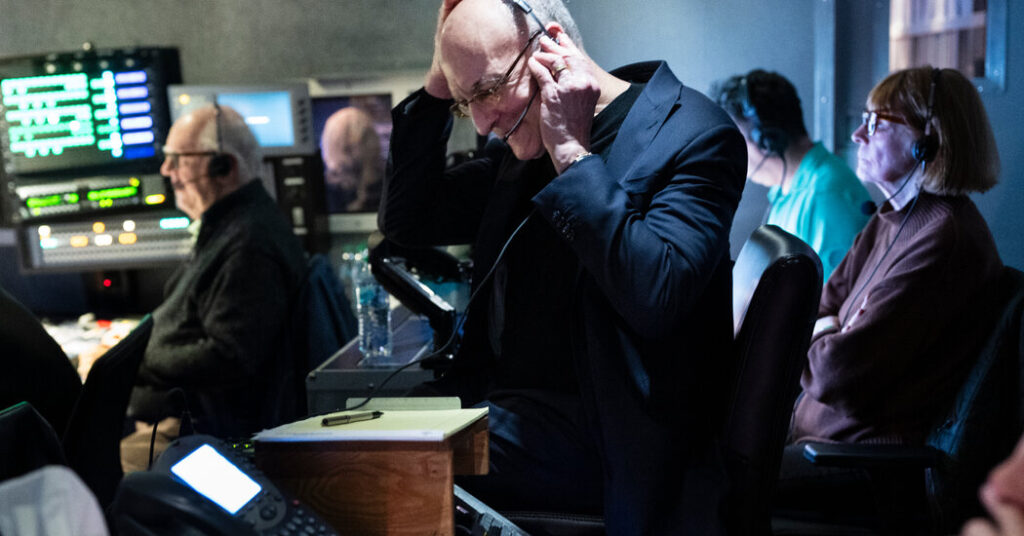
From the general manager’s box at the Metropolitan Opera, Peter Gelb surveyed the hall that has been his domain for nearly 20 years. It was 10 minutes before curtain one evening in April, the orchestra was warming up, and there was just enough time to check the hall for empty seats — very few that night — and to steer his guests, including the director of a new opera about Frida Kahlo and Diego Rivera, to their places in his box.
This was the final performance of “Innocence,” the searing work by the Finnish composer Kaija Saariaho about a school shooting. “Innocence” was one of a number of Met productions this season that won the acclaim of audiences and, to a certain extent, critics — “Tristan und Isolde,” “I Puritani,” “La Sonnambula” and “The Adventures of Kavalier & Clay” among them.
But for all the success onstage, Gelb is under siege, struggling to steer the Met through a fiscal crisis that is imperiling its position as the most ambitious opera company in the country. Gelb is an old-school New York character trying to ride the generational, cultural and financial changes that are sweeping not only the Metropolitan Opera but also opera houses around the world.
In the latest setback, the Met faces a $30 million shortfall after Saudi Arabia pulled out of a collaboration Gelb had negotiated; it was expected to provide $200 million to the company over the next eight years. This blow came after the Met tapped nearly one-third of its endowment to cover operating expenses.
But as he finishes his 19th season, confronting doubts about the viability of the Met as well as key parts of his strategy to rescue it, Gelb conveys confidence that he will again find a way to save the opera house that he said he always dreamed he would run. He is resilient and relentless, a former record company executive and agent who, in his own telling, has rarely met a challenge he couldn’t beat.
“I don’t think it’s reasonable to have the kind of magical thinking that the Met cannot fail just because it hasn’t failed before,” he said. “But I do believe in what we’re doing. We’re not sitting back waiting for a miracle, we’re actively working on finding solutions.”
As the Met’s general manager, Gelb is one of the most powerful figures in the performing arts world. He decides which operas should be produced on this most prestigious of stages and which singers to hire for star roles. His power extends to even more mundane matters, like determining which donors should get prime seats for opening nights.
Gelb, who is paid $1.2 million annually, oversees a $326 million budget, the largest in the country for an opera house. Beyond the often caustic scrutiny of opera critics and patrons, Gelb must reckon with the demands of 3,000 full- and part-time employees, 15 labor unions and a 144-member board of directors, including 47 with governance authority, meaning they have legal and fiduciary responsibility over the Met. (That power includes the power to hire and fire a general manager.)
Bartlett Sher, a theater director Gelb recruited to direct operas, including “Kavalier & Clay,” said that being the Met’s general manager is “unquestionably the most difficult job on earth,” adding: “Opinions in opera are so strong. Everyone seems to know better. He can’t do a thing without being criticized up and down.”
GELB HAS USED HIS PLATFORM to disrupt decades of tradition at the Met — promoting new operas, discarding old and lovedproductions of warhorses like “Carmen,” “Aida” and “Tosca,” in favor of contemporary and often less well-attended shows. He has hired Broadway directors. He is known for spending lavishly on prestige productions: “Tristan” cost about $3.5 million to produce, though it went on to play eight sold-out performances.
His campaign to change the Met has not always been well received. His now-retired production of Wagner’s “Ring,” which replaced a long-admired Met production by Otto Schenk, cost $16 million to produce and was described by Alex Ross, the classical music critic for The New Yorker, as “the most witless and wasteful production in modern operatic history.”
Gelb, now 72, will be 76 when his contract expires on July 31, 2030. He said he has no desire to retire, assuming he is healthy and the Met board wants him to continue, and notwithstanding what he described as an errant remark he made to an Associated Press reporter that he would step down in 2030.
“I should leave when I cannot do the job properly or when the board doesn’t want me to be here,” he said during one of a series of interviews in his office behind an unmarked door off the Met lobby. “I’m a workaholic, I’ve always worked. I don’t enjoy free time. I wake up in the middle of the night thinking about work. Some people have egos that are so satisfied that they don’t need work. I need work. My life would be empty without work.”
Much of that middle-of-the-night worrying is the result of the perils-of-Pauline financial crises at the Met under Gelb, as well as the response in some quarters to his unorthodox ideas for addressing them.
Gelb’s decision to draw down the Met’s endowment from $340 million to 2022 to $216 million today to cover operating expenses runs counter to standard budgetary practices. He entered a long negotiation to collaborate with Saudi Arabia, a country with a history of human rights abuses, and expressed confidence the deal would come through almost up until the moment it collapsed (“There was no choice,” he said of both efforts.) Some board members want the Met, which has a $62 million line of credit coming due in February, to file for bankruptcy protection — an idea that Gelb has rejected, calling it “a last resort.”
And Gelb confronts a daily barrage of complaints from opera fans who have strong views on everything from set design to the choice of a tenor or director. “Gelb is a total failure who must resign now,” read a typical reader comment on a New York Times review of “Tristan.” That new production of the “Frida y Diego” opera, which opened Thursday night? “Joyless and confused,” the critic Joshua Barone wrote in The Times.
But senior members of the board of directors, in interviews, applauded the Gelb’s efforts to reinvent the company for a new generation and to deal with the financial problems. “Peter has the support of the vast majority of the board,” said Ted Johnson, its president and chief executive.
Ann Ziff, the chairman of the board, said the Met “would be crazy not to try to get another contract from him because of the direction that he’s taken us. He has pulled us through all these crises.”
“Yes, I’m certainly concerned,” she added. “But I have faith in the situation with Peter at the helm.”
Even if Gelb is not yet in his final Metropolitan Opera chapter, he is beginning to contemplate the twilight of his tenure. There is already speculation about his successor. Leading that list is Alexander Neef, the general director of the Paris Opera, and, to a lesser extent, Anthony Roth Costanzo, the countertenor who was appointed general director of the Opera Philadelphia just two years ago.
Deborah Borda, a former president of the New York Philharmonic, said Gelb would be “hard to replace.”
“Running the Metropolitan Opera is the single most challenging and difficult job in the American arts world — and perhaps the entire world,” she said. “He keeps springing back. He keeps it going. He figured out what the old-time audiences wanted, but he had the courage to bring in so many new productions.”
GELB WAS STANDING AT ROW Q in the darkened Met auditorium, leaning over a plank laid across four chairs, on which rested a laptop, a landline, a cellphone charging stand and a dispenser of hand sanitizer. “This is my field station,” he said. Gelb had set up an office in the auditorium for a piano-only rehearsal of “El Último Sueño de Frida y Diego,” and he was a whirl of texting, telephoning and emailing, pausing to talk to singers, musicians, directors and technicians who stopped by with a greeting, question or concern.
His cellphone lit up in the dark, displaying the name and picture of the director Yuval Sharon, and for the next five minutes, Gelb and Sharon talked through casting ideas for the new production of Wagner’s “Ring,” which Sharon is directing. Gelb then loped onstage to talk to the director of “Frida,” Deborah Colker, about safety concerns as the stage splits apart to reveal an underworld.
Gelb is officially the general manager of the Met, a job that, unusually in this world, combines the role of artistic director and chief executive. And for all his focus on the existential issues of Met governance, he is at heart a stage producer who takes an acute interest in even minute details of production. The chorus master pulled him over to complain that the chorus was positioned too far upstage. “Everyone wants to be downstage,” Gelb said as he returned to his seat.
Watching from his desk, Gelb decided that red flashing lights hidden in crevices under the stage made the set look like a rock concert. He went back onstage to ask that the lights just be left on during the scene. They were.
WHAT WILL IT TAKE to put the Met’s finances in order?
Gelb shifted in his chair as he considered the question. “Ideally, we need a check for the endowment of $1 billion,” he said. At 5 percent interest, that would generate $50 million a year, enough, combined with an aggressive annual fund-raising campaign, to offset the Saudi loss.
But finding such a donor has only grown more difficult. The argument Gelb uses in fund-raising — that a vibrant arts scene is critical to a flourishing civilization — is competing for requests for donations for social justice causes and fighting the perception that opera is out of touch and a playground for the elite.
“The financial challenges of the house — it’s never going to be easy,” said Yannick Nézet-Séguin, the Met’s music director, a Gelb recruit who has become a partner with him in programming operas and hiring singers and directors. “It’s a huge opera house, the biggest in the world. And you know, in a certain shape and form, everyone is struggling.”
The Met’s financial struggles date to the Great Depression and have ebbed and flowed over the decades: Gelb arrived just before the 2008 recession, which hit the company hard. And the financial problems have grown significantly worse since the coronavirus pandemic. Earned income — ticket sales, and money from broadcasting live opera performances to movie theaters — made up 50 percent of the opera’s operating budget before the pandemic but has fallen to 33 percent. Donations make up the rest.
Attendance has begun climbing back: Productions like “Tristan” and “Kavalier & Clay” sold out multiple performances. But the broadcasts, a bright hallmark of Gelb’s tenure, have collapsed. “We used to get $18 million a year from the theaters,” Ziff said. Audiences stopped showing up at movie theaters for an afternoon of opera, and revenues from those performances now cover only the cost of the productions.
Gelb has responded with a barrage of ideas: Searching for another country to replace Saudi Arabia in a lucrative international collaboration. Selling naming rights to the opera house. Auctioning the two Chagall murals that hang in the Grand Tier, valued at $55 million by Sotheby’s, on the condition that the buyer leave them in place.
“I am trying to be as entrepreneurial as possible,” he said. “That’s my upbringing and my pedigree.”
BY HIS OWN ACCOUNT, Gelb has stumbled over the years, such as when he replaced a Franco Zeffirelli production of Puccini’s “Tosca” with a grim version directed by Luc Bondy. “That was a mistake,” he said. “That production probably should have never happened.” The Met replaced Bondy’s with a David McVicar production more in the Zeffirelli tradition.
But over these past 20 years, Gelb has helped to transform the Met, from what appears onstage to who sits in its seats. Sharon said Gelb had brought “contemporary opera front and center in a way that has been a real response to this moment,” and pointed to the “Tristan” he directed, after a five-year courtship by Gelb, with the soprano Lise Davidsen singing Isolde earlier this year.
“He could easily taken the safe route,” said Sharon, who is known as one of the most innovative directors in opera. “He really didn’t.”
By the end of next season, the Met will have shown 122 new and established productions since Gelb became general manager. That includes 42 new to the Met stage, eight of which were commissioned by the Met. The average age for single-ticket buyers, who make up 80 percent of the box office revenue, has dropped to 44 years old from 65 over the course his tenure.
He has in recent years hired some of the most acclaimed singers of the era, including Asmik Grigorian, Joyce DiDonato, Ryan Speedo Green and Davidsen, who will appear as Brünnhilde in the “Ring.” Davidsen said her decision to spend so much of her time singing for New York audiences was because of Gelb.
“In many ways it’s all because of Peter, as the tone or atmosphere of an opera house very much comes from the top down,” Davidsen said.
John Allison, the editor of Opera magazine, said Gelb “has dragged an old institution into the modern world.” He continued: “It’s hard to imagine the Met still being with us today if it had continued on the trajectory where it was 25 years ago.”
Still, unless Gelb finds his billionaire donor, the financial problems that have shadowed the Met for a century seem likely to worsen. David Bohnett, a philanthropist and the former chair of the Los Angeles Philharmonic, said Gelb’s “artistic achievements have been both significant and enduring.”
“The harder question now is whether the Met’s underlying business model is sustainable,” he said.
Gelb said when he came to the Met 20 years ago, he did not “understand fully the impossibility of the economics of a big nonprofit theater like this.”
“It’s definitely not hopeless,” he said. “I am determined to get us through this.”
Adam Nagourney is the classical music and dance reporter for The Times.
The post Does This Man Have the ‘Most Difficult Job on Earth’? appeared first on New York Times.