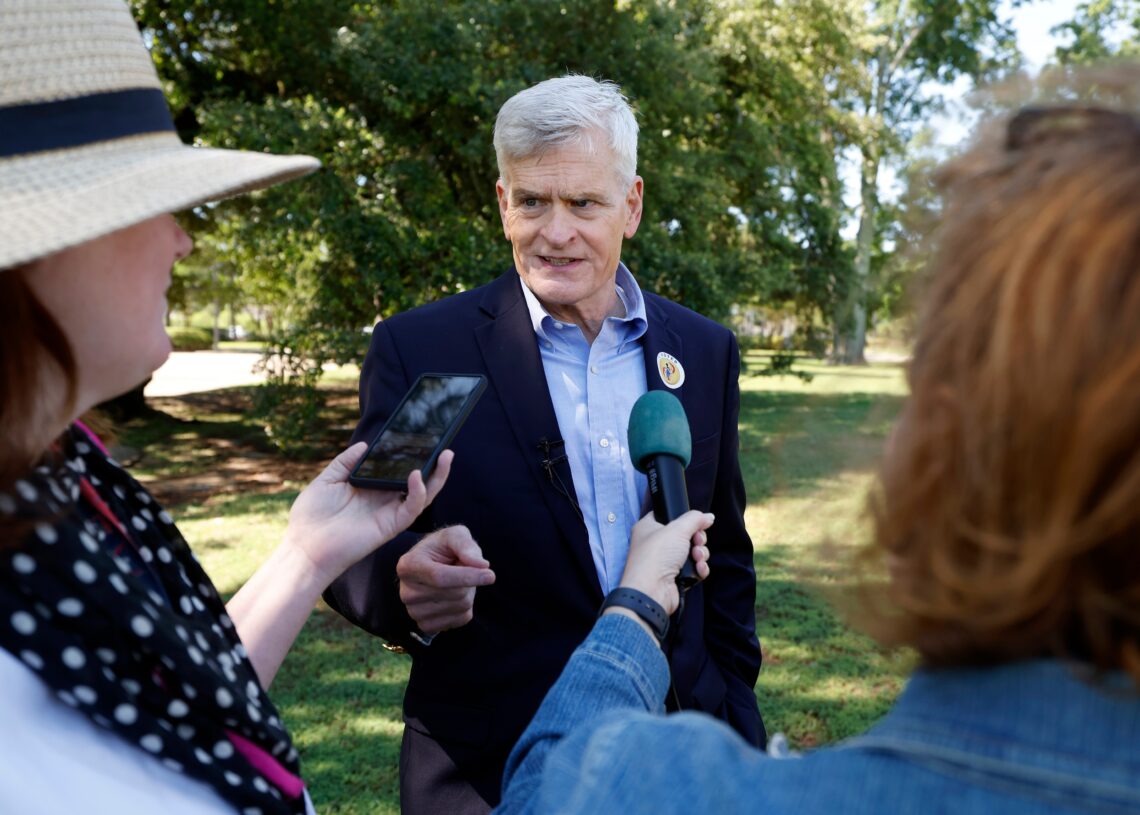
Sen. Bill Cassidy (Louisiana), one of seven Republican senators who voted to convict President Donald Trump in his 2021 impeachment trial, failed to make a runoff Saturday after voters in his state heeded Trump’s call to oust him.
The loss marked a bitter end to Cassidy’s two terms in the Senate and the most significant defeat for a Republican who sought to hold Trump accountable for the Jan. 6, 2021, attack on the U.S. Capitol since Rep. Liz Cheney (Wyoming) lost her primary four years ago.
The president has been intent on rewriting the history of Jan. 6 and eager to punish those who blamed him for sparking it.
Trump endorsed one of Cassidy’s primary challengers, Rep. Julia Letlow, and celebrated his defeat Saturday night.
“His disloyalty to the man who got him elected is now a part of legend, and it’s nice to see that his political career is OVER!” Trump wrote on social media.
Letlow did not defeat Cassidy outright because she did not win a majority of the vote. Instead, she advanced to a June 27 primary runoff in which she will face John Fleming, the state treasurer.
Letlow led Fleming 45 percent to 28 percent with almost all of the vote counted. Cassidy trailed with 24 percent of the vote.
Cassidy, the chairman of the Senate Health, Education, Labor and Pensions Committee, is the first sitting senator to lose a primary since 2017, when Sen. Luther Strange (R-Alabama) lost to Roy Moore in a special election months after he was appointed to the seat.
The primary was the latest test of Trump’s power to take revenge on Republicans who have defied him.
Five Republican state senators in Indiana who had bucked the president by refusing to redraw the state’s congressional districts lost primaries this month to Trump-backed challengers. Rep. Thomas Massie (R-Kentucky), who angered Trump by repeatedly breaking with his party, will face a primary challenger on Tuesday whom Trump is supporting.
Cassidy, 68, had a financial advantage in the race. His campaign and an allied super PAC, Louisiana Freedom Fund, spent more than $22 million on ads, according to the tracking firm AdImpact — more than Letlow, Fleming and their allies combined.
Letlow, 45, won her House seat in a special election in 2021 after the death of her husband, Luke Letlow, who had been elected to the same seat but died days before he was set to be sworn in. She campaigned on her work on the House Appropriations Committee to fund projects in her districts and reminded voters in relentless ads that she was the only candidate with Trump’s endorsement.
Fleming, 74, a former congressman who went on to serve as White House deputy chief of staff during Trump’s first term, won over some voters by casting himself as more conservative than Letlow or Cassidy. He said he spoke to Trump by phone in February and encouraged Trump to make him Trump’s “Plan B” in the race.
Trump appeared to praise Fleming on Saturday, even while he urged voters to support Letlow, writing that Cassidy would “get CLOBBERED, hopefully, in today’s BIG election, by two great people!!!”
Saturday’s primary was the first that Louisiana held since a new state law took effect, instituting separate Democratic and Republican primaries in congressional elections. The state previously used a “jungle primary” system in which all candidates appeared on the same ballot regardless of party, followed by a runoff between the top two finishers if none won a majority of the vote.
The new system allows unaffiliated voters to vote in either primary. Cassidy said his campaign had heard from voters bewildered by the new system and feared they would be disenfranchised.
“People are calling my office to say they tried to vote for me but they could not,” Cassidy told reporters Friday.
Trey Williams, a spokesman for the Louisiana secretary of state’s office, said the office had conducted an extensive campaign to educate the public about the new system and train poll workers. The Letlow and Fleming campaigns said they had not heard of supporters experiencing similar problems.
“The guidelines have been clearly communicated, and we fully trust election officials across the state to ensure voters understand what’s required under Louisiana’s closed primary system,” Katherine Thordahl, a Letlow campaign spokeswoman, said in a statement.
Trump was acquitted in his 2021 impeachment trial after the Senate voted 57-43 to convict him, falling short of the two-thirds threshold required.
Cassidy is the first of the seven Republican senators who voted to convict Trump to lose a primary. Three of them did not run for reelection; a fourth, Ben Sasse (Nebraska), resigned in 2023 to become president of the University of Florida.
Cassidy and two other Republicans — Sens. Lisa Murkowski (Alaska) and Susan Collins (Maine) — remain in the Senate. Murkowski fought off a primary challenge in 2022. Collins is not facing a challenge in next month’s Republican primary, but Democrats are working to defeat her in November.
Most of the 10 House Republicans who voted to impeach Trump in 2021 are also gone. Four of them — including Cheney — lost their primaries the following year. Four others did not run for reelection, and two remain in office: Reps. David G. Valadao (California) and Dan Newhouse (Washington). Newhouse is not seeking reelection this year.
Unlike Collins or Murkowski, Cassidy has rarely bucked Trump since he returned to the White House. Cassidy voted to confirm Health Secretary Robert F. Kennedy Jr. last year despite concerns about Kennedy’s criticisms of vaccines — a deeply personal issue to the senator, a physician who has described watching patients die of diseases that vaccines can prevent.
While Cassidy has avoided antagonizing Trump, he has not disavowed his vote to convict him. Instead, he tried to persuade Republican voters to overlook it, campaigning on his record delivering for one of the poorest states in the country. He emphasized his defense of the state’s oil and gas industry and his work to make sure a law Trump signed last year that eliminated taxes on tips applied to barbers.
“If you want somebody who works well with President Trump, you vote for Bill Cassidy,” Cassidy said last week in an interview in Baton Rouge. “He may not like me, but he had signed into law four bills that I either wrote or negotiated in the last four months.”
Letlow tried to turn Cassidy’s record against him, criticizing him for voting for the bipartisan infrastructure law that President Joe Biden signed in 2021, which Cassidy hailed as an accomplishment. And she said it was clear Republican voters had not forgiven him for his impeachment trial vote.
“Even to this day, six years later, they’re still talking about it,” she said last week in an interview in Madisonville. “They’re still just as angry and feel like he wavered and turned his back on something that was very important to them.”
Maegan Vazquez contributed to this report.
The post GOP senator who voted to convict Trump in impeachment trial loses primary appeared first on Washington Post.