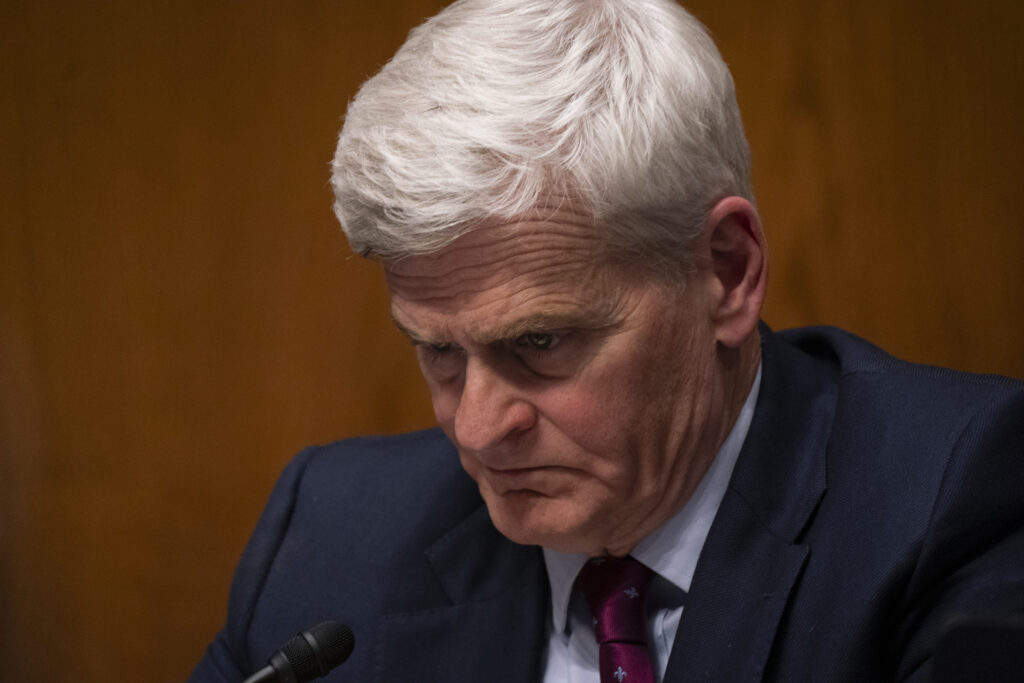
Sen. Bill Cassidy’s defeat in Saturday’s Republican primary in Louisiana will be covered as evidence of President Donald Trump’s grip over the party. Cassidy voted to convict Trump after his second impeachment following Jan. 6, 2021, and this was payback.
At the same time, Cassidy’s third-place finish highlights another unfortunate trend in American politics: the decline of open primaries across the country.
One reason Cassidy was willing to break with Trump five years ago is that Louisiana had a different election system than it does now. From 1975 until this year, the top two finishers on Election Day, regardless of party, would face each other in a runoff if neither garnered 50 percent. That allowed a Republican like Cassidy to win by assembling a coalition that included independents and moderate Democrats.
But the state legislature voted to get rid of that “jungle” system, partly to get rid of Cassidy. And it worked. In a state as red as Louisiana, the GOP primary is tantamount to the general election.
Bosses in both parties have been working to change the rules the last few years to make it harder for more moderate politicians like Cassidy to survive.
In California, some Democrats are rallying behind a push to eliminate their state’s jungle primaries after being spooked by a scenario in which two Republican candidates could face each other in the general election for governor.
In Alaska, many Republicans are trying to repeal their state’s voting system, which puts all candidates on one ballot and allows voters to rank them. A ballot initiative this November would replace that with a traditional party primary system with no need for candidates to reach a majority to win.
In Tennessee, which technically has open primaries, Republican officials recently added language to ballots requiring voters to sign a statement “under penalty of perjury” in which they must “declare allegiance” to whichever party whose primary they vote in.
Elsewhere, partisans are actively fighting efforts to open up primaries. In D.C., Democrats are refusing to honor the will of voters, who overwhelmingly approved a 2024 referendum to open up partisan primaries to independent voters. Massachusetts Democrats oppose a similar measure that will be on the ballot this fall.
In every instance, party leaders seek a viselike grip on power. The result will be elected officials who are less representative of all the people in the states they represent.
The post Bill Cassidy and America’s increasingly broken primary system appeared first on Washington Post.