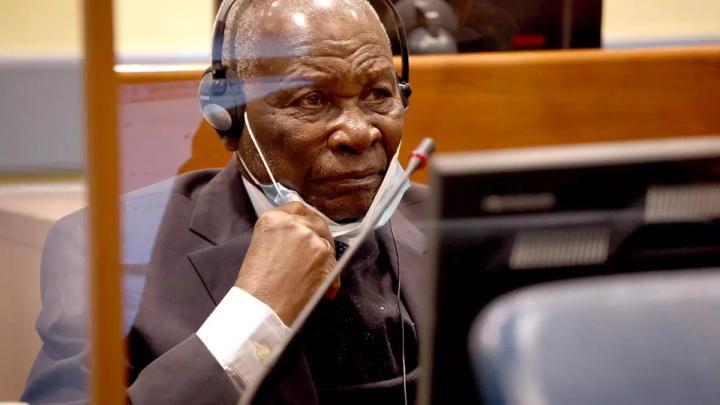
Félicien Kabuga, a Rwandan business tycoon who spent decades on the run after allegedly financing the country’s 1994 genocide of ethnic Tutsis and moderate Hutus, died May 16 in The Hague. He was believed to be at least 90.
The United Nations did not immediately provide a cause of death.
For a generation, Mr. Kabuga symbolized the wounds that have festered in his tiny East African nation since the end of the massacre that left hundreds of thousands dead. Availing himself of his immense wealth and of the help of family and associates abroad, he remained a fugitive for 26 years, evading international authorities despite a $5 million U.S. government bounty for evidence leading to his capture.
Mr. Kabuga, Rwanda’s most-wanted man, had once been one of its wealthiest entrepreneurs. He allegedly funded and armed extremist ethnic Hutu militias, known as the Interahamwe, with truckloads of machetes and hoes. During 100 days of conflict, they slaughtered more than 800,000 ethnic Tutsis and moderate Hutus.
Mr. Kabuga, an ethnic Hutu himself, also co-founded and financed the private radio station Radio Télévision Libre des Mille Collines (RTLM), which incited Hutus “to kill the Tutsi cockroaches” and was later described by survivors as the “voice of genocide.” The extremist media played upon decades of hate mongering between ethnic Hutus and Tutsis, pitting neighbor against neighbor through spiteful anti-Tutsi propaganda broadcasts listened to by millions.
In 1998, the U.N. International Criminal Tribunal for Rwanda indicted Mr. Kabugaon charges of genocide and crimes against humanity and five other counts of violating international humanitarian law.
French investigators finally tracked him down in May 2020 in a third-floor apartment in the Paris suburb of Asnières-sur-Seine, where he was living under a false identity.
Addressing a French court during a bail hearing, Mr. Kabuga said that the allegations were “lies” and that he had not killed any Tutsis. “I was working with them,” he said, according to the BBC.
To genocide survivors, Mr. Kabuga was the mastermind of their suffering. “Kabuga is our Osama bin Laden,” Benoit Kaboyi, the executive secretary of Ibuka, Rwanda’s largest genocide survivors group, told Knight Ridder newspapers in 2004.
Félicien Kabuga is believed to have been born July 19, 1935, when Rwanda was a Belgian colony, though he claimed at times to have been born earlier. Also in dispute is his birthplace: Some reports suggest he was born in the town of Munig; others say his hometown was the hamlet of Nyange, roughly two hours’ drive north of the capital, Kigali. He grew up in poverty, in a small yellow house with six siblings.
Mr. Kabuga received no formal education, instead working on the family farm. As a teenager, he made baskets and traded them for beans that he later sold in the market. With the money he earned, he pursued business ventures, including trucking and the import and export of goods. But he made his fortune largely from the tea trade. Like many Rwandans, Mr. Kabuga spoke Kinyarwanda, French and Swahili. He learned English to expand his businesses into the former British colonies of Kenya and Uganda, according to relatives and neighbors.
Mr. Kabuga married Josephine Mukazitoni, and they had at least five children.
He grew even more prosperous and politically connected when one of his daughters married the son of President Juvénal Habyarimana, who died in a mysterious plane crash in 1994 that triggered the genocide. The wedding gave Mr. Kabuga entry into the Hutus’ elite inner circle, where he became an influential business adviser to the government.
In the weeks before and after Habyarimana’s death, Mr. Kabuga was the president of the country’s National Defense Fund, through which he allegedly “provided funds to the interim Rwandan government for the purposes of executing” the mass slaughter, according to the U.S. State Department’s reward offer for Mr. Kabuga.
He also allegedly gave “logistical support to the Interahamwe militiamen by issuing them weapons and uniforms and by providing them transport in his company’s vehicles,” according to the State Department.
Tutsi rebels led by Paul Kagame seized power after the genocide, and Mr. Kabuga fled to Switzerland, where he briefly remained until he was denied asylum and returned to sub-Saharan Africa. As Kagame solidified his rule — he has been Rwanda’s president since 2000 — Mr. Kabuga hid in Kenya, where he had built significant business interests and political allies in the government.
Multiple attempts to catch him failed, often because he was tipped off by Kenyan officials or police officers. In January 2003, a Kenyan freelance journalist, William Munuhe, was found fatally shot in his home in a Nairobi suburb. According to investigators and local reports, Munuhe was working with the FBI in a sting operation to nab Mr. Kabuga.
In April 1998, according to a report by the International Crisis Group, investigators from the U.N. tribunal linked him to a house owned by the nephew of Daniel arap Moi, then the president of Kenya. But later that year, Mr. Kabuga was spotted in Southeast Asia, according to a 1999 U.N. report on illicit arms transfers.
In late 1999, roughly $2.5 million in bank accounts Mr. Kabuga held in France, Belgium and Switzerland were frozen after the international criminal tribunal targeted his financial resources. A decade later, Stephen Rapp, then U.S. ambassador at large for war crimes, accused senior Kenyan officials of harboring Mr. Kabuga and demanded that they deliver him.
At the time, Mr. Kabuga’s capture was widely seen by survivors of the genocide and analysts as vital to unifying Rwanda, a deeply divided nation still grappling with its tortured past. Mr. Kabuga was also viewed as one of the few people who knew how the genocide was orchestrated.
“Truth has to be established for reconciliation to happen,” François Grignon, then East Africa director of the International Crisis Group, told Knight Ridder in 2004. “Kabuga’s capture is one of the key elements to this.”
A team led by U.N. war crimes prosecutor Serge Brammertz eventually tracked him to France in 2020.
“The French authorities located the apartment in which he was hiding, which led to the operation,” Brammertz told the BBC. Mr. Kabuga was able to hide for so long because of “the complicity of his children,” he added.
His wife died in 2017 in Belgium. A complete list of survivors was not immediately available.
“Mr. Kabuga’s apprehension sends a powerful message that those who are alleged to have committed such crimes cannot evade justice and will eventually be held accountable, even more than a quarter of a century later,” a spokesman for U.N. Secretary General António Guterres said in a statement after the fugitive’s capture.
The post Félicien Kabuga, Rwandan accused of financing genocide, has died appeared first on Washington Post.