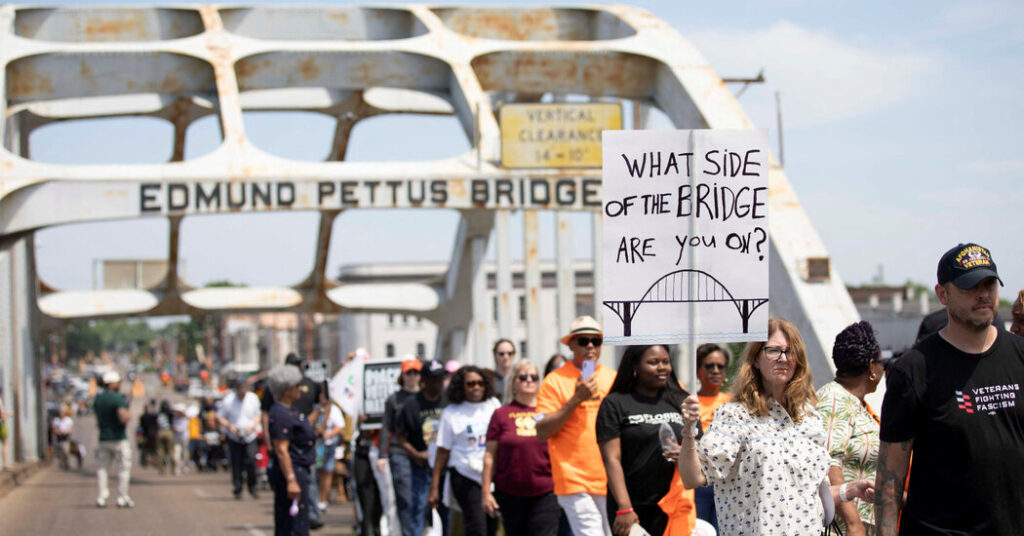
The crowd stood in silence on Saturday atop the Edmund Pettus Bridge, the span in Selma, Ala., named for a Confederate general that has been an enduring monument to the braided legacies of struggle and defiance that have infused the fight for civil rights in the South.
The bridge had infamously been the site of bloodshed, where footage of law enforcement beating down protesters as they marched in 1965 horrified the nation. The marches helped galvanize the political support necessary to enact the Voting Rights Act, one of the core legislative achievements of the civil rights movement.
Since then, civil rights leaders and others involved in the movement have kept returning — in anger over setbacks, in jubilation over victories and in mourning as a generation of pioneering activists began to fade.
This time, they had come in search of clarity and direction.
Last month, the Supreme Court dealt a blow to the Voting Rights Act, clearing the way for lawmakers across the South to quickly redraw congressional maps and eliminate majority-Black districts once protected by the act in order to create a more favorable landscape for Republicans.
Those who assembled on Saturday to oppose the decision and its aftermath retraced the route of the demonstrations in 1965, beginning in Selma and ending roughly 50 miles away in Montgomery, at the Capitol. But the gathering, organizers said, was not a protest. If anything, it was more akin to an altar call, a tradition in some Christian churches in which worshipers stand before a congregation and affirm their commitment to their beliefs.
“We gather on this day in mourning, in lamentation, in outrage, and in deep, profound love,” the Rev. Sofía Betancourt, the president of the Unitarian Universalist Association, said from the pulpit of Tabernacle Baptist Church in Selma, where the daylong event began. “We gather in the knowledge that we must rise up and say, Never again.”
The most immediate concrete consequence of the Supreme Court’s decision was explicitly partisan: Republican lawmakers in several states moved swiftly to redraw congressional maps in time for the November midterms, weakening Democrats’ standing for the election.
Yet many of the activists, clergy members and elected officials who took part on Saturday argued that the cause at hand transcended politics. It was a civil rights matter, they said — a spiritual and moral one, even.
Standing from the pulpit of Tabernacle, a sanctuary steeped in civil rights history, one clergy member recalled growing up in Bossier Parish, La. She was 4 when the Voting Rights Act was passed in 1965. Her father was 37, her mother 32. “They had already lived half their life without civil rights,” she said.
She told the crowd that prayer was powerful, but that prayer alone was not enough. She echoed the words of the civil rights leader Fannie Lou Hamer: “You can pray until you faint, but unless you get up and try and do something, God is not going to put it in your lap.”
Sirporia Sims, 31, was among those ready to pick up that mantle. “It has set us back quite a bit,” said Ms. Sims, who lives in Selma and whose work with Foot Soldiers Park and Education Center, a nonprofit based at the foot of the Edmund Pettus Bridge, focuses on encouraging civic engagement. “But we’re not going to let it take us all the way back.”
What the fight ahead looks like, and the strategy it will entail, is still being defined.
Randall Woodfin, the mayor of Birmingham, told the crowd assembled in Montgomery that many of those gathered were the “descendants of real foot soldiers” — young activists, some of them still children, who demonstrated in the 1960s while law enforcement officers sprayed them with high-pressure fire hoses and snarling police dogs lunged at them.
Draw on their fortitude, he told the crowd. Honor their experience by maintaining the fight, no matter how long it takes.
“We’re in this fight for the long game,” Mr. Woodfin said. “It requires you, in this moment, not to be silent. It requires you not to give up, to not only have hope but turn that into something tangible.”
“All roads lead to the South!” a man in the crowd called out, echoing the theme of the gathering.
“You heard that, brother,” Mr. Woodfin replied. “You’ve heard it before — the South’s got something to say.”
Bryant K. Oden contributed reporting from Montgomery, Ala.
Rick Rojas is the Atlanta bureau chief for The Times, leading coverage of the South.
The post The Fight for Voting Rights Returns to Selma appeared first on New York Times.