You can describe the costs of Donald Trump’s second presidency by the damage he has done — to the rule of law, to the United States’ standing in the world, to the constraints on corruption and self-dealing we once took for granted.
As Mr. Trump closes in on 500 days in office, it is even more devastating to measure the extent to which his has become the presidency of lost opportunities.
He has wasted the nation’s time and attention span on a festival of personal obsessions: tariffs, Greenland, a ballroom, the outcome of the 2020 election and an ill-considered war. In doing so, he created a public agenda entirely out of sync with the problems our nation needs to solve. He also blinded himself to the ways in which he might have made his presidency more successful and more popular.
We are in a moment when we need to build — more housing and better ways to address child care, elder care and health systems. The country also needs to think ahead: about the disruptive impact of artificial intelligence, the need for alternatives to fossil fuels, the imperative of strengthening rather than wrecking alliances and of curbing inequality that is rising unsustainably and leaving nearly 60 percent of consumer spending in the hands of just the top 20 percent of us.
My hope is that Mr. Trump’s opponents will set aside the feuding that seems to captivate the Democratic Party and realize that voters are in the market for big fixes to problems that are being left to fester.
It’s disconcerting that Mr. Trump’s visit to China this week coincided with a growing consensus in China that he has been, in the words of a Beijing think tank, an “accelerator of American political decay” and thus of American decline. When President Xi Jinping of China made an oblique reference to American decline, Mr. Trump rushed out with an inartful but characteristic social media statement blaming “the tremendous damage we suffered during the four years of Sleepy Joe Biden.”
The president’s most important missed opportunities are rooted in his seeming to believe his own rhetoric casting the Biden administration as a catastrophic failure. Yes, voters who swung to Mr. Trump were mad about prices and a porous southern border. But they certainly weren’t looking for him to wreck what was working. The Economist magazine was onto something when it declared that President Joe Biden’s economy was “the envy of the world.”
“Trump had this economy that by most accounts had finally contained inflation, and he could have ridden it,” Julian Zelizer, a Princeton University historian and the editor of a recently published historical assessment of the Biden years, told me. “Instead, he decided to put in place this tariff program that created unease and instability, and pulled back from Biden-era investments — in new technology, for example — that most economists argued could have been successful.”
The lost opportunity is obvious. Mr. Trump was so intent on pushing the Federal Reserve to cut interest rates that he had his Justice Department manufacture a bogus criminal investigation against the Federal Reserve chair, Jerome Powell (which the department has, for now at least, dropped). But if Mr. Trump had forgone his tariff spree, he would have gotten exactly what he wanted without the need for a phony probe. Mr. Powell made clear that absent Mr. Trump’s tariffs, the Fed would have cut interest rates.
The steady-as-it-goes approach to the economy also happened to be the policy Mr. Trump largely adopted in his first term.
When Mr. Trump took office in 2017, the Obama-era recovery from the 2008-9 crash was hitting full steam. The new president didn’t get in the way. The economy enjoyed 76 consecutive months of job growth to the end of the Obama administration, and Mr. Trump extended the streak to 109 months, until Covid hit. That streak benefited him politically. On the eve of the pandemic in January 2020, according to Gallup, his approval rating on the economy stood at 63 percent. What he’s doing this time is backfiring. The May 1 to 4 Economist/YouGov poll found that approval of Mr. Trump’s handling of jobs and the economy stood at 34 percent.
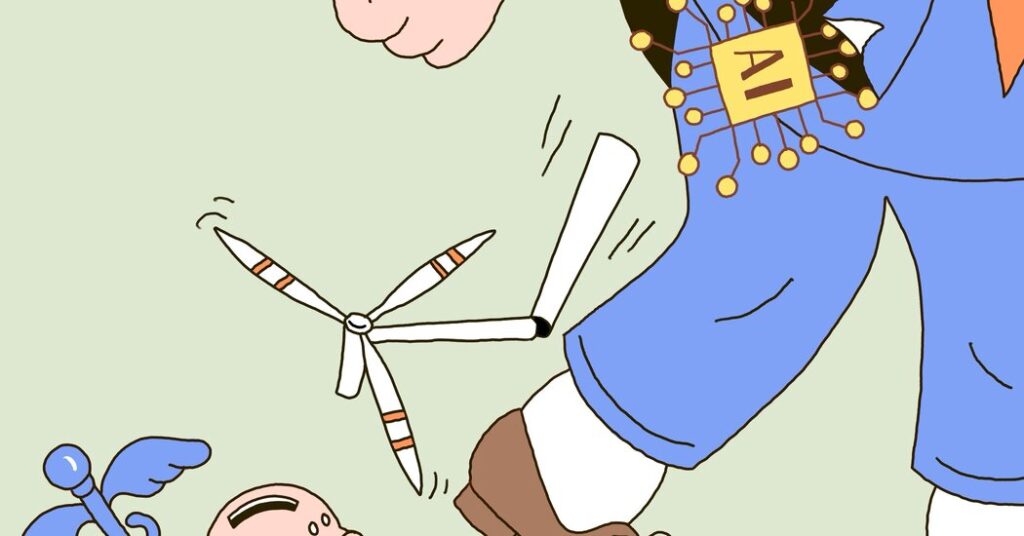
A similar story can be told about alternative energy. Mr. Trump’s war with Iran — and the energy shortages and price spikes it has caused — has demonstrated the need to find alternatives to fossil fuels. Yet he has dismantled incentives for clean energy and electric cars systematically, even fanatically. “I hate wind,” he once told a group of oil and gas executives at a fund-raising dinner.
“Whenever you hear someone say ‘Strait of Hormuz,’ think about the Trump’s administration’s opposition to clean energy,” said Jared Bernstein, who led Mr. Biden’s Council of Economic Advisers and is a policy fellow at Stanford’s Institute for Economic Policy Research. “The idea that we would stop pursuing more abundant energy supplies is a massive own-goal kick.” In the process, the United States has ceded dominance to China on wind turbines and solar panels, and on electric cars. “China is absolutely cleaning our clock,” Mr. Bernstein told me.
Fortunately, as David Wallace-Wells has pointed out in The Times, green energy continues to be built out at a rapid clip, both in the United States and around the world. But we could be doing more, and certainly shouldn’t be pursuing self-defeating policies to slow the transition.
Continuing to increase the number of Americans with affordable health insurance is another lost chance for the country, and for Mr. Trump, who has insisted over the years that he really wants “insurance for everybody.” Yet his hatred of Obamacare has always outstripped that goal.
Improvements to Obamacare subsidies in the Biden years pushed the proportion of Americans without health insurance down to a record low of 7.7 percent. Rather than finding ways to move forward, Mr. Trump and the Republican Congress have pushed the nation back, with steep cuts in support for coverage. As Reed Abelson and Margot Sanger-Katz reported this month in The Times, the proportion of Americans covered under Obamacare is expected to drop this year to roughly 19 million, down from the 24 million last year.
There are, finally, issues that should be at the center of our debates but barely register in the cacophony that emits from the White House. At the top of that list is the social and economic impact of artificial intelligence.
The nation is mesmerized by what A.I. can do — and petrified of what its impact might be on jobs, incomes and how we live our lives. There is plenty of talk about all this, of course, but hardly the rigorous policy debate the country needs, notably about how, for example, to make A.I. worker-friendly, not worker-hostile.
“We are phenomenally unprepared if job dislocation comes,” Sharon Parrott, president of the Center on Budget and Policy Priorities, told me, “and we are dismantling the supports that people will need to transition.” Until this month, the Trump administration had taken an entirely laissez-faire approach to A.I.’s development, and it’s far from clear where it’s moving now.
Mr. Trump’s cratering approval ratings grow out of many specific discontents, but they also reflect a realization that the atmosphere he has created is antithetical to serious deliberation over any of the challenges our nation confronts. The good news is that because of this, most Americans are not simply turning against the president but are increasingly desperate to move past the Trump era altogether. The slogan from our past that may speak best to our present: It’s time to get the country moving again.
E.J. Dionne Jr. is the author of “Why Americans Hate Politics,” “Our Divided Political Heart,” “Why the Right Went Wrong” and, most recently, “100% Democracy,” with Miles Rapoport.
The Times is committed to publishing a diversity of letters to the editor. We’d like to hear what you think about this or any of our articles. Here are some tips. And here’s our email: [email protected].
Follow the New York Times Opinion section on Facebook, Instagram, TikTok, Bluesky, WhatsApp and Threads.
The post Trump Is Wasting Our Time appeared first on New York Times.