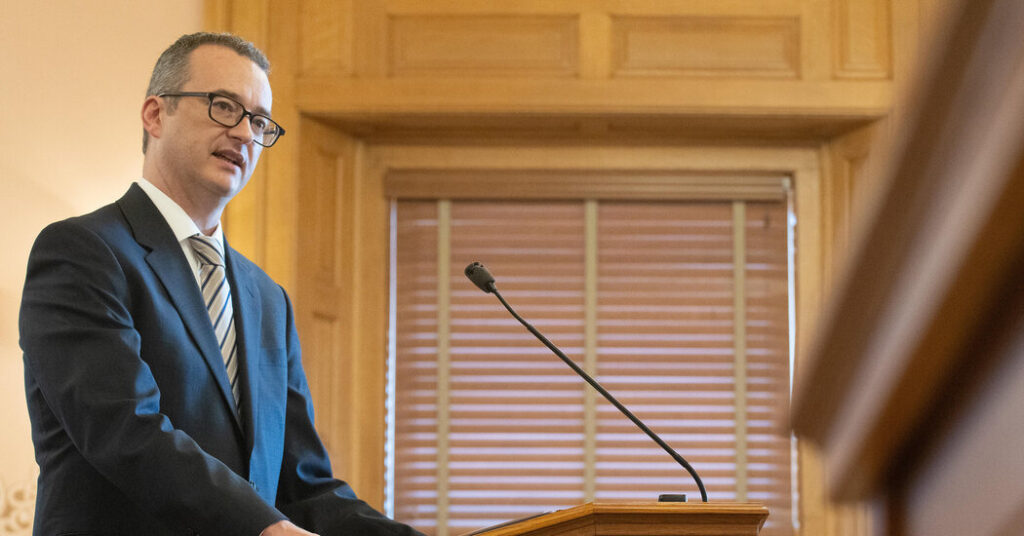
Kansas cannot enforce its ban on nonsurgical gender-transition treatments for minors, a state judge ruled on Friday. The ruling gives supporters of transgender rights a significant, though temporary, victory after more than a year of setbacks in capitols and courtrooms across the country.
“This is a momentous win for not just our plaintiffs, but for everyone who is affected in Kansas,” Harper Seldin, a lawyer for the American Civil Liberties Union, said in a phone interview on Saturday.
The judge, Carl Folsom III of the State District Court in Douglas County, said in granting a temporary injunction that the law had likely violated parents’ rights to make decisions for their children. Attorney General Kris W. Kobach, a Republican whose office defended the law, criticized the ruling as “a stark example of judicial activism,” and vowed to appeal.
“The judge invented a new constitutional right out of whole cloth,” he said in a statement. “Even though the Kansas Constitution says nothing about it, the judge created a new right of parents to obtain otherwise-illegal treatments for their children.”
Judge Folsom, who was appointed by Gov. Laura Kelly, a Democrat, wrote in his 117-page ruling that transgender children would likely face irreparable harm if the ban remained in place. He also described testimony that gender-transition treatments for minors were safe and effective as credible.
Ms. Kelly vetoed the law last year, describing it as “government interference in Kansans’ private medical decisions,” but the Republican-controlled Legislature overrode her. Judge Folsom’s ruling blocked the portions of the law restricting hormone treatments and puberty blockers, but did not block enforcement of a provision banning gender-transition surgeries for minors.
The Kansas judge ruled on the same day that Texas’ attorney general, Ken Paxton, announced that, as part of an agreement to settle a state investigation, Texas Children’s Hospital would create the nation’s first clinic focused on medical care for young people who stop or reverse their gender transitions.
The settlement, coordinated with the U.S. Justice Department, became the latest example of a hospital feeling pressure to end gender-related treatments for adolescents who say they feel a mismatch between their gender identity and sex at birth. Last week, a New York City hospital said it was one of several to have received a grand jury subpoena from a federal prosecutor in Texas seeking information about adolescents who received gender-related medical care.
About half of American states have banned or sharply limited access to gender-transition treatments for minors. Transgender people and their families have challenged those laws in court, with mixed results. Last year, the Supreme Court upheld a Tennessee ban on transition treatments for minors in the case United States v. Skrmetti. That ruling, which found that states had the ability under federal law to restrict those procedures, was a crushing blow to the transgender rights movement.
Because the Kansas challenge was filed in state court and focuses on issues in the State Constitution, it was not bound by the Skrmetti ruling.
The Kansas lawsuit, filed last spring by the American Civil Liberties Union of Kansas on behalf of two transgender teenagers and their parents, claimed that the ban violated the State Constitution. The case has yet to go to trial on its merits. Lawyers for the teenagers sought the injunction because they said there was a risk of permanent harm to their clients if they were not allowed to resume treatment.
Mr. Kobach said when the lawsuit was filed that the “A.C.L.U. is twisting the meaning of the Kansas Constitution into something unrecognizable.” He added that the Legislature “was well within its authority when it acted to protect Kansas children.”
Republican supporters of the law, which bans hormone treatments, puberty blockers and transition surgeries for transgender patients younger than 18, described it as a measure that guards young people from life-altering choices that they might later regret. Under the law, doctors who provide those treatments to minors could lose their licenses and be sued by patients or their parents.
Kansas Republicans have continued to pass laws that restrict transgender identity, including one this year that abruptly invalidated the driver’s licenses of residents who had changed their gender designations.
Gender-transition treatments remain a topic of debate among medical authorities. The major American medical societies endorse them, but a report commissioned by the Trump administration concluded that the risks outweigh the benefits.
An estimated 2.8 million people aged 13 and older in the United States identify as transgender, according to the Williams Institute, a demographics research center at the University of California, Los Angeles. That amounts to about 1 percent of the U.S. population in that age group. A small fraction of them seek medical transition.
The Trump administration has been moving against gender transition treatments for minors by seeking to cut off funding for hospitals that provide them. The administration has also moved to ban trans women and girls from competing in women’s sports; to bar trans people from serving in the military; to house trans women who are federal prisoners with men; and to stop issuing passports that reflect a trans person’s gender identity.
Mitch Smith is a Chicago-based national correspondent for The Times, covering the Midwest and Great Plains.
The post Kansas Judge Blocks Law Banning Gender-Transition Treatments for Youths appeared first on New York Times.