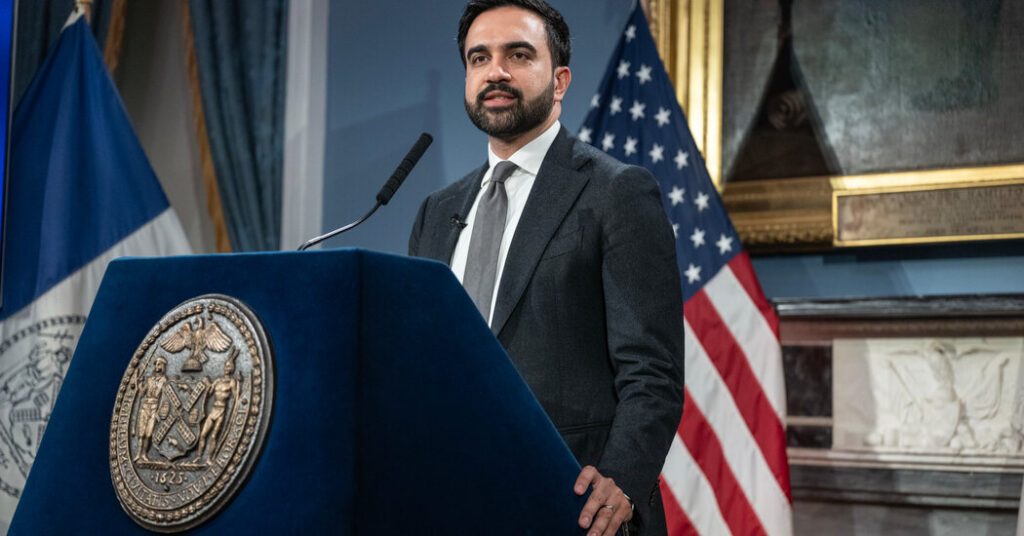
Shortly before sundown on Friday, Mayor Zohran Mamdani commemorated the displacement of hundreds of thousands of Palestinians during the creation of Israel, an event that Palestinians refer to as the Nakba.
Mr. Mamdani did so by posting on social media a four-minute, documentary-style video created by City Hall that featured an interview with a woman named Inea Bushnaq, who was 9 years old when she was displaced with her family during the conflict.
“Inea is a New Yorker and a Nakba survivor,” Mr. Mamdani said, using the Arabic term for “catastrophe,” which Palestinians use to refer to the loss of their land in 1948. “She shared her story with us — one of home, tradition and memory over generations.”
The decision to mark the day is part of Mr. Mamdani’s continued public support of Palestinian rights, history and causes. At the same time as he has championed them, he has also drawn attention for not celebrating events linked to Israel.
Unlike previous mayors, Mr. Mamdani did not note Israel’s independence day, which Israel and pro-Israel Jews celebrated on Thursday. And his office has said he will not attend the Israel Day parade at the end of May.
His posture represents a shift for New York City’s mayors. Mr. Mamdani’s recognition of Nakba Day appeared to make him the first mayor to publicly commemorate it, an action that immediately angered some Jewish leaders.
For decades, Israelis and Palestinians have waged a narrative battle over the founding of Israel. To many Israelis, and to many Jews in the diaspora, the country’s founding represents a triumph after millenniums of persecution that culminated in the Holocaust.
To many Palestinians, the creation of Israel represents a national trauma of violence and displacement that continues today with the war in Gaza that followed the Hamas-led Oct. 7, 2023, attack on Israel.
That debate is particularly acute in the New York region, which is home to both the largest Muslim and the largest Jewish population in the United States and has been the site of frequent protests over the Middle East conflict in recent years.
Mr. Mamdani’s social media post made clear which historical narrative he finds more persuasive. Pro-Palestinian New Yorkers celebrated his decision to share the video, calling it a long-overdue acknowledgment of the pain experienced by Palestinians.
“For the first time in the history of the Great City of New York, its Mayor names and remembers the Nakba,” Asad Dandia, an ally of Mr. Mamdani’s who was recently named the official historian of Brooklyn, wrote on social media. “And I get to be alive to see it.”
But the post was also criticized by Jewish leaders and other supporters of Israel in New York and elsewhere who objected to its framing and said marking one commemoration and not the other was unnecessarily divisive and antagonistic.
“This reflects Mayor Mamdani’s continued disregard for the concerns of the Jewish community and his tendency to deepen divisions at a moment when leadership should be focused on bringing people together in extremely complex times,” Mark Botnick, who served as an aide to former Mayor Michael Bloomberg, said when reached before the weekly Jewish observance of Shabbat began Friday night.
Mr. Mamdani, the city’s first Muslim mayor, has made his views on the Israeli-Palestinian conflict clear. His unwillingness to endorse or cater to the views of pro-Israel New Yorkers, even in a pro forma way, has repeatedly drawn criticism from them.
The video Mr. Mamdani posted on Friday night focused on the childhood experience of Ms. Bushnaq, who described fleeing her home, being unable to return and then spending years moving from place to place.
“I’ve lived in different places, and I’ve always been an outsider,” she says in the video, referring to Italy, England and, ultimately, New York City. “In this diverse city I feel most at home, since leaving Palestine.”
Her story was interspersed with blocks of text describing Palestinian deaths and displacement during the Nakba, including footnotes to a United Nations report and the works of Israeli and Palestinian historians.
Jewish leaders criticized the mayor for posting the video just before sunset on Friday, when Jews observe the Sabbath and many turn off their phones and other electronic devices. They also criticized the video itself for omitting contextual information about the conflict.
The UJA-Federation of New York said in a social media post that the video failed to include information about violence against Jews before, during and after the creation of Israel. It said the video also did not discuss the 1948 war between Israel and several Arab states or the displacement of Jews from Middle Eastern countries, whose descendants now make up about half of Israel’s Jewish population.
“And you chose 5:40 p.m. on Friday to post it — as Jewish New Yorkers prepare to light Shabbat candles,” the organization said. “We noticed.”
Mr. Mamdani’s views of the conflict in the Middle East are longstanding and deeply felt. The son of a prominent scholar on colonialism, he came of age in the pro-Palestinian movement, founded a chapter of Students for Justice in Palestine at Bowdoin College and campaigned for an academic boycott of Israel.
Mr. Mamdani is the city’s first mayor to be wholly identified with the Democratic Socialists of America, and has said he was drawn to the group because it supports boycotting Israel.
That organization also posted a statement on social media in honor of Nakba Day on Friday, connecting the displacement of Palestinians in 1948 to the ongoing conflicts in Lebanon, Gaza and the West Bank.
“Today, the Palestinian cause is the moral compass for justice,” the group said. “The Nakba is an ongoing process that we must organize and fight to end.”
Mr. Mamdani’s association with the Democratic Socialists has deepened the unease some Jewish New Yorkers feel about him.
Last year, when he was running for mayor, Mr. Mamdani declined to initially condemn the phrase “globalize the intifada,” which many Jews see as a call for violence but which Palestinians and their supporters consider a cry for liberation. He said he himself had never used the phrase, and later said he would discourage others from using it.
In recent years, reported hate crimes have risen against Jews and Muslims in New York and across the country.
In March, law enforcement disrupted what officials said was an assassination attempt planned by a member of a radical pro-Israel group against a prominent Palestinian activist in New York. And on Friday, federal prosecutors accused the commander of an Iranian-backed militia with planning to attack a New York City synagogue and other Jewish sites.
In recent weeks, chaotic protests have taken place outside of events at synagogues in New York City that promote real estate in Israel and its settlements in the occupied West Bank, which most of the world considers to be illegal. Mr. Mamdani has spoken out against the events.
Liam Stack is a Times reporter who covers the culture and politics of the New York City region.
The post Mamdani’s Nakba Day Social Media Post Marks Shift for N.Y.C. Mayors appeared first on New York Times.