There was a vague agreement that China would purchase Boeing jets and more American soybeans. There was discussion about Iran and opening the Strait of Hormuz, and a nod to other issues, like cracking down on chemicals used to make fentanyl.
But President Trump departed Beijing on Friday with almost nothing concrete to show for his two-day summit with President Xi Jinping of China. After months of buildup and a delay necessitated by Mr. Trump’s difficulty in extricating the United States from the war with Iran, the summit ended with no major public progress on the Middle East, trade, Taiwan, nuclear proliferation, artificial intelligence or any of the other myriad issues that are sources of friction between the world’s two superpowers.
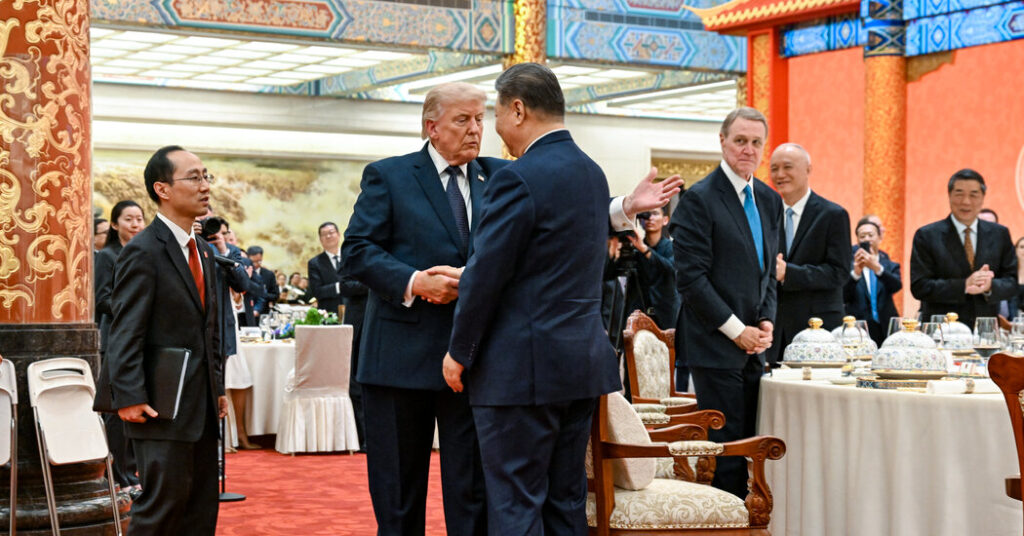
Instead, Mr. Trump seemed intent on a different kind of diplomacy, forging a personal bond with a Chinese leader who appeared far more focused on advancing his own nation’s strategic agenda.
Mr. Trump toasted Mr. Xi as “my friend” at their banquet in Beijing on Thursday and said he had “become really a friend” when they sat down before the cameras on Friday.
A Chinese Foreign Ministry spokesman, asked at a briefing during the summit whether Mr. Xi considered Mr. Trump a friend, responded with boilerplate: “the two sides exchanged views on major issues.”
Mr. Trump has hailed the summit in Beijing as a major success, highlighting the personal bond he says he has built with China’s longtime leader. But the feeling is not necessarily mutual, as evidenced by Mr. Xi’s more measured tone and the lack of clarity about any major agreements.
Orville Schell, vice president of the Center on U.S.-China Relations at the Asia Society in New York, called the summit “quite insubstantial and aspirational.”
“We have Trump dreaming out loud,” he said.
The mismatch shows the risks in Mr. Trump’s personality-driven foreign policy, his bet that he can solve the world’s problems and defend American interests by his charm and force of will. In Mr. Xi, the U.S. president faced a counterpart this week well versed in Mr. Trump’s desire for praise and pomp, and with an apparent strategy for how to exploit it.
The result, analysts said, was a summit that illustrated the growing confidence of China on the world stage alongside a strategically muddled U.S. foreign policy under Mr. Trump.
The summit might yet come to be seen as the start of a shift toward a more stable relationship between the United States and China. But few of even the limited accomplishments that Mr. Trump spoke about were confirmed by China, while Mr. Xi set the tone with an assertive posture over Taiwan.
Experts say there is no question that personal chemistry between leaders is crucial, especially when authoritarian, centralized countries like China are involved.
Susan L. Shirk, a senior State Department Asia specialist in the 1990s, said President Bill Clinton worked hard to establish a rapport with Jiang Zemin, the Chinese leader at the time; he would keep his eyes on Mr. Jiang even during the translation of his remarks, Ms. Shirk recalled.
But Mr. Trump’s lavishing of praise on Mr. Xi was different, Ms. Shirk said, especially in contrast to the Chinese leader’s more restrained language. At times it was “embarrassing,” she said, like when Mr. Trump told the Fox News host Sean Hannity in an interview during the summit that Mr. Xi was “tall, very tall,” and then veered into ethnic stereotyping: “especially for this country, because they tend to be a little bit shorter.”
“He was flattering him excessively and it was clearly not working,” said Ms. Shirk, a professor at the University of California, San Diego. “The lack of preparation created this kind of void of substance in the meeting, and the Chinese stepped into that void.”
Mr. Trump has already discovered that the power of his personality has limits in foreign policy. In his first term, he failed to get North Korea to give up its nuclear weapons despite asserting that he and Kim Jong-un, the country’s leader, “fell in love.” In his second term, he has failed to stop Russia’s invasion of Ukraine despite a dozen phone calls with President Vladimir V. Putin of Russia and their summit in Alaska.
Still, asked to name the summit’s most important achievement for the United States, Mr. Trump told Fox News’ Bret Baier: “I think the most important thing is relationship. It’s all about relationship.”
“It sounds like something that doesn’t mean anything, but it’s everything,” Mr. Trump said.
China, too, hailed the personal aspect of the visit. Wang Yi, China’s foreign minister, said after the summit that “head-of-state diplomacy is the ‘guiding star’” of “the most important and complex bilateral relationship in the world.” He said Mr. Trump and Mr. Xi spent nearly nine hours together and had been able “to achieve overall stability after experiencing ups and downs.”
But China entered the meeting with a broader agenda, while deflating U.S. claims of success. Mr. Xi warned Mr. Trump about the threat of a clash over Taiwan, even as Mr. Trump said nothing about the island democracy until after Air Force One took off from Beijing. Mr. Wang also suggested that the achievements Mr. Trump had trumpeted — for example, China buying as many as 750 “big beautiful” Boeing jets — were not a done deal. On Saturday, China said it would acquire some aircraft, but stopped short of confirming a specific purchase of Boeing planes.
“The working teams of both sides are still discussing the relevant details and will finalize the results as soon as possible,” Mr. Wang said, referring to the economic talks between the United States and China.
The disjointed dynamic stood in contrast to Mr. Xi’s relationship with the leader he does call a friend: Mr. Putin. Their summits have featured much warmer displays than the pomp in Beijing this week, including the time they made pancakes and drank vodka in 2018. Their meetings often include joint statements, including the one in 2022, just before Russia’s invasion of Ukraine, that their countries’ friendship had “no limits.”
Mr. Putin will visit China next week, the Kremlin said on Saturday. The announcement was a reminder that Mr. Xi still looks to Russia as a crucial geopolitical partner and helps enable Russia’s war with trade and technology — a relationship that many in Washington see as a threat to American security.
Mr. Trump could see Mr. Xi again at a gathering of Asia and Pacific region leaders in Shenzhen, China, in November and at the Group of 20 summit that Mr. Trump will host at his Doral golf resort near Miami in December. Mr. Trump also said Mr. Xi would visit the United States on Sept. 24, a sign that the high-level diplomacy that Mr. Trump has kicked off with China may only be beginning.
Whether all the meetings will yield benefits for the United States is yet to be seen, analysts said, though few dispute that any U.S. president needs to build a relationship with his Chinese counterpart. Mr. Schell, the Asia Society expert, cautioned that Mr. Xi had little track record of making concessions to the United States.
If concrete agreements do “come as a result of the bonhomie of this summit, I think we might be able to call it something of an inflection point,” Mr. Schell said. “That has not yet happened.”
Keith Bradsher contributed reporting from Beijing, and Chris Buckley from Taipei, Taiwan. Ruoxin Zhang contributed research.
Anton Troianovski writes about American foreign policy and national security for The Times from Washington. He was previously a foreign correspondent based in Moscow and Berlin.
The post Trump Calls Xi a ‘Friend.’ But He Left China Without Any Breakthroughs. appeared first on New York Times.