The streets of the British capital hosted an ideological split-screen on Saturday as separate, far-right and pro-Palestine demonstrators competed for attention in dueling protests.
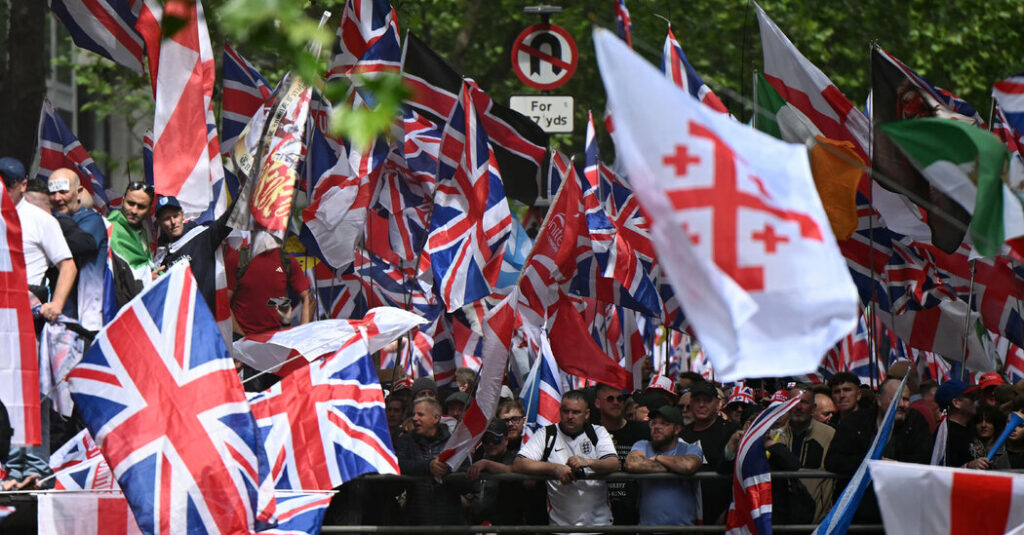
Marching through central London, tens of thousands of far-right protesters wearing “Make Britain Great Again” hats and draped in Union flags demanded support for white culture and an end to migration.
Along another route, similar numbers of pro-Palestine and anti-fascism demonstrators decried racism as they carried signs and banners calling for freedom for Palestinians in Gaza and an end to the genocide they said was taking place there.
The groups largely stayed separate, with few reports of arrests or violence, after what London police said was an “unprecedented” security operation designed to keep the protests from descending into a riot.
Police said 4,000 police officers, as well as helicopters, armed vehicles and drone teams, were deployed Saturday. By 5 p.m., the police had reported 31 arrests but said the groups had largely stayed on their assigned routes and “both protests have proceeded largely without significant incident.” The FA Cup final, a major soccer competition, was also held on Saturday afternoon, bringing large crowds to the city and adding to the complexity.
“The scale of the operation is unprecedented in recent years,” said Cmdr. James Harman, the deputy assistant commissioner of London’s Metropolitan Police Service, in a Wednesday news briefing ahead of the protests. “The planning for it has been ongoing for months.”
Protesters carrying flags and banners began arriving early in the morning as they made their way along London’s streets to the meeting points for the competing marches.
The far-right demonstration was organized by Tommy Robinson, an anti-Islam agitator whose real name is Stephen Yaxley-Lennon, under the banner, “Unite the Kingdom.” Mr. Robinson, who has several criminal convictions and has served several stints in prison, has said it was a demonstration for “national unity, free speech and Christian values.”
“We have been in a culture war for a long time,” Mr. Robinson told the crowd on Saturday. He said the march represented a movement that was “thinking about how we can create a cultural revolution in this country.”
Along the protest route, several marchers echoed that sentiment.
“I’m just supporting being British,” said Corina Short, who came to the rally from Kent, about an hour away from London. “It means I can fly my flag with pride without feeling as though it’s a crime.”
Marchers waved signs that said “Stop the Boats,” a reference to asylum seekers who arrive on Britain’s shores, and chanted derisive slogans about Prime Minister Keir Starmer, a center-left politician and the head of the Labour Party.
“He says we’re causing division, he’s causing division,” Paul Gibson, from Nottingham, said of Mr. Starmer. “He protects the criminals, the Muslim gangs, the Islamic extremists, but when it comes to us, he blames us.”
In a video posted on Friday on social media, Mr. Starmer said the organizers of the march, “including convicted thugs and racists, are peddling hatred and division.”
The competing protest on Saturday was an annual Nakba Day demonstration, commemorating the mass displacement of Palestinians from their homes in 1948 during the Arab-Israeli War.
Organizers said it also stood “united against Tommy Robinson and the far right.” That rally was organized by a coalition of groups, including the Palestine Solidarity Campaign, the Stop the War Coalition and others, and was joined by “Stand Up To Racism,” a group opposing Mr. Robinson’s march.
Protesters carried signs declaring that “It’s Not a Crime to Stand Against Genocide,” “Stop Gaza Genocide” and “Freedom For Palestine.” Many waved the black, white, green and red Palestinian flag.
At one point, the crowd broke out into chants of “We are all Palestinians.”
Apsana Begum, a Labour member of Parliament who spoke at the rally, told the crowd that there were differences between the two marches.
“We know that the far right marches because our solidarity with the Palestinian people threatens their cause,” she said, according to PA Media, the British press association. “We will not be divided by the far right. We will not be silenced by any government, and we will not go quietly while crimes against humanity continue and are committed with impunity.”
Many people in the march appeared to be as focused on British politics as they were on the Middle East. Several carried signs that said “Stop Racist Reform U.K.,” a reference to the right-wing populist political party in Britain headed by Nigel Farage. His party made huge gains in elections in England, Scotland and Wales last week.
Both London demonstrations took place against an increasingly tense political backdrop, with the country’s terrorism threat level increased in recent weeks amid rising antisemitism, Islamophobia and extreme right-wing sentiment.
The bulk of the policing operation on Saturday was on keeping the two marches apart. At one point, the rallies converged on the same area of the city, near government buildings — at their closest, separated by just over 500 yards.
“We can’t ask a counterprotest to be in a completely different area of London,” Commander Harman said during the briefing on Wednesday. “They have to have an amount of proximity in order to make their point. We think we’ve come up with the right policing plan to keep people safe on the day, although it’s challenging.”
Protesters were required to stick to prearranged routes and to disperse by a designated time, or face arrest. The police also extended powers to arrest any speakers who used the events “as a platform for unlawful extremism or for hate speech,” Commander Harman said, noting that it was the first time these restrictions had been imposed for a rally of this type since the powers were enacted recently. It was not clear on Saturday whether any speakers had been arrested under these restrictions.
Live facial recognition technology was used for the first time in policing a protest, in a part of the city where people taking part in the right-wing rally are expected to gather beforehand. The technology compared those walking by with “the faces of those on a specific watchlist” of people wanted for suspected criminal offenses, Commander Harman said.
Officials said two of the 31 arrests occurred near the train station where the far-right demonstration began.
“One of the two men was arrested in connection with the incident in Birmingham where a man was run over,” the police wrote on X. “The second arrested man was wanted for a separate offense which involved encouraging people to attack a police officer.”
Some foreign far-right activists were also barred from entering Britain for that demonstration, the government announced this week.
“We will not allow people to come to the U.K., threaten our communities and spread hate on our streets,” Mr. Starmer said in a speech on Monday. “This is nothing less than a battle for the soul of our nation.”
Britain late last month raised its national terrorism threat level to “severe” from “substantial,” the fourth of five levels on its scale, meaning officials assessed that an attack was highly likely in the next six months. The Joint Terrorism Analysis Center, which is responsible for the assessment, announced the change after a stabbing attack on two Jewish men in the north London neighborhood of Golders Green and a series of other antisemitic attacks.
The center said the increase was “not solely a result of that attack,” but also of broader concerns about an “increasing threat of Islamist and extreme right-wing terrorism in the U.K.”
Ahead of the protests, “fears in Jewish communities are particularly heightened, but we’ve also seen increased concern more broadly, including in Muslim communities,” Commander Harman said.
The police are well aware of the risks the opposing demonstrations could pose. In September, Mr. Robinson and his supporters gathered in London in a protest that devolved into violence when several people involved clashed with the police. At that time, antiracism protesters had also gathered in a counter-demonstration elsewhere in the city, and around 1,000 police officers had set up barriers between the dueling protests.
Michael D. Shear is the chief U.K. correspondent for The New York Times, covering British politics and culture and diplomacy around the world.
The post Rival Protests Take Place in London, With a Major Security Effort appeared first on New York Times.