In addition to being a professor and a physical therapist at Arcadia University in Pennsylvania, Jaime Bayzick is a soccer mom. At the end of games, she’s always surprised at how many fit parents stumble on the old, rickety bleachers.
So why is it harder to step off a bench without falling as you get older? It’s not usually a muscle problem, but a brain one.
“It’s actually quite complex,” Dr. Bayzick said. “It requires a lot of balance, it requires timing, weight shifting.” In other words, coordination.
Coordination is the brain’s ability to send and receive signals from the nervous, muscular and sensory systems so that you move fluidly. When you’re young, most of this happens automatically. As you age, those signals slow, and movements that once came naturally demand conscious effort. Like strength, though, coordination can be improved.
“Coordination training teaches the body how to use strength and fitness under pressure, unpredictability and distraction,” said Bill McGehee, a professor and rehabilitation expert at Tufts University School of Medicine.
Coordination is also a fairly easy skill to improve; you can make meaningful gains at home in a few minutes a day, said Dr. Bayzick. Training your coordination can improve not only your athletic performance but also your cognitive function as you age.
“Aging is not just about staying strong — it’s about keeping your brain adaptable,” Dr. Bayzick said. Because the brain often learns best when it’s engaged, most coordination training involves more novelty and playful movements than traditional exercise does.
Try this workout two to three times a week to train your brain and body at the same time — or you can choose a few of these movements to incorporate throughout the day.
Overview
Time: Less than 15 minutes
Intensity: Low to medium
What You’ll Need:
-
A tennis ball or another soft ball that can fit in one hand
Adjust For You
While these moves are a great start, your brain needs novelty to adapt, Dr. McGehee said. Once they start to feel like second nature, make small tweaks to keep challenging your coordination, such as closing your eyes during the balancing ball toss. Or, Dr. Bayzick said, you can try “dual task training” — doing the move while solving a complex math problem, for example, or reciting the alphabet backward.
Opposite Arm Swings
Purpose: Challenge your motor coordination; warm up your shoulders and thoracic spine
Time: 30 seconds
Raise both arms overhead and keep your spine neutral. Swing your left arm forward and your right arm backward. Start slow and gradually move your arms faster. Once you know the pattern, switch directions of the arms for an extra challenge.
Contralateral March
Purpose: Improve cross-body movement while working core stability
Time: 30 seconds
Stand with your shoulders straight and your core engaged. Raise your left arm overhead while lifting your right knee to a 90-degree angle. Pause for one second. Lower both and repeat on the opposite side. At first, stay in one in place. Make the exercise harder by marching forward.
Simple Juggling
Purpose: Improve hand-eye coordination and reaction time
Time: 60 seconds
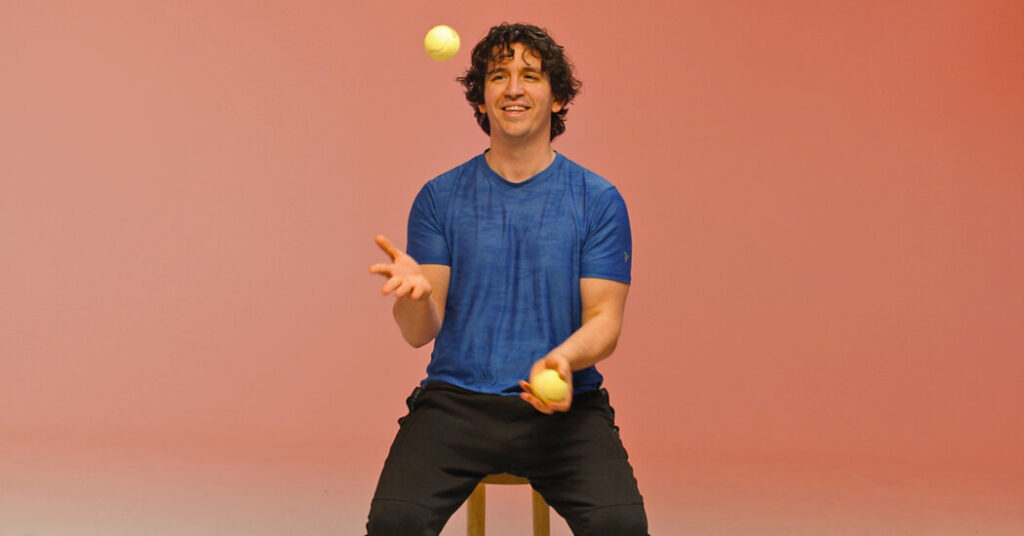
Hold a tennis ball or lacrosse ball in your dominant hand. Toss it in a gentle arc to your nondominant hand, then toss it back. Once the basic toss feels easy, add a clap between each catch, or toss the ball slightly higher or faster. For a bigger challenge, try juggling two balls at once.
Balancing Ball Toss
Purpose: Combine balance, hand-eye coordination and core stability
Repetitions: 10 tosses per side
Holding a tennis ball or another soft ball, stand on your dominant leg, lifting your opposite knee to a 90-degree angle. Toss the ball from your dominant to nondominant hand. Continue to toss back and forth, keeping your eyes on the ball and stabilizing through your dominant foot. Repeat on the other side. Once this drill becomes easy, toss the ball against a wall, and catch it as it comes back to you.
A-Skips
Purpose: Develop coordination and lower-body control
Repetitions: 20 skips per side
Stand tall, with your core engaged and your eyes looking forward. Drive your right knee up to a 90-degree angle, while simultaneously pushing off the ball of your left foot so you hop slightly off the ground. As your right knee rises, swing your left arm forward, keeping a 90-degree bend at the elbow. Bounce softly on the ball of your left foot, then immediately drive your left knee up as you push off your right foot and swing your right arm forward. Keep your foot flexed as your knee rises. Move forward at a controlled pace, focusing on driving the knees and arms rather than moving quickly.
Bear Crawl
Purpose: Cross-body movements and core control
Repetitions: Five paces each side, or 30 seconds
Start on your hands and knees with your toes tucked. Bracing your core, push into your wrists and toes until you’re in a hovering position, with your knees raised an inch or two off the floor. With control, move your left hand and right foot forward. Stabilize, then move your right hand and left foot forward. Your knees should not touch the ground.
Repeat as you move forward. Or, for some variation, try it backward as well.
The post 6 Exercises to Improve Your Coordination appeared first on New York Times.