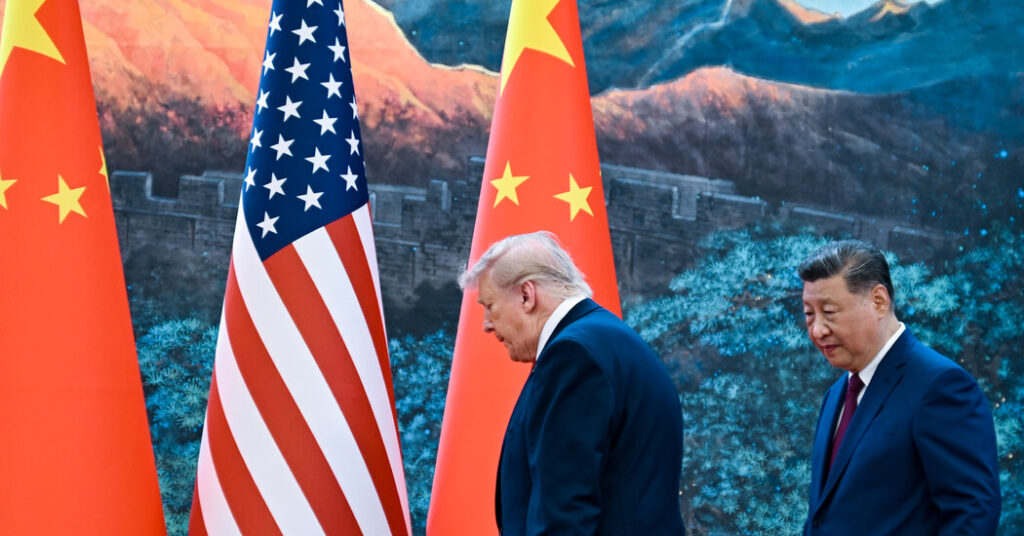
A grand summit in Beijing is a natural time to assess the state of the U.S.-China competition, the dynamics of great power conflict, the balance of forces in this new Cold — or maybe just Cool? — War.
It’s also a good time to revisit my own predictions. Six years ago, in the early days of the coronavirus, I argued that rather than a “Chinese century” we might be looking at a “Chinese decade,” a window when China’s power would hit a peak and the American position would be maximally endangered — but with a more favorable balance awaiting the United States in the later part of the century, if we could get through the Chinese maximum unscathed.
One part of that analysis was simply wrong. I was writing at a moment when the American response to the pandemic seemed much more shambolic than Beijing’s efficient containment strategy, and I assumed that there could be a kind of Covid dividend for China from that difference. In hindsight, America’s stumbling approach actually proved more effective than China’s in the long run, because the People’s Republic eventually found itself in a permanent-lockdown trap that yielded all kinds of social and economic damage.
But in other ways, the 2020s have proceeded somewhat as I expected. The American imperium has been hard pressed on every front, and our leadership — slumping and senescent in the last presidency, obnoxious and bullying in this one — has gifted China a reputation for relative stability, notwithstanding Xi Jinping’s own aggressive and repressive moves.
There is a lot of talk about rebuilding American manufacturing, and the Trump era has seen a partial decoupling of the United States and China, a clear shift away from the “Chimerica” model that defined the 2010s. But the decoupling is taking place in the shadow of a profound Chinese industrial advantage and continuing Chinese scientific and technological success. We can debate what it means that China lags just behind Silicon Valley in the artificial intelligence race (that’s the topic of this week’s episode of my podcast, “Interesting Times”), but our edge in frontier models doesn’t feel like a definite hard-power advantage as long as China is radically outpacing us in building machine tools, robots, ships and drones.
Six months ago, I was telling myself an optimistic story about the national security balance, where the United States maintained an edge in battlefield experience — with our support for Ukraine against Russia and our interventions in Iran and Venezuela serving as a testing ground for new weapons and A.I.-enabled tactics. But watching the American military stockpile collapse under the pressure of a regional war against Iran this year should make everyone skeptical that our advantages are adequate for a sustained conflict in East Asia. Fighting Iran to a stalemate seems like the kind of thing that happens just before you fight the Chinese and lose.
So the world of the 2020s does seem to have gone China’s way in very important respects. To the extent that comparisons to the actual Cold War are relevant, China is a more powerful material competitor than the Soviet Union ever managed to become, and our so-far-unsuccessful Iranian gamble has left the American hard-power position looking as parlous as it’s ever been.
But what about the world of the 2040s or 2060s? Six years ago I wrote that China’s growth rate might be slowing, making it less likely to achieve either the living standards of its East Asian neighbors or eclipse the United States as the world’s largest economy. Since then, the Chinese attempt to lock in a broad economic sphere of influence through its Belt and Road Initiative has hit repeated setbacks. And as it turned out, 2021 was the point of greatest nominal-G.D.P. convergence with the United States, and since then America has grown faster while China has struggled with its Covid hangover and various internal problems — raising the possibility that there will never be a moment when the Chinese economy is the biggest in the world.
Or maybe we should call it a likelihood rather than a possibility, since it’s incredibly difficult to generate high rates of growth under conditions of rapid population aging — and the other great trend of the last six years is that China’s demographic situation now looks much, much worse.
The end of the one-child policy in 2016 was supposed to boost birthrates. Instead the Chinese fertility rate has been crashing, hitting an average of 1.0 births per a woman’s lifetime in 2025, half the replacement level; it was the country’s fourth consecutive year of population decline. The grim social trends that attract justified attention in the United States — the alienation of the sexes from each other, a loss of interest in marriage and family — seem to have advanced much more rapidly in China. A new paper on attitudes among Chinese young people finds that 32 percent of those aged 18 to 24 reported “no desire for children,” up from 5 percent in 2012.
These patterns make a striking counterpoint to the evidence of increasing Chinese confidence, even arrogance and hubris, about the inevitability of American decline. Just how confident can Chinese people really be in their culture’s future if the rising generation is so disinclined to reproduce? Just how confident should China’s leaders be that they can outlast the United States if their population could be cut in half over the next few generations? How much power, hard or soft — and China’s global cultural influence remains notably limited — can a rapidly aging civilization expect to project?
At the very least, any scenario where Chinese power doesn’t ebb has to involve radical technological disruption. As in, a world where robots and A.I. take over an extraordinary share of economic and creative labor. Or a world where radical health improvement makes population aging far less economically significant. Or a world where technology revolutionizes human reproduction, making it possible for authoritarian states to engineer repopulation, like the World State with its hatcheries in Aldous Huxley’s “Brave New World.”
In any of these scenarios, a potential Chinese age in human history will look like no era or imperium we’ve ever seen before. Whereas if you imagine a future that remains at least somewhat normal, somewhat human, it still seems reasonable to short the Chinese century and bet that Beijing’s power is peaking now or soon.
Then the great question becomes whether Xi Jinping sees the world this way. To the extent that we believe in the narrative of Chinese confidence, a comfortable expectation in the Middle Kingdom that America’s problems are part of a long arc of Western decline, we should be hopeful that we can pass through this moment without a deadly confrontation.
Chinese hubris, in this sense, might be the best guarantor of world peace, ensuring that Beijing will wait and wait to test its power against ours, wait and wait to claim Taiwan … and find, in waiting, that its best chance has passed it by.
But presumably Xi and his circle can see all the trends that I’ve just described. And if they don’t have perfect confidence in technological revolution, if they aren’t self-deceived about the prospects for American collapse, then I would expect them to have a plan for potential confrontation very, very soon.
The Times is committed to publishing a diversity of letters to the editor. We’d like to hear what you think about this or any of our articles. Here are some tips. And here’s our email: [email protected].
Follow the New York Times Opinion section on Facebook, Instagram, TikTok, Bluesky, WhatsApp and Threads.
The post China’s Peak Is Now appeared first on New York Times.