TAKE ME WITH YOU, by Steven Rowley
While reading Steven Rowley’s new novel, “Take Me With You,” I was struck by déjà vu. At first, I thought it was because I was comparing it to Joseph Olshan’s book “Nightswimmer,” a seminal piece of H.I.V./AIDS fiction published in 1994. Both novels deal with the disappearance of a partner. In Olshan’s book, a man goes missing while swimming with his partner in the Pacific Ocean. In Rowley’s book, a man — Norman — goes missing after stepping into a beam of light in the middle of the desert, with his husband — Jesse — looking on in horrified fascination. But that wasn’t the familiarity I felt.
The novel opens 30 years in the past, shortly into Jesse and Norman’s first meeting. “Within the hour they will have sex,” Rowley writes. It’s wonderfully pointed and paints the heated urgency of two queer men finding a crackling connection in a time when the world snarled at such things (not that it’s changed much). They are curious, cautious. Horny and hopeful.
Flash-forward to the present. Jesse and Norman are in their 50s (Norman nearly 60). They’ve spent a lifetime together, experiencing a longevity that many queer people of their era did not get to have. That heat from their first meeting is now a slow simmer, the mundanity of life and long-term relationships sinking in. That’s not a bad thing; old love isn’t supposed to be new love. It’s well worn, familiar, a soft blanket on a rainy day.
In this prologue, Rowley describes the couple’s domestic bliss as they get ready for bed in their newly remodeled Joshua Tree home. Jesse uses a product called AGE DEFENDER for his skin. He muses lovingly over his partner’s graying hair. Takes two Advil (why? Why not!). Tongue scraper. Sonicare toothbrush that needs replacing. Knees crunching.
And here’s the déjà vu: I know these pains. I’m turning 44 this year. It’s been a couple of decades since my twink years, and it shows. Lines around my mouth and eyes. Aches in parts of my body I didn’t know existed. Time seems to be moving faster and faster.
“We’re too young to be old,” Norman says. And Jesse responds with the expected, that they’re too old to be young. They’re both right.
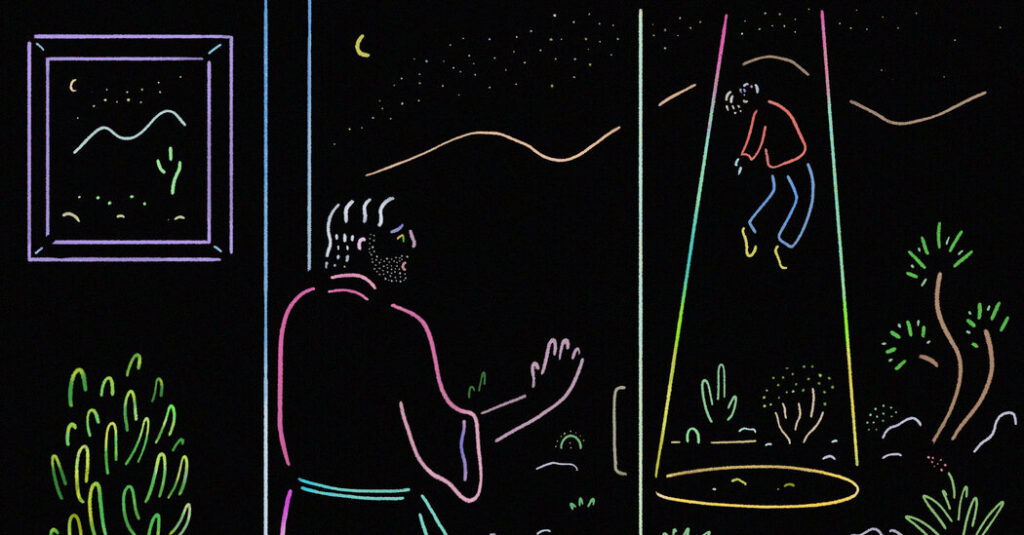
While they’re talking, the lights have been flickering throughout the house and that night, as Jesse looks on, Norman rises into the sky in a beam of light and disappears.
What follows isn’t urgent. Jesse — a comedic novelist who teaches humor at a local college — doesn’t do the expected. The police are not called. No missing person report is filed. Instead of detailing a frenzied search for Norman, the story picks up nearly three weeks later as Jesse settles into his absence and grapples with much more existential questions: Who is he without his husband? Can we be someone without our someone? Relationships are the eventual merging of lives, but also the merging of people. Love and comfort can sometimes overshadow individuality, and that’s at the core of the novel. What do we lose when we find our person? And if we do lose part of ourselves, is that necessarily so bad?
Rowley chronicles Jesse’s new existence with lovely detail. He goes to work. He teaches comedy to six students, telling them he can’t teach them to be funny (which made me cackle). He forms an endearing friendship with the local conspiracist. He fends off Norman’s sister, Lally, who comes to visit with a life-altering family question, but then quickly realizes that something isn’t quite adding up, Norman isn’t simply out of town, as Jesse says. He adopts a dog. And that dog leads to a clue about what happened with Norman.
To everyone (other than Lally), Jesse answers semi-honestly when asked where Norman is. He’s been abducted by aliens. Through this absurd plot, Rowley dives into a deep human anxiety: that someone you loved could just … disappear. It’s a heady thought, one that permeates throughout the book, alternating between melancholia and wonder. But isn’t that life? There is fear, yes, but in that fear can be found the strength of purpose in living for oneself rather than someone else.
Rowley doesn’t shy away from the hard questions, and the novel is all the better for it. “Take Me With You” is a joyously bittersweet meditation on queer aging and the ridiculousness of love and living.
If you’re lucky, you get to be old enough to complain about your knees. Isn’t that something?
TAKE ME WITH YOU | By Steven Rowley | Putnam | 353 pp. | $30
The post Aliens Abducted His Husband. Now What? appeared first on New York Times.