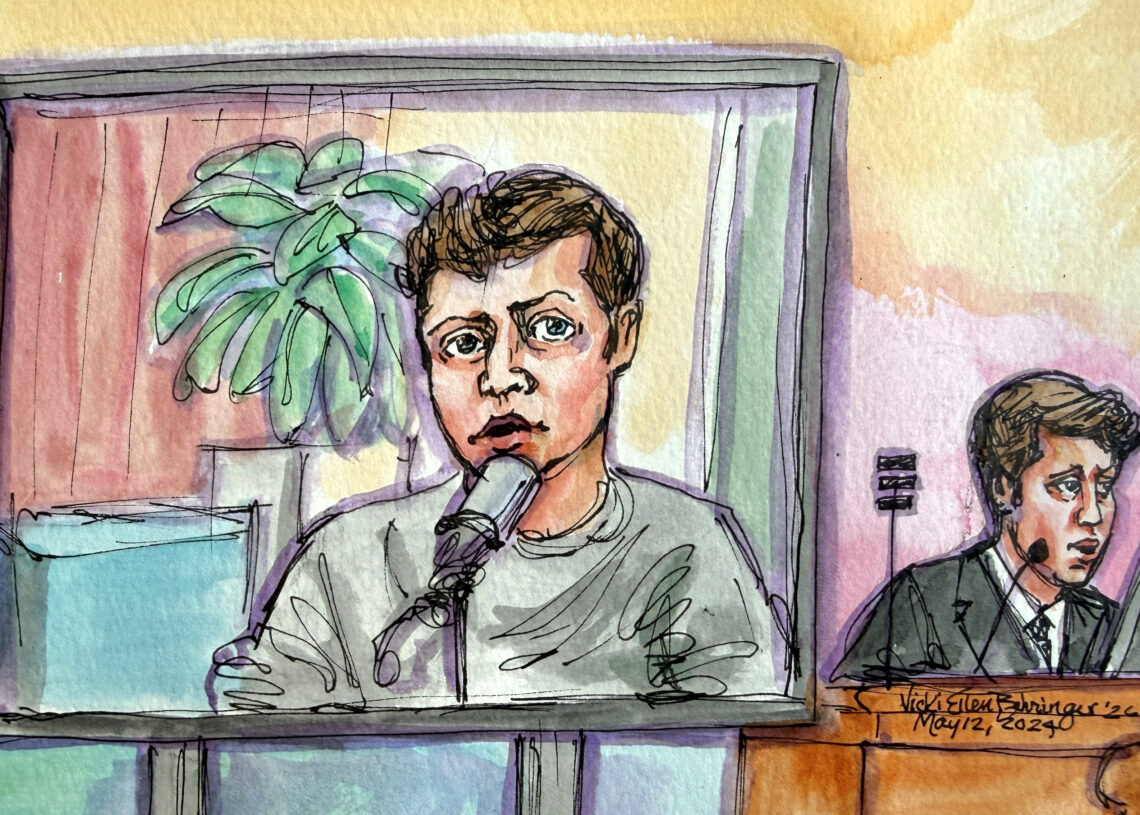
OAKLAND, Calif. — “Do you always tell the truth?” an attorney for Tesla CEO Elon Musk gruffly asked Sam Altman, CEO of ChatGPT maker OpenAI, in federal court this week.
“I believe I’m a truthful person,” Altman replied. The attorney pivoted, asking him if people Altman did business with would ever think he misled them. “I can’t answer that for other people,” said Altman — but several had already had their say in court.
Altman spoke on Tuesday in the closing days of a trial in which several of his onetime close associates, including former OpenAI executives and board members, testified that he misled or lied to them.
The CEO’s trustworthiness has been at the heart of Musk’s case in his lawsuit that colorfully played out in court over the past three weeks. The opposing sides gave closing arguments Thursday and jury deliberations begin Monday.
Musk alleges that Altman and OpenAI president Greg Brockman, who co-founded the artificial intelligence venture with Musk as a nonprofit in 2015, pivoted away from its mission of helping humanity benefit from AI after Musk left the project in 2018. Instead, Musk claims, Altman and Brockman transformed OpenAI into a profit-chasing business with the aim of enriching themselves.
The trial has given new life to allegations of lying and self-dealing that have followed Altman for years, even as he has cemented his position as the most influential CEO in Silicon Valley’s AI revolution, sitting atop the company that kick-started it with ChatGPT and is now worth over $850 billion. A former mentor once wrote admiringly of Altman that “You could parachute him into an island full of cannibals and come back in five years and he’d be the king.”
OpenAI’s rivals Google and Anthropic have largely caught up to its early lead, but ChatGPT remains more popular than other chatbots, with over 900 million users. The company has maintained friendly relations with the Trump administration, with Altman attending Trump’s inauguration. Brockman is among the largest donors to MAGA Inc., a super PAC aligned with President Donald Trump, according to Federal Election Commission filings.
Alongside that success, questions about Altman’s leadership have grown and taken more consequential forms inside and outside the Oakland courtroom.
Last week, James Comer (R-Kentucky), chairman of the House Committee on Oversight and Government Reform, wrote to Altman asking OpenAI to provide information about potential conflicts of interest raised by trial evidence that showed he had a stake in a fusion energy company OpenAI struck deals with.
This week, 10 Republican state attorneys general asked the Securities and Exchange Commission to “strictly review any filings submitted by OpenAI to protect investors,” citing his “history of self-dealing and undisclosed conflicts of interest.”
James Rubinowitz, a New York-based trial attorney who is not associated with the case, said there could be lasting consequences for Altman.
“Even if Musk loses the legal case, Altman has already lost the public one,” Rubinowitz said. “You do not put your chief scientist, your CTO, and two former board members on a stand calling you a liar and walk away unchanged.”
OpenAI, Altman and Brockman have denied Musk’s claims in court and argued that the Tesla CEO’s case is motivated by a desire to harm a competitor to his own AI venture, xAI, which was recently folded into Musk’s rocket maker SpaceX. (The Washington Post has a content partnership with OpenAI.)
Musk’s case in the U.S. District Court for the Northern District of California asks the court to remove Altman and Brockman from their leadership positions and restore the project to a fully nonprofit venture.
A spokesperson for OpenAI, Altman and Brockman declined to comment for this article. On Tuesday, after Altman’s testimony, the company’s lead lawyer in the trial, Bill Savitt, spoke with journalists outside the courthouse and defended the CEO’s responses to questions from Musk’s lawyer.
“I don’t think it’s easy to sit there and have someone barking at you like a rabid dog, saying things that aren’t true,” Savitt said. “What happened today in court is what happens when one side has no evidence. The prosecution resorts to character assassination, lies and accusations.”
A spokesman for Musk declined to comment for this article.
Altman’s honesty first became a matter of widespread public debate when OpenAI’s board of directors in November 2023 abruptly fired him as CEO and accused him of not being “consistently candid” with the company’s directors. He was rehired just days later, and all but one of the board members who voted to oust him were replaced, after OpenAI’s employees and investors revolted against the surprise move.
Musk’s team deposed or called into court as witnesses several former OpenAI executives and board members who were part of his firing and testified that Altman had been manipulative or untruthful.
In deposition videos played in court, former board member Tasha McCauley said Altman had contributed to a “culture of lying” at the company, while another, Helen Toner, said she had believed Altman misled people to get his way at the company. Both joined the vote that fired Altman.
Former OpenAI chief scientist and board member Ilya Sutskever, a legendary AI researcher and a co-founder of the company, testified at trial that in the lead-up to Altman’s firing, he gathered evidence to present to the board showing Altman’s “pattern of lying.”
Former OpenAI Chief Technology Officer Mira Murati, who left the company in 2024, testified in a deposition video played in court that she had originally supported the board’s decision to fire Altman in 2023.
“My concern was about Sam saying one thing to one person and a completely different thing to another person,” said Murati, who was briefly named as interim CEO after Altman’s ouster. She testified that she changed her position to supporting Altman’s return as CEO after realizing his departure was likely to cause the company to implode.
Musk’s lawyers also questioned Altman in court about whether his personal investments in start-ups created conflicts of interest with his role at OpenAI. A document shown in court showed Altman had a $1.65 billion stake in Helion, a fusion energy company with which OpenAI has a deal to buy energy from in the future if its technology proves successful. Comer’s letter to Altman cited his stake in the company. Altman said he recused himself from discussions about that deal.
In court on Tuesday, OpenAI board chair Bret Taylor said Altman didn’t have any role in approving the Helion deal, and that OpenAI’s independent board members approved the agreement with the energy company unanimously.
Altman has also long contended, including in Senate testimony, that he does not own equity in OpenAI itself. In court, he acknowledged that he owned a stake in a fund run by start-up incubator Y Combinator that owns some OpenAI shares.
Musk’s lawyers said the admission showed that Altman misled the Senate about his financial interest in the company. Altman was previously Y Combinator’s president but was asked to leave the influential incubator in 2019 in part due to concerns he was putting his own interests and work at OpenAI ahead of those of the firm, The Post previously reported.
Musk’s lawyers also referenced a 16,000-word article published in the New Yorker in April that cast Altman as a highly persuasive but untrustworthy leader. Altman defended his actions to the magazine, saying it was necessary to rapidly change positions on certain issues to keep up with the pace of progress in the AI industry.
Alison Taylor, a professor at New York University who studies corporate responsibility and business ethics, said that the culture of Silicon Valley leads to company founders getting away with behavior that might be considered unacceptable in other industries, because they are seen as having special affinity for running their businesses.
“It’s an approach to innovation that is hero-driven and individualist, the idea is these people have got a secret sauce,” she said. “We might expect more scrutiny; it seems at the moment boards are asleep at the wheel.”
OpenAI called its board chair Bret Taylor and a longtime company employee, Joshua Achiam, as witnesses in support of Altman in court. Both testified that the CEO was firmly committed to OpenAI’s mission of building AI that benefits all of humanity.
“I didn’t share the concern about truthfulness,” Achiam, OpenAI’s chief futurist, said.
The post He’s king of the AI boom. Why do former colleagues say he can’t be trusted? appeared first on Washington Post.