David Robinson always wanted somebody to talk with about what was on his mind, but never had the opportunity, he said.
He knew of some perceived stigmas associated with traditional therapy for mental health, particularly among Black men, including fear of being judged or being ashamed of telling their story. Those same feelings arose when he thought of confiding in someone he knew.
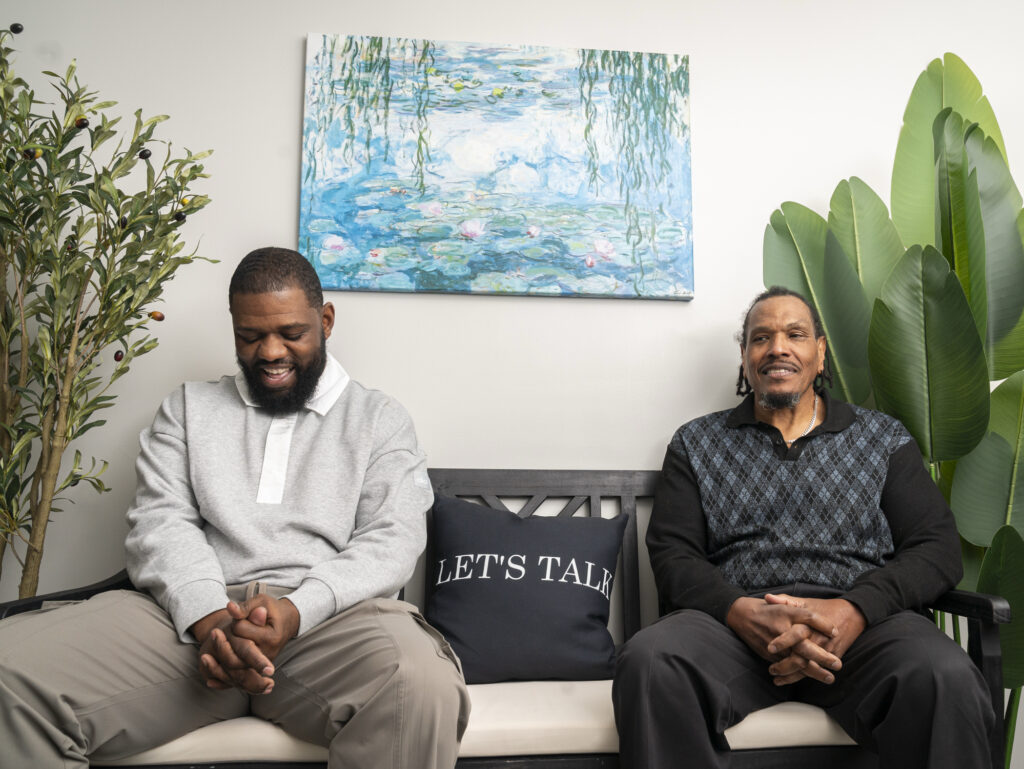
But then he met Guy Molock, a 68-year-old grandfather. For about two months, they’ve spoken weekly, with Molock offering a familiar face and a safe space.
“It’s just given me a place where I can find my peace,” Robinson, 40, said.
Molock is a volunteer with Friendship Bench DC, a team of about a dozen older adults who fan out across the District to sit and listen to people share their lives.
The literal and figurative meeting benches can be found throughout the city — from Martin Luther King Jr. Memorial Library downtown to Washington View apartments in Southeast. Since launching in D.C. in June 2024, there have been close to 700 sessions.
Those who are listening on the bench are known as “grandparents,” with some like Molock also being biological grandparents. All must be 60 or older.
Friendship Bench was founded by Dixon Chibanda, a psychiatrist in Zimbabwe, and recognizes elders as respected leaders in their community.
In D.C., the program is an initiative of HelpAge USA, a nonprofit that empowers older people and promotes their well-being, said Cindy Cox-Roman, its president and CEO.
The program takes a peer-based approach to mental health intervention, Cox-Roman said. Visitors are asked a standard set of questions, and if they need professional care, can be referred to a specialist.
“It’s helpful to think of Friendship Bench DC being a preventive mechanism to help people struggling with difficult thoughts and feelings from spiraling into a greater degree of anxiety or depression,” Cox-Roman said.
Unlike clinical resources, Friendship Bench DC comes at no cost to visitors and doesn’t require any insurance. The meeting spaces are designed to feel comfortable, some with colorful art on the wall, faux plants and calm lighting.
Visitors can schedulea private, confidential session that usually lasts about an hour. They can choose whether to continue to meet with their grandparent, usually on a weekly or biweekly basis, and most do.
Scarlett Small, 73, a retired federal worker, wears the same button every session. “Tell me your story,” it reads.
“We’re not pushy,” she said.
Many of the grandparents involved first met through Help Age USA during the coronavirus pandemic and formed a community while in the isolation. They began brainstorming ways to help address mental health in their neighborhoods. Friendship Bench, with its model of using older people as a solution, became their answer, Cox-Roman said.
The golden rule: Don’t give advice. Grandparents instead are trained — over 10 weeks, and through practice sessions — to learn how to listen empathetically, summarize what they’ve heard and equip visitors to help solve their problems.
Joseph “Joe” Hawthorne, 46, began meeting with Small earlier this year to cope with the loss of his sister. After Small asked during one of their conversations how he could honor his sister, Hawthorne turned it into action by spending more time with his family again instead of distancing himself.
“I’m more intentional,” Hawthorne said.
Carlene Meheux spotted a flier for Friendship Bench DC during one of her many visits to D.C. public libraries. The word grandparents caught her eye, she said. Her grandmother, whom she was closest to, died several years ago.
Going through a divorce, recovering from health issues, while also launching her own company, Meheux decided to give the program a try.
She was paired with Tuere Anne Marshall, 74, in April and the two now meet regularly at MLK library.
“Friendship Bench is like a buoy that I can always see on the horizon,” Meheux, 39, said. “There’s a date and a time where I know that I’m going to be heard.”
Marshall, a retired English literature professor, said the program has given her purpose, too.
“I’ve got a lot to share, and I have a reason,” she said. “I still have breath in my body … this is actually expanding my territory, in terms of the people who I am meeting.”
Cox-Roman said an independent evaluation team found that rates of depression have dropped for most Friendship Bench DC visitors, and social connections were strengthened. Ninety percent said they now have someone to discuss their mental health and all would recommend the program.
The program, which has 20 locations, is working toward adding 15 more. The sites are particularly situated within walking distance of communities that have less resources.
Friendship Bench DC aims to have 25 grandparents next year, Cox-Roman said, including more men like Molock, who is the sole grandfather of the group.
A retired lawyer and pastor, Molock joined Friendship Bench DC about a year ago after watching a CBS Sunday morning special about the program. Molock said he wished he would have had someone to go to when he was younger, so he decided to be that for someone else.
“Things are really tough right now for a lot of people,” Molock said. “I felt I’d be a good listener.”
Earlier this year, Robinson said he had been praying for a new job and someone to talk to about a weight he continued to carry after years of sexual abuse as a child.
He would get both when he connected with Molock at a workforce program, where Molock had been invited to explain his role with Friendship Bench DC and provide those in the class with interview skills. The sincerity in Molock’s voice drew Robinson in, he said.
“I ran into this whole situation at a time where I really needed this,” Robinson said. “It’s really like shined a light on my life.”
Their meetings at Washington View apartments encouraged Robinson to check out a job fair, and he was referred to a professional therapist for help about the trauma from the abuse.
Now, Robinson works as a leasing assistant for the apartment building. And he keeps meeting with Molock in the same building, too. On their bench.
The post These grandparents sit on benches, ready to talk to strangers who need them appeared first on Washington Post.