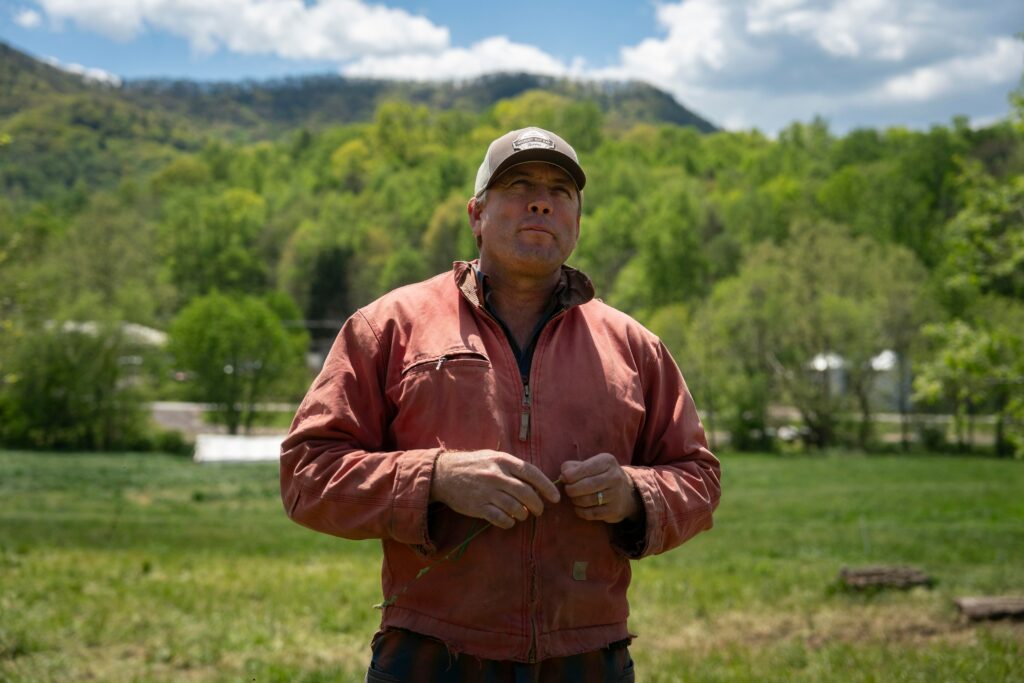
ASHEVILLE, N.C. — Fifth-generation farmer Jamie Ager won the Democratic nomination in a swingy, rural North Carolina House district in March. Now, he faces two opponents: a well-known Republican and his own party’s brand.
Democrats’ path to winning back power in this year’s midterms may run through a handful of districts like Ager’s, making rural voters a priority for a party that needs to capture only a handful of swing seats to overcome Republicans’ razor-thin House majority. But decades of data show that the Democratic Party has lost sway with rural voters — a shift Republicans gleefully highlight and a point that Ager is eager to discuss.
“One of the reasons that I felt frustrated by the Democratic Party is because it’s just become such an urban party,” Ager said in an interview at Hickory Nut Gap, the farm his family has owned for generations in Fairview, North Carolina, and where he has spent the last 25 years raising cattle, poultry and pigs. “There’s just a disconnect from what it’s like to live in rural America.”
Ager is one of a handful of Democratic candidates with backgrounds in farming, fishing or agriculture who are running for Congress this year, and who see a rare opening for Democrats to make inroads among rural voters after President Donald Trump’s tariffs and the war in Iran have had an outsize impact on agriculture, including rising prices and market instability.
Ager is pitching himself as a product of agrarian values, which he defines as having a strong work ethic, centering family and working with your hands. At times, his inclination to position cities as cultural foils is more akin to the views typically associated with Republicans.
“I did feel a little bit frustrated with the party. It felt like they didn’t understand my lifestyle out here,” Ager said of other Democrats. “A lot of the conversation around, like, plant-based meats and stuff like that felt a little bit like, ‘What are you guys talking about?’ People are just so academic and not tuned in to what’s really going on out here in rural America.”
Despite that effort to distance himself from the national brand, Ager knows it’s a tough sell with a D next to his name on the ballot. His opponent, two-term incumbent Rep. Chuck Edwards (R), is a strong fundraiser who’s known for traversing the district in a mobile office to reach even the most remote constituents.
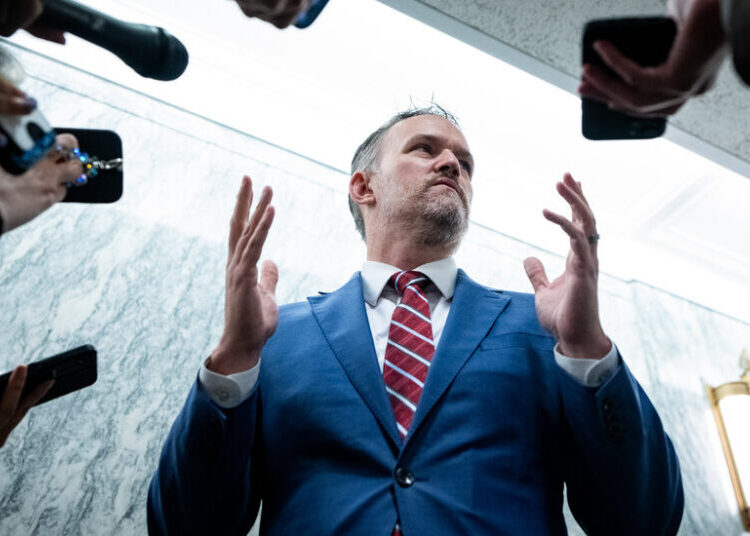
A businessman who runs several McDonald’s franchises, Edwards sits on the powerful House Appropriations Committee and had largely avoided the spotlight in Washington — until early May, when the congressman’s team acknowledged that he’s under investigation by the House Ethics Committee. On Thursday, the committee publicly confirmed that it is investigating Edwards over allegations regarding sexual harassment of former female staffers.
Edwards declined to comment for this story. In a call with The Washington Post, his campaign consultant, Paul Shumaker, argued that the cultural differences between this district’s voters and national Democrats are even starker than Ager described.
“Where the Democratic Party stands is very inconsistent with the views and values of voters in North Carolina,” Shumaker said, arguing that voters in the North Carolina district align more closely with Republicans on social issues, including abortion, immigration and LGBTQ rights.
In this purple district, the unfolding controversy around Edwards’s alleged behavior in office could make Ager’s case easier. But Ager — the grandson of another farmer-turned-politician, former congressman Jamie Clarke — must still convince voters in this mountainous, agrarian part of the state that he has their back, unlike the Washington bureaucrats he said abandoned the district after the deadly Hurricane Helene.
“When you’re frustrated, you can complain about it, or you can actually go do something,” Ager said, when asked about his decision to run for Congress. “Complain about stuff, go do it. And therefore, let’s go see what we can do.”
A cultural disconnect
Farmers were once a reliable voting bloc for Democrats. Southern rural voters, Midwest farmers and union-aligned working-class voters helped carry Jimmy Carter, a Democratic peanut farmer from Georgia, to the White House in 1976, but the party’s appeal to these voters began to fade in the following decades.
According to the Pew Research Center, Republicans in 2000 held a narrow advantage among rural voters over Democrats — 51 percent to 46. Today, that gap has more than tripled — the GOP now holds a 25-percentage-point advantage among rural voters over Democrats. Trump won the rural population by 23 points in 2020, and 25 in 2024.
The number of unaffiliated voters in North Carolina has exploded over the last 25 years. In this swing state, nearly 39 percent of voters are registered to no party, while Republicans and Democrats each hold about 30 percent of registrations.
Ager argues that this turn away from Democrats is part of a broader disillusionment with government, which is why he avoids associating himself with his political party. At events, his campaign logo stands out by its bright-green color — no sign of the Democratic blue. He’s campaigned alongside statehouse candidate Suzanne Gavenus, a Democrat married to a Republican judge who, in an interview, also heavily downplayed her party affiliation, saying she wants voters to “learn about me before [they] see my label.” And when asked if he would like national Democrats to join him at campaign rallies, Ager was noncommittal.
“I don’t know, we haven’t thought about [it],” he said. “I guess it could be good and bad, right?”
North Carolina’s 11th District, where Ager is running, is home to most of the western part of the state, folding together small Appalachian towns, the Blue Ridge Mountains and the heavily blue city of Asheville. The region — known for attracting retirees, artists and, more recently, remote workers and craft breweries — relies on an economy of agriculture and tourism.
Ager points to Congress’s inability to help North Carolina rebuild following Helene — which swept through the Appalachian region in September 2024, devastating entire towns and destroying key infrastructure with floods and mudslides — as a major factor behind his neighbors’ disillusionment with Washington.
He speaks from experience — the storm ravaged his farm, and as he crisscrossed the property, he pointed out bits and pieces that he has spent the last 18 months slowly putting back together. People in the region, he noted, are still living in campers, tents, trailers and on their neighbors’ couches because they haven’t been able to return to their own homes and businesses.
As he kept a watchful eye over a litter of piglets in one of many reconstructed pens on his family farm, Ager argued that Washington left many in the district to rebuild on their own.
“We had to put it all back together ourselves,” Ager said, noting that federal disaster relief aid for the state is slowly trickling in after long delays.
While local and federal officials warned by early October of 2024 that funding was insufficient to properly help North Carolina recover from Helene in its immediate aftermath, Congress did not pass legislation to provide relief until the end of that December. And, as The Post reported, local governments in western North Carolina argued that reimbursement delays and administrative bottlenecks slowed the actual flow of money from reaching communities and infrastructure projects.
A year after Helene, the Federal Emergency Management Agency still hadn’t reimbursed local governments for millions spent on cleanup and recovery, upending local budgets, hindering reconstruction, and keeping North Carolinians from returning to their homes and businesses.
Barb Bewernitz, who leads a local arts nonprofit, said art galleries in Old Fort, North Carolina, and orchards an hour’s drive away in Henderson County were washed away.
“Everything flooded,” she said. “Topsoil has washed away … [it’s] just years of damage. You don’t just come back in one or two years. It’s a long-term recovery.”
Stephen Knight, an independent voter who owns a bookstore in the district, told The Post that he has lost faith in the federal government’s ability to do what people “expect it to do.” Knight said there is “so much” the region still needs following the devastation two years ago that many families and businesses still haven’t been able to get back on their feet.
“[But] all I’ve seen with this Trump administration is: no, no, no. Deny, deny, deny,” he said. “We’ve got money for wars all over the world. But we don’t have money for the poor and for working-class people.”
‘A question of will’
The 119th Congress includes 33 farmers, ranchers or cattle farm owners, as well as one almond orchard owner, a forester, a fruit orchard worker and a horse trainer, according to CQ Roll Call, which tracks the occupation of each House member and Senator. But 140 members of the current House — 31 percent — and nearly half of Senators have law degrees and practiced law, CQ found. Only 7 percent of Congress is made up of individuals with direct ties to agriculture — and the majority are Republicans.
Matt Barron, a Democratic strategist who focuses on rural districts, said his party has not put in the time or monetary investment to organize to win voters with ties to farmland.
“They can’t even create a rural desk at these party committees, which is sort of the first step of working with candidates and saying, ‘Hey, we looked at your state or your district in these rural areas, and you should think about doing cost-effective rural radio drives or ads in rural weeklies,’” Barron said.
That would entail researching which festivals crown a Watermelon Queen in the South, or figuring out where to find the most popular lobster festival on the Maine coast, and advising candidates where to reach voters and how to engage them, he said.
“It’s not rocket science,” Barron added. “It’s more a question of will.”
The lack of national party branding, investment and infrastructure has led other Democratic candidates with agricultural or rural ties to make a similar calculation to Ager. In Alaska, fisherman Bill Hill is running as an independent, despite aligning with Democratic positions.
“Over 60 percent of our voting population does not align itself with a party” in Alaska, said Hill, who’s running to unseat Rep. Nick Begich (R). “Alaskans are tough to put in a little political box, and we speak more broadly to what’s good for Alaskans and Americans, and we’re not so focused on hyper-partisan issues.”
Hill, who also worked as a teacher and unionized construction worker, is employing a populist message, saying in an interview that fishermen, farmers, union members and mechanics “feel left behind by a government that focuses on special interests, corporations and billionaires.”
In Montana’s 1st District, at least two Democratic ranchers, including Matt Rains, are seeking departing Rep. Ryan Zinke’s (R) seat. Rains, a veteran who works on a ranch his family has run since the 1800s, said he doesn’t “really lean in to the national Democratic message that much.”
Instead, he talks about Democrats’ history in his state, invoking the creation of farm co-ops and measures that brought electric phones and fuel to small communities.
“We’ve always had rural Montanans’ best interests at heart,” he said. “It’s just a matter of putting that spotlight back on that fact.”
And in Wisconsin, Rebecca Cooke, a Democrat who grew up on a dairy farm, is challenging Rep. Derrick Van Orden (R). She said she’s campaigning as heavily in rural areas of the district as she is in urban places.
“That’s something that the Democratic Party needs to do more of,” she said. “But being able to speak the language of rural Wisconsin, you can’t really manufacture that kind of authenticity.”
‘Farmers are working people’
Even before he launched his congressional campaign, Ager’s name was a regular presence throughout the district. His family farm’s products — grass-fed beef, beef tallow, eggs, pasture-raised chicken and bacon — line stores just a few miles away from the farm. At coffee shops and markets on the road that connects Fairview with Asheville, neighbors nodded in familiarity when asked about his campaign.
“So many people all over western North Carolina see me less in the context of politics and more as a farmer, as a business owner,” he said.
“He does represent the values of this part of the state,” said Johnny Merrell, a resident who, chatting while playing slot machines at a gas station, noted that the prices of food and gas have shot up in the region, stressing residents.
Although the impact of Trump’s tariffs and the war in Iran have been felt nationally, rural areas of the country are more vulnerable to increased prices of animal feed, seeds, steel and aluminum. Retaliatory tariffs have also significantly reduced foreign demand for American agricultural goods, and the war has made the prices of gas and fertilizer skyrocket. Analysts at the World Bank suggestthat fertilizer costs could rise by about 31 percent this year, which would increase food prices.
“The erratic kind of tariffs that we’ve seen have been unhelpful for so many farmers all over,” Ager said. “Figuring out how to build your business model whenever the costs are erratic [because of a] whim of the administration becomes frustrating and challenging.”
Still, Ager sees barriers with his own party.
As he made his way toward a heard of his grass-fed cows, crossing the creek that cuts through his farm, Ager spoke about how Democrats have allowed a cultural divide to overshadow the real economic and practical concerns of voters like him.
“I’m talking to lots and lots of folks out in rural America, and it’s funny, because I talk to people in the city, and they’re like, ‘How do you talk to these rural farmers?’ You say, ‘Hi, how’s your mom doing?” Ager said, with a chuckle.
It’s almost as if, Ager said, the Democratic Party forgot that, historically, it is the party of the working people.
“And farmers are working people,” he said.
But then, he adds: “There’s just this, like, insecurity and self-righteousness [that] I feel like so many urban Democrats have that just felt like making me barf. I don’t want to be anything part of that.”
The post A North Carolina farmer is testing whether Democrats can still win rural America appeared first on Washington Post.