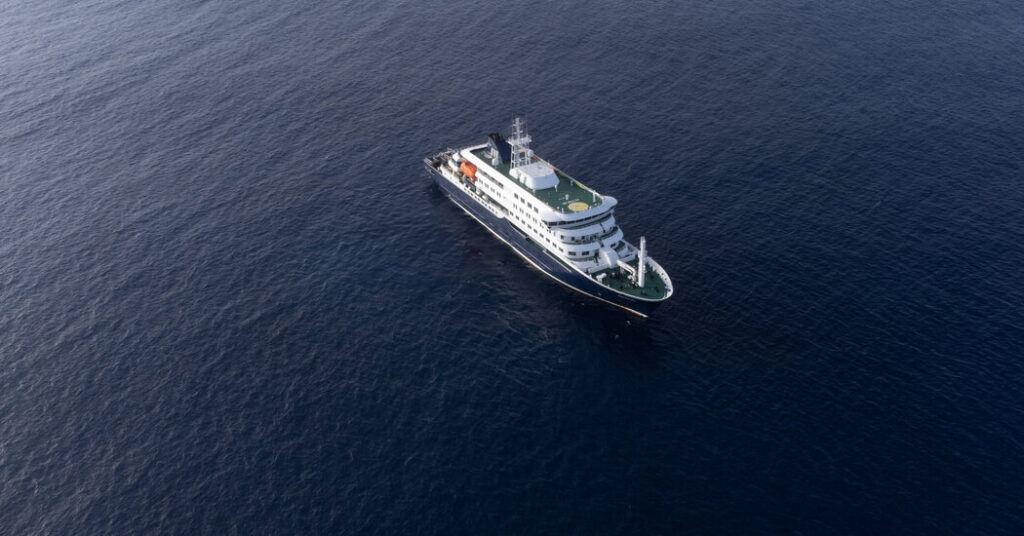
The grim-faced captain had bad news for the people gathered in the lounge of the MV Hondius. One of their fellow passengers had died.
“Tragic as it is, it was due to natural causes, we believe,” the captain, Jan Dobrogowski, told them on April 12. He added that the ship’s doctor had said the man was “not infectious, so the ship is safe.”
Less than two weeks earlier, the captain had convened the same group for a celebratory toast, as the Hondius left Argentina to sail the south Atlantic for bird watching and wildlife spotting on some of the world’s most remote islands.
Now, passengers consoled the dead man’s widow, Mirjam Schilperoord‑Huisman, 69, of the Netherlands. She and her husband, Leo Schilperoord, also 69, had crossed South America in pursuit of rare birds. Some asked if she would prefer that the trip be cut short.
“Everyone is here for a purpose,” she responded, according to Ruhi Cenet, a Turkish documentary filmmaker who was on the ship. She urged her fellow bird watchers to push on because her husband “would have wanted me to do the same.”
Within weeks, two more passengers, including Ms. Schilperoord‑Huisman, would be dead. The cause, health officials say, was almost certainly the Andes species of the hantavirus, a family of viruses carried by rodents that can spread between humans.
Over the following weeks, a world still traumatized by the coronavirus pandemic watched anxiously as the passengers and crew of the Hondius, hailing from at least 23 countries, lived the nautical nightmare of a potential outbreak in close quarters, far out at sea.
As health officials sought to contain the virus, understand how it had come aboard and trace the contacts of passengers who had disembarked, people on the ship depicted their journey in interviews and social media posts. It was a trip, priced roughly between $8,000 and $27,000, that began with the promise of seeing life in the wild and ended in protective gear and quarantine.
The Hondius and most of its passengers eventually sailed to Tenerife in the Canary Islands, where local leaders did all they could to stop them from coming, including suggesting that rats might swim ashore and bring the virus with them.
As of Friday, the World Health Organization said, at least 10 cases — eight confirmed and two suspected — of the hantavirus had been traced to the ship. It said two of the three deaths had been attributed to the virus, and that it was strongly suspected to have caused the third.
Around the world, dozens of people have been forced to quarantine in case they develop symptoms during the virus’s incubation period, which can be as long as six weeks. In the United States, where 18 people from the ship were in special facilities, health officials said on Thursday that they were monitoring 16 other people who had been on a flight with someone known to have been infected, as well as seven more who left the cruise ship in April.
Public health officials have stressed that the threat to the general public is low, based on what is known about the virus and the close, sustained contact usually required to spread it. Still, scientists who have studied the virus for decades caution that it is unpredictable, and that under certain circumstances, it can be transmitted without direct contact.
Over the past month, the specter of another pandemic turned the world’s attention to a single cruise journey. It began with passengers sharing breakfast buffets, sitting together during wildlife and astronomy lectures and lining up for cones at ice cream socials. But once news of the hantavirus spread, they retreated into isolation, avoiding an invisible pathogen that had become as palpable as the swells that rolled below them.
77 Species in 13 Hours
The Hondius, sailing under a Dutch flag and named after a Flemish cartographer, was built to navigate icy waters and go to some of the world’s most far-flung places. It attracted wildlife lovers eager to glimpse hourglass dolphins, fur seals, assorted whales and penguins and rare migratory birds. Lecturers and guides also joined.
The ship began the journey on April 1, in Ushuaia, Argentina, with passengers disembarking at various islands. Some joined the trip for just parts of the route.
Among the passengers was a Turkish bird watcher who posted under the name “bird detective”; an American travel influencer; and the ill-fated couple from the Netherlands.
Back home in their Dutch village, Haulerwijk, the couple’s backyard bordered the woods. They walked the quiet, orderly streets on the lookout for birds, binoculars usually hanging from Mr. Schilperoord’s neck, said Jan van Schepen, a neighbor. “They traveled a lot,” he said.
In the months before the couple joined the cruise, they had traipsed around South America in a camper seeking glimpses of wild birds. On Feb. 6, in Algarrobo del Águila, Argentina, they spotted 36 species, including the spectacled tyrant and the Chaco earthcreeper.
They went to Finca Cielo Verde in the northwest Salta Province, where Argentine epidemiologists say there is a history of hantavirus infections. There, they spotted a glittering-bellied emerald and a white-throated cacholote.
In March, they moved to the northeast. On a single day, in the province of Corrientes, they spotted 77 species in 13 hours.
Mr. Schilperoord logged it all on a site for bird watchers, eBird.
Before the ship’s departure, some people, several of whom would join the cruise, went to a bird-watching spot in Ushuaia near a landfill known for attracting birds.
Later, there would be speculation — echoed in internet memes and on late night talk shows — that the landfill was the source of the outbreak. The government of Argentina at first said Mr. Schilperoord had visited the site, but declined to say how it knew that. Several guides who brought different groups there said the Dutch couple were not among them.
A spokesman for the local health ministry in Ushuaia dismissed the landfill theory as a disinformation campaign, meant to damage the area’s reputation as a tourist destination. What is clear is that Mr. Schilperoord, who fastidiously logged so many of his bird-watching visits, did not record one at the landfill site.
On March 30, he logged the buff-winged cinclodes and the dark-faced ground tyrant at a glacier outside Ushuaia. Then he and his wife joined the ship, along with passengers on a trip organized by Oceanwide Expeditions, for the final journey of the season before winter came to the Southern Hemisphere.
At that point, the ship carried 175 people, according to Oceanwide and the W.H.O.
Lamb for Easter Dinner
Jake Rosmarin, an American travel influencer, wished his followers a “happy embarkation day” in a video he posted. He offered a tour of the Hondius, its dining quarters and cabins, its coffee stations and lecture theater. On the same day that Mr. Schilperoord spotted a Magellanic penguin and a sooty shearwater, according to his log, the American briefed his followers on a coming storm. “It’s about to get rough,” he said, “so stay tuned.”
A few days later, the passengers prepared to disembark on South Georgia Island. They received a briefing on “biosecurity to make sure that all of our outer gear was clean to prevent introducing anything to South Georgia’s fragile environment,” Mr. Rosmarin said in his update. Mr. Schilperoord reported seeing a southern royal albatross, a blue petrel and other birds.
As they came back from the island, passengers stood still as spinning blue brushes rolled over their legs, like in a car wash. They disinfected their muck boots. “We also had a full biosecurity inspection,” Mr. Rosmarin told his followers, adding later that it “kills everything.”
Over the next few days, passengers gathered for buffet meals. They dined on baked trout and, on Easter Sunday, lamb for dinner.
On April 6, at the bay of Godthul on South Georgia, Mr. Schilperoord logged 19 species, including an Antarctic tern, a king penguin and a South Georgia pipit. It was the last entry he made in his two years on eBird, bringing his total to just under 6,000 birds.
At some point after that, he fell ill. Five days later, on April 11, after receiving intensive care in the sick bay, he died.
‘A Serious Medical Situation’
The passengers suspected nothing about a virus. They carried on with their activities: cooking demonstrations (borscht and curry); a “crafternoon,” during which they learned to crochet; a trivia night that revealed that their average age was somewhere in the 60s. They did laps around Deck 8.
On April 13, the day after the captain delivered the news of Mr. Schilperoord’s death, the ship reached Tristan da Cunha, a British territory with slightly more than 200 residents. Over the next three days, passengers took small boats around the island and then disembarked for a tour.
“We also passed by the supermarket, the school, the island’s two churches and the pub,” Mr. Rosmarin informed his followers.
A report on the island’s website mentioned the waffles that students at St. Mary’s school ate with three visitors from the ship. Other passengers drank with residents at the Albatross pub, a time “full of laughter and stories,” the website reported.
A small group went to a church on the island for a service in Mr. Schilperoord’s memory, said Mr. Cenet, the Turkish documentarian. On April 16, the ship reached Nightingale Island, where some of the birders stood with binoculars, staring at an exceedingly rare olive-yellow Wilkins’s finch twitching on a bough, according to a video posted by Mr. Rosmarin.
Over the next few days, Ms. Schilperoord‑Huisman started getting sick. Despite the calm sea, she held tight to the ship’s railings and accepted help from other passengers, whom she called “my protective angels,” Mr. Cenet said.
From April 22 to 24, at the island of St. Helena — where Napoleon was exiled — about 30 people disembarked. Among them was Ms. Schilperoord‑Huisman, who was planning to fly to Johannesburg with her husband’s remains, on the way home to the Netherlands.
But she seemed to become sicker after boarding the plane in a wheelchair. Dutch flight attendants tended to her for about an hour.
“The crew helped her, without any protection against a virus, and then they served everyone on board snacks and drinks,” said Barbara de Beukelaar, who stood behind Ms. Schilperoord-Huisman in the boarding line. She seemed exhausted and deeply sad, Ms. de Beukelaar said.
The crew decided she was too sick to travel beyond Johannesburg. She was taken by ambulance to a clinic there, where she died on April 26. Tests later showed that she had the hantavirus, the W.H.O. said.
The next day, another person was medevacked from Ascension Island to Johannesburg for intensive care treatment. He was later confirmed to have the hantavirus.
By the end of April, others on the Hondius had become ill, including the ship’s doctor, who had treated the Dutch couple, and at least one other crew member.
On Saturday, May 2, a woman from Germany who had spent time with the Dutch couple died on the ship. Later testing confirmed that both she and the ship’s doctor had the hantavirus.
Oceanwide, the cruise company, released a statement on May 3, saying there was a “serious medical situation” aboard the Hondius. It implemented isolation measures and asked health officials to conduct testing.
When the ship reached its destination, Cape Verde, on May 3, the passengers were not allowed off.
Mr. Rosmarin, the chipper travel influencer, spoke to his followers in a voice warbling with emotion. “I’m currently on board the MV Hondius, and what’s happening right now is very real,” he said.
‘The Worst Days’
When the ship requested medical testing, protocols kicked in under the W.H.O.’s regulations. Officials in Cape Verde received the alarm loud and clear. So did an anxious world.
“This makes us jump,” said Ann Lindstrand, a representative for the W.H.O. in Cape Verde, adding that at first, she feared it could have been “a new Covid.”
Specialists boarded the ship to treat sick passengers and provide protective equipment. Three more people were medevacked out, including the ship’s doctor and a British guide. The body of the German woman remained aboard. Passengers did not know when or where they could disembark.
“These were the worst days,” said Javier Padilla, Spain’s secretary of state for health, who received status reports from the Spanish passengers.
Cape Verde argued that it was too small a country to handle the outbreak. The W.H.O. reached out to Spain, to see if the ship could go to the Canary Islands. Prime Minister Pedro Sánchez agreed, motivated, he said, by a sense of “solidarity” in a global health crisis.
Local leaders in the Canary Islands fought his decision. But at 7:15 p.m. on May 6, the ship left for the islands, and morale on board improved. Bird watching resumed.
Emin Yogurtcuoglu, the Turkish passenger who posted as “bird detective,” spotted a Leach’s storm petrel with a deep-forked tail. On May 7, at least seven bird watchers on the ship got up early and logged their sightings of storm petrels and other seabirds on eBird.
On Saturday, May 9, Fernando Clavijo, the Canary Islands’ leader, made a last-ditch effort to stop the ship from coming.
He sent Spain’s health minister, Mónica García, a screenshot from an A.I. search purportedly showing that “rats are excellent swimmers and can survive in water for long periods.” Ms. García replied hours later with a technical report that said rats were unlikely to be on the Hondius, and that in any case, the ones associated with hantavirus infections are not good swimmers.
As Spanish civil defense aircraft circled the ship, Mr. Yogurtcuoglu, now wearing a blue mask, kept posting. “Our ocean crossing has officially come to an end today,” he wrote in one. In another, his camera tracked a lone gliding seabird, along with a drone and a helicopter hovering over a nearby dump site.
Soon after, people in white hazmat suits sidled up to the ship.
As the last passengers left the ship on Monday evening, headed for chartered planes and, in many cases, weeks of quarantine, health experts around the world scrambled to trace and test people who might have been exposed to the virus.
Shortly after 7 p.m., the Hondius honked four times and turned back to the open sea for its long voyage back to the Netherlands, for disinfection.
Reporting was contributed by Carlos Barragán from Tenerife, Canary Islands, Spain; Lynsey Chutel from London; Ilvy Njiokiktjien from Haulerwijk, the Netherlands; and Emma Bubola from Buenos Aires.
Ship-tracking data from MarineTraffic.
Jason Horowitz is the Madrid bureau chief for The Times, covering Spain, Portugal and the way people live throughout Europe.
The post How a Nature Cruise Turned Into a Nightmare appeared first on New York Times.