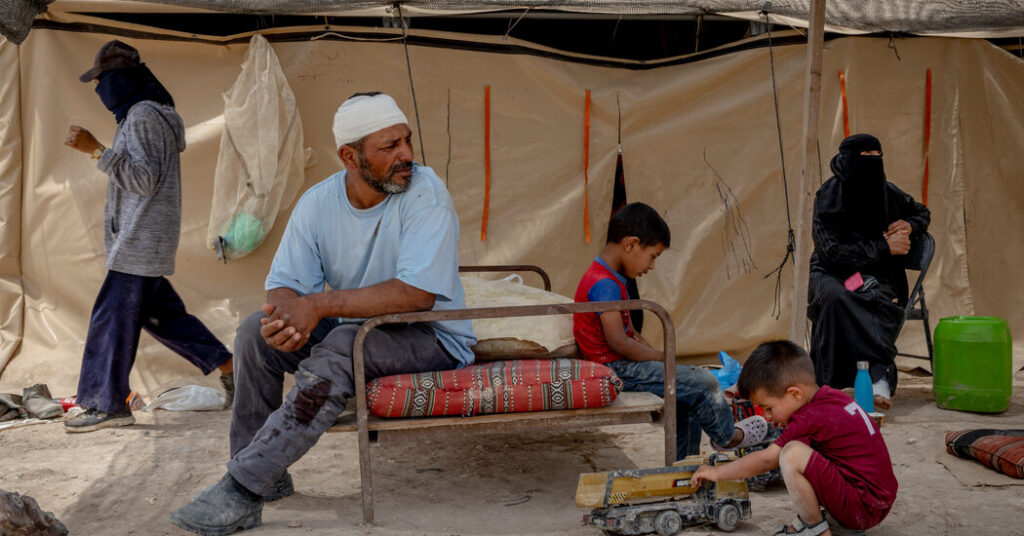
Muhammad Gawanmeh recognized the black pickup when it first pulled in front of his tent, trailed by an ATV carrying Israeli settlers he also recognized.
In January, he had fled his home of more than 40 years in the Israeli-occupied West Bank after violent settlers repeatedly attacked his village, wielding assault rifles and even setting up a base of operations in the middle of his neighborhood. Mr. Gawanmeh held on until the very end before he uprooted his wife, children and extended family, the last of more than two dozen households to abandon hope.
With nowhere else to go, he erected a tent in the safest place he could find in the hamlet of Al-Awsaj, a sun-bleached stretch of land carved from stony hillsides, deep in territory that is indisputably under Palestinian administration.
And yet last weekend, here were the same settlers again, seven men in all, sending a current of fear through the recently displaced families who cowered in their tents as Mr. Gawanmeh, 45, stood outside.
The attack began right away.
Settler violence has grown commonplace in the West Bank in recent years, part of a campaign of harassment, abuse and forced displacement. Since Israel captured the West Bank in the 1967 Middle East war, more than 700,000 Israelis have settled in the West Bank among more than three million Palestinians.
Since the Hamas-led Oct. 7, 2023, attack on Israel, violent settlers, emboldened by a right-wing government, have forced thousands of Palestinians from their homes, according to the U.N. Office for the Coordination of Humanitarian Affairs. The Palestinians are forbidden from carrying weapons, while the settlers are often heavily armed.
The Israeli military and police not only routinely fail to stop the violence, but a New York Times investigation found that they also often intervene on behalf of the Jewish settlers.
In the attack last weekend, the masked settlers used pepper spray on Mr. Gawanmeh, he said, temporarily blinding him. A few of them beat him while others stood on lookout, according to a video of the attack captured by his family and shown to The New York Times.
When Mr. Gawanmeh’s eldest son, Ahmad, 22, began to shout for help, the settlers fled the scene.
But the assault was not over.
They circled the area in their vehicles, watching. When they realized the family was alone, with the other men working in the farms nearby, they returned.
Mr. Gawanmeh said he considered fighting back. But he knew better.
“They would shoot me, or I would be the one to go to jail,” he said hours after the attack, his shirt and pants still covered in blood. “So I let them beat me.”
The settlers hurled a stone that struck Mr. Gawanmeh in the back of the head, he said, knocking him nearly unconscious. Afterward, he said, they used a baton with nails driven through it to batter him on the ground, tearing a large wound in his leg. Both injuries required multiple stitches.
Family members said the settlers also threw stones at Mr. Gawanmeh’s wife, Alia, 43, injuring her foot, and even struck their 4-year-old son, Obaida.
The settlers fled, firing gunshots in the air, only when they spotted Mr. Gawanmeh’s brothers racing up the hill, the family said.
Asked about the attack, the Israeli military said it strongly condemned the violence. The statement added that Israeli soldiers were deployed to the area following a report of violence involving several Israeli civilians who entered privately owned Palestinian territory, threw stones and fired into the air.
When they arrived, the soldiers searched the area, but found no suspects, the military said.
Israel police, forensic teams and soldiers collected testimonies and evidence and the military was investigating, the statement said.
In the past, some Israeli officials have minimized the seriousness of settler violence. Prime Minister Benjamin Netanyahu of Israel has dismissed some perpetrators as a “handful of kids” from broken homes.
Settler attacks on Palestinians in the West Bank have grown worse since the start of the most recent war with Iran, according to the U.N. Office for the Coordination of Humanitarian Affairs, which recorded an average of seven attacks a day in the past few months.
The past weekend was particularly brutal, with Palestinian media reporting nearly 20 different attacks, a territory-wide blotter of arson, invasion and beatings.
On Wednesday, Israeli military forces fatally shot a teenage Palestinian amid a new rampage by violent settlers in the West Bank zone under Palestinian administration, Palestinian witnesses said.
The settlers, accompanied by Israeli soldiers, stormed several villages near the city of Ramallah. The settlers beat residents, stole livestock and tractors and smashed car windows, the witnesses said.
When some of the Palestinian residents tried to stop them, Israeli soldiers opened fire at them and killed the youth.
The Israeli military said soldiers opened fire after “a violent riot” with stone-throwing. Its statement said the Israeli forces were trying to prevent confrontation, extract the livestock, and escort all Israeli civilians out of the area.
Ayad Jafry, a witness, said no one was throwing stones.
But last weekend’s assault was a notable escalation, particularly in territory ostensibly under Palestinian control.
The settlers’ message could not have been clearer.
“There is nowhere safe for us,” said Naif Gawanmeh, Muhammad’s brother.
The Oslo Accords signed in the 1990s divided the occupied West Bank into three zones. Much of the violence in recent years has been concentrated in land designated as Area C, where the Israeli military is responsible for overseeing civilian administration as well as security.
Much of the land is rural, home to Bedouin communities whose villages of trailers, tents and corrugated sheepfolds are often draped along the undulating terrain. As more and more of that land is cleared of Palestinian life, the violent settler movement is pressing into once-unthinkable areas, along the edges of major Palestinian cities and into regions supposed to be under total Palestinian autonomy under the Oslo agreement.
Al-Awsaj, where the attack occurred last weekend, was designated as part of Area A, land that the Palestinian Authority administers — as close as it gets to sovereign territory.
The family of Yusuf Kaabna, the teenager killed on Wednesday, had also been displaced to Area A after their homes in another zone came under settler attacks, according to Jonathan Pollak, an Israeli activist who knows the family and documented the attacks where they previously resided.
The site where the Gawanmeh family now lives, a treeless mountainside northeast of the West Bank city of Jericho, is populated with recently displaced people.
Last summer, settlers moved into and then evicted hundreds of Palestinians from the village of East Muarrajat, which sits just a few miles southwest in the central Jordan River valley. The Palestinians’ abandoned homes and livestock shelters remain in the sloped valley like ghostly ruins.
But the settlers did not stop at East Muarrajat. Instead, they moved on to mount another offensive, in Ras Ein al-Auja, the family home of the Gawanmehs, which sits within sight of East Muarrajat. Over several visits to the area, New York Times journalists witnessed repeated harassment by settlers.
Residents said the settlers deployed the same terror campaign in both places, brutalizing villagers day and night, until residents had no choice but to flee.
This was how Mr. Gawanmeh said he recognized the settlers who attacked him last Saturday, and their vehicles. Even with their masks on.
The family had called for help as soon as the attack started, running down a list of agencies. The Israeli police did not answer, they said, nor did the Palestinian Authority, whose security forces have a large base a few miles away.
Asked about the incident, the Palestinian Authority said it does not respond to settlers attacks, citing the potential for political repercussions if the Palestinian authorities were to get into a confrontations with the settlers or the Israeli army.
When Israeli soldiers eventually turned up, they questioned witnesses. Mr. Gawanmeh’s son Ahmad told them he saw everything and had been attacked himself.
Rather than take Ahmad’s statement on the spot, however, the soldiers handcuffed and took him away for questioning, according to the family and activists who arrived on the scene immediately after the assault.
Her son’s fate uncertain, Mr. Gawanmeh’s wife limped out from under a makeshift awning, her right foot wrapped in gauze.
What will we do, she asked aloud. The settlers had stolen half their sheep before the family fled Ras Ein Al-Auja, she said, and she was certain they now wanted the rest.
“They will come back,” she said. “And they will keep coming until they’ve stolen everything we have.”
Her son was later released and returned to the camp.
David M. Halbfinger, Natan Odenheimer and Fatima AbdulKarim contributed reporting.
Azam Ahmed is international investigative correspondent for The Times. He has reported on Wall Street scandals, the War in Afghanistan and violence and corruption in Mexico, Central America and the Caribbean.
The post They Fled to Safety in Palestinian Territory, Then Settlers Attacked Again appeared first on New York Times.