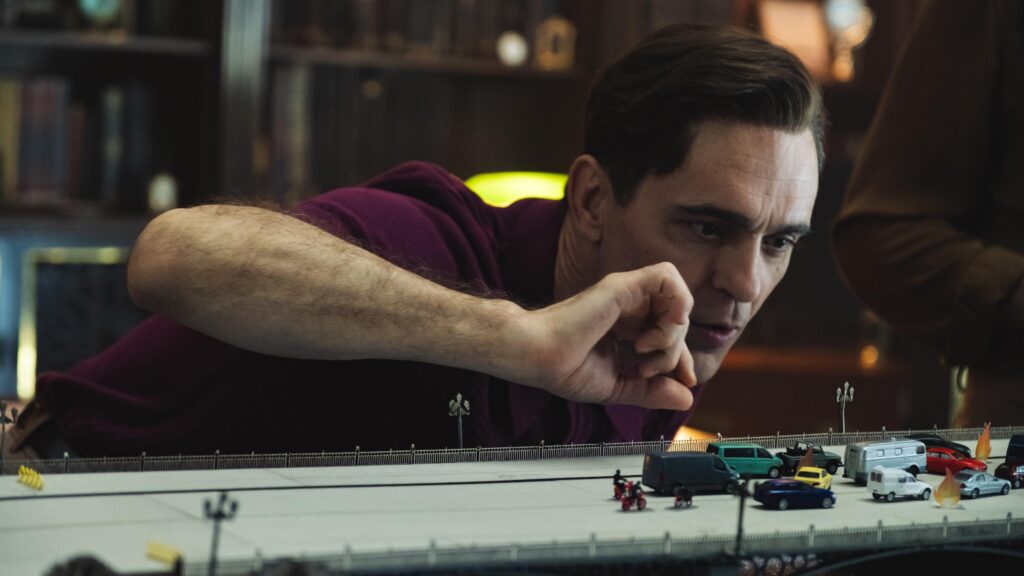
Berlin and the Lady with an Ermine, the second season of the prequel series to Netflix’s hit show Money Heist, follows jewel thief Berlin (Andrés de Fonollosa) in a high-stakes operation in Seville. What looks like a straightforward art heist gradually turns into a multi-layered criminal scheme involving a hidden fortune, an underground vault, and shifting alliances inside the team. What begins as a job centered on a single masterpiece slowly expands into a plan where the real target is not the painting itself, but the entire financial structure protecting a powerful aristocrat.
The mission is triggered by Duke Alvaro Hermoso de Medina, a wealthy and influential figure who hires Berlin to steal Leonardo da Vinci’s painting Lady with an Ermine. However, the request is not as simple as it seems. Alvaro uses the painting as part of a controlled scenario designed to keep Berlin inside his orbit, testing his abilities while subtly maintaining influence over every step of the operation.
Alvaro’s controlled trap
Alvaro is not a passive victim of the heist but the architect of the situation. Instead of resisting Berlin, he designs the circumstances of the job himself, ensuring that every movement happens inside a space he believes he can observe and influence. The painting request is the tool he uses to achieve this control, creating a scenario where Berlin must operate under rules that appear external but are actually shaped by Alvaro.
Once Berlin accepts the job, the dynamic changes. The painting becomes less important as an object and more important as an entry key into Alvaro’s private system. While Alvaro believes he is evaluating Berlin’s skill, Berlin is quietly using the opportunity to study everything behind the request, including security patterns, financial structures, and hidden operations that reveal a much larger criminal network.
The hidden vault and the real target
During his infiltration of Alvaro’s estate, Berlin discovers a hidden underground vault containing stolen artworks and approximately 75 million dollars in cash. This changes the entire direction of the mission, revealing that Alvaro’s wealth is not symbolic but physically stored and protected through a structured illegal system. The painting theft is no longer the central objective but only a surface-level operation.
From this moment, the plan becomes dual-layered. One part continues the theft of the painting to maintain Alvaro’s trust and avoid suspicion. The second part focuses on extracting everything from the vault without triggering a full security response. Both layers must operate simultaneously, because exposing the real objective would collapse the entire structure of the mission.
Inside the vault’s fire system
The underground vault is protected by a dual-layer structure designed with a fire-based security system between the layers. If unauthorized access is detected, a ring of fire activates inside the vault, sealing the space and rapidly reducing oxygen levels. The system is not meant to block entry but to eliminate intruders trapped inside, turning the vault into a controlled death zone.
During the heist, the crew must work under these conditions while maintaining coordination outside the vault. Roi, one of Berlin’s team members responsible for field operations and extraction support, and Bruce, another crew member specialized in physically demanding tasks, enter the most dangerous section during activation. Bruce withstands the fire zone long enough for the cash extraction to be completed, allowing the team to proceed with the second phase of the plan.
Damian, Candela, and Genoveva’s disruptions
As the operation becomes more complex, internal conflicts rise and affect the team. Damian, Berlin’s associate and planner, starts questioning whether the heist is still justified, since Alvaro technically agreed to the conditions that brought Berlin into his estate. His hesitation creates delays during critical decision points where timing is essential.
At the same time, Berlin falls for Candela, a skilled street thief who joins the operation. Their romance distracts Berlin, who is usually focused and more emotionally detached. Meanwhile, Damian becomes involved with Genoveva, Alvaro’s wife, who has direct access to Alvaro’s private spaces and internal routines. These overlapping relationships inevitably create operational risks.
The double heist
Berlin structures the operation as two simultaneous heists running inside the same system. The first is the theft of Leonardo da Vinci’s painting Lady with an Ermine, which is carried out in a controlled way to maintain Alvaro’s trust and prevent suspicion. The second is the extraction of the underground vault, which is the true objective of the mission.
The success of the plan depends on psychological manipulation. Berlin convinces Alvaro that he still has full control over what is happening inside his own estate. This illusion delays any serious counteraction and allows both the vault extraction and the art removal to be completed before he realizes the scale of what is happening.

The professor’s plan and the evidence against Alvaro
Sergio Marquina, known as The Professor and Berlin’s brother, is a strategist who operates from outside the field and designs the intellectual structure behind major operations. His guidance pushes Berlin to think beyond immediate profit and focus on long-term consequences, turning the mission into a full dismantling of Alvaro’s criminal system rather than a simple theft.
Following this logic, Berlin collects incriminating evidence during the heist that exposes Alvaro’s illegal operations. This evidence ensures that even if Alvaro retains some resources after the robbery, he will remain vulnerable to legal and criminal consequences that prevent him from rebuilding his network.
Where the stolen paintings end up
After completing both the vault extraction and the art theft, Berlin chooses not to keep or sell the stolen artworks. Instead, he arranges for them to be anonymously returned to their original museums. This removes any remaining traceable assets from the operation and ensures the crew does not retain physical evidence that could link them to the crime.
This decision also defines the purpose of the entire mission. The objective was never possession of wealth or art, but the destruction of Alvaro’s ability to control either. By returning the paintings, Berlin ensures that the only lasting outcome is the collapse of Alvaro’s influence and structure.
What happens to the Lady with an Ermine?
Lady with an Ermine functions as the trigger for the entire operation but loses importance after the vault is discovered. Following the collapse of Alvaro’s system, it is implied that the painting is later sold at a reduced value, reflecting the loss of control over his collection and the breakdown of his financial structure.
The story also references its real-world sale in 2016 to the Polish government, reinforcing the contrast between its symbolic role in the narrative and its actual historical status as a high-value artwork whose ownership and meaning change depending on context.
Samuel’s choice to stay silent
Samuel, Alvaro’s bodyguard, is responsible for security and internal surveillance. During the operation, he discovers Berlin’s plan early through surveillance hidden inside fake cash bundles used in the heist. Although he has the opportunity to stop the entire operation, he chooses not to intervene.
His decision is driven by emotional detachment from Alvaro, who consistently prioritizes wealth, status, and control over genuine personal connection. Samuel’s silence allows the entire operation to unfold without interruption and becomes a key factor in the success of both heists. After the collapse, Alvaro loses his wealth, his art collection, and his marriage, leaving him completely isolated while Samuel becomes the only stable presence in his life.
Cameron’s death
Cameron is a member of Berlin’s crew specialized in field operations and close-range support during the heist. She is captured by men on a yacht after they identify her connection to the team. She is offered a chance to survive if she betrays the others, but she refuses, which leads to her death in freezing water. Her death is later disguised as an accident to cover the real circumstances.
Before dying, Cameron records a final voice message for Roi, another member of Berlin’s crew involved in operations and emotional support within the team. In the message, she admits that her feelings for him were real and that she had previously denied them due to emotional confusion. The message reaches Roi only after her death, changing how he understands their entire relationship.
What happens to Berlin?
At the end of the story, Berlin marries Candela after both phases of the heist are completed and Alvaro’s entire system has collapsed. This occurs only once all operational threats are removed and the crew is no longer under immediate danger.
Afterward, Damian and Genoveva leave together following Alvaro’s complete downfall, which includes the loss of his money, his art collection, and his personal relationships. The ending confirms that the operation was not limited to theft, but was designed to dismantle every structural layer that sustained Alvaro’s power, leaving him without control over either his assets or his personal life.
The post Breaking Down the Ending of Heist Series Berlin and the Lady with an Ermine appeared first on TIME.