“The whole world is watching our meeting,” Xi Jinping, the Chinese leader, said as he welcomed President Trump to the Great Hall of the People in Beijing.
That wasn’t an overstatement.
Cameras from different countries were trained on the leaders of the world’s largest economies, allowing pundits to pick apart the diplomatic meaning of their words and gestures. Those cameras offered a rare opportunity for Chinese people too: seeing Mr. Xi up close and from angles not usually presented by state media.
And some found the visuals an occasion for comedy.
On China’s censored internet, political humor and honest online discussion are dangerous. Talking about Mr. Xi is the top taboo. The danger is grave within the country, and even Chinese people living abroad fear for their families back home. So to comment on the summit, Chinese speakers flocked to Threads, X and other open platforms that are banned in China, some scaling the Great Firewall with a VPN.
The many jokes and ironic comments posted offered a window both into how the more liberal-minded Chinese public views Mr. Xi and his leadership style, and how political opinion survives when it has nowhere else to go. When criticizing leadership directly can lead to jail, jokes become more than jokes. They are, as some people commented, equal parts hilarious and heartbreaking, an act of trying to find humor in absurdity and cruelty. (These humorous takes remain anonymous, even when posted on platforms outside the Great Firewall, and the users can be difficult to track down.)
Mr. Xi, the most powerful Chinese leader since Mao Zedong, is on the front page of the official People’s Daily nearly every day. He dominates the prime time television news. And yet, he remains a mysterious figure even to his own people. Unlike Mr. Trump, who posts constantly on social media and regularly takes questions and even unscheduled phone calls from the press, Mr. Xi is always choreographed. He reads from a script and strikes the same pose in every photograph with world leaders.
During the summit, some social media users mocked this predictability, commenting that Mr. Xi appeared to be exactly the same height as Mr. Trump — and nearly every visiting world leader he has appeared with in photos. As a 32-year-old tutor in southern Fujian province put it on Threads, “I’d be much more interested in seeing Yao Ming meet Xi Jinping,” referring to the former N.B.A. player who is 7 foot 6 inches tall, “just because they’d be the same height too.” He asked not to be named for fear of government retribution.
The stodgy, ritualized language Mr. Xi used in his remarks during the summit — “great changes unseen in a century,” “the chaotic international landscape” and “the world has once again come to a new crossroads” — prompted a different kind of derision. These were not abstract phrases to many young Chinese, but rather words drilled into them for college exams under the required curriculum known as Introduction to Xi Jinping Thought on Socialism with Chinese Characteristics for a New Era.
Some people joked that, having listened to Xi’s speech, Mr. Trump could now appreciate what it was like to sit through Xi Jinping Thought classes in college.
When some Chinese social media users suggested that boredom was driving Elon Musk, one of the business leaders who accompanied Mr. Trump, to post nonstop on his social media site X, one Thread account noted dryly that he must be experiencing “Xi Jinping Thought classes level of boredom.”
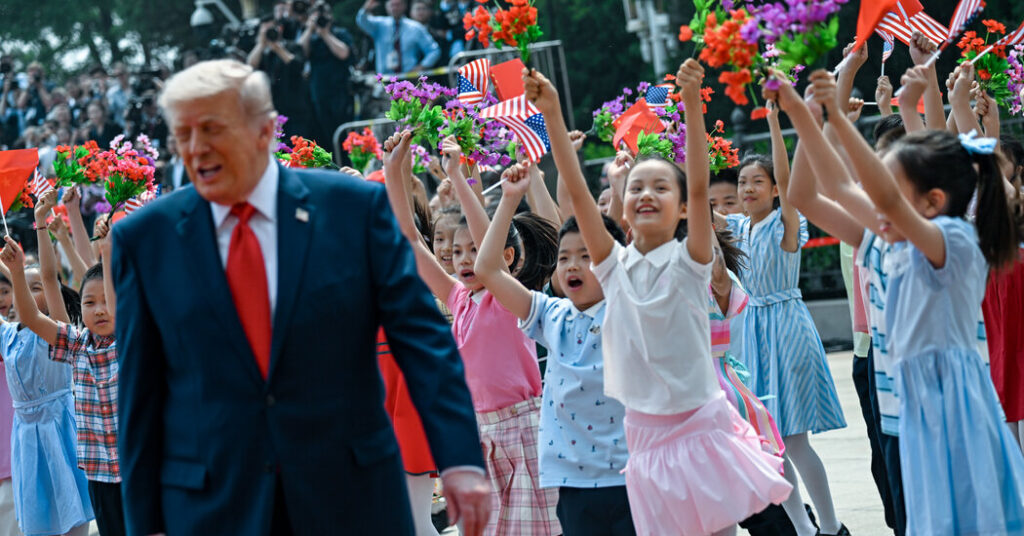
Another element of the summit was instantly, uncomfortably familiar to many Chinese people watching the welcome ceremony. As Mr. Trump walked the red carpet, he seemed charmed by the dozens of children who greeted him waving flowers and Chinese and American flags and chanting welcome slogans while jumping up and down. “I think I was particularly impressed by those children!” Mr. Trump told Mr. Xi. “They were happy. They were beautiful … Those children were amazing. They represent so much.”
But for many accounts commenting on the ceremony, those children represent something else completely: the forced conformity demanded by ruthless authoritarians. Social media users paired the video of the children with footage of North Koreans cheering for their leader, Kim Jong Un.
Some accounts said those children looked like something from China during the Mao era, when China was more isolated. During that period, the few visiting international dignitaries were welcomed by children jumping up and down. They were there for Cambodian leader Norodom Sihanouk throughout the 1970s, and for President Ronald Reagan who visited in 1984. But by the time President Bill Clinton visited Beijing in 1998, the visual message was different. He gave a speech and took questions from college students at Peking University. To many Chinese, that felt like progress. Thursday’s ceremony felt like a reversal. Even the children’s clothes, some social media users commented, felt old-fashioned.
The welcome ceremony, wrote a user on X posting under the name Fearless James, a 47-year-old small business owner in California, exposed a familiar political aesthetic that enthusiasm must be orchestrated and emotions rehearsed. He asked not to be named because he still visits his family in China and worries about government retribution.
“Is China moving backward?” he asked. “A society that is truly confident doesn’t need children chanting slogans to prove its enthusiasm. A country that is genuinely open doesn’t need to repackage diplomatic events as collective performances.”
Li Yuan writes The New New World column, which focuses on China’s growing influence on the world by examining its businesses, politics and society.
The post For Xi’s Critics, Summit Spectacle Is Fuel for Jokes They Can’t Tell appeared first on New York Times.