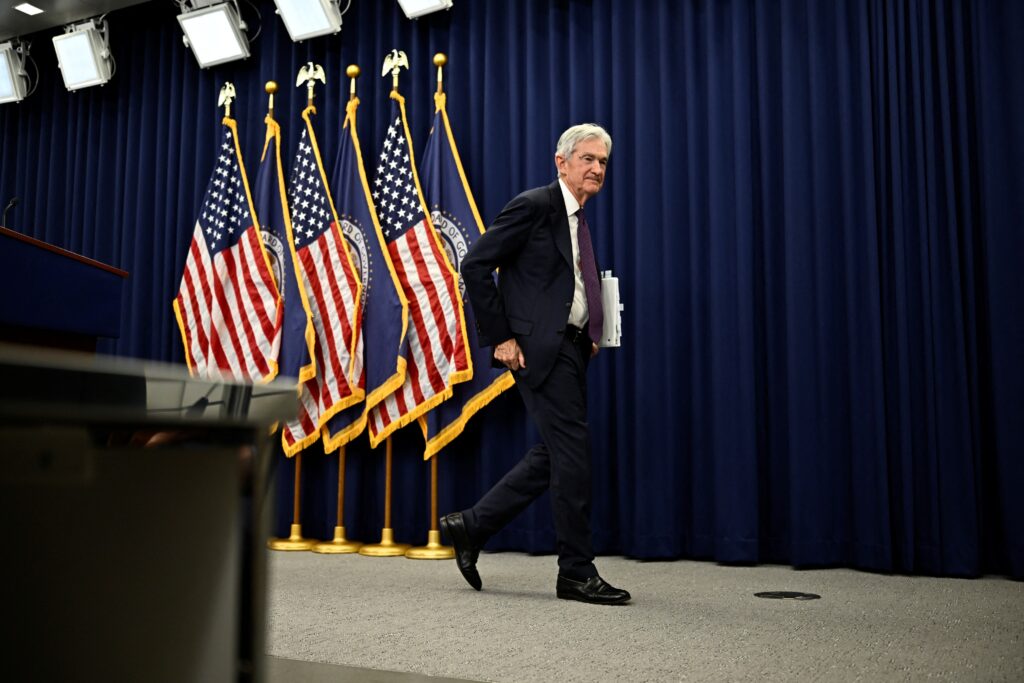
Jerome H. Powell steps down Friday as chair of the Federal Reserve after running the world’s most powerful central bank through a pandemic, the worst inflation in 40 years, and an unprecedented assault on the Fed’s independence.
He won’t go far: Powell plans to remain on the Fed’s board of governors.
He steered the country through the pandemic recession when 20 million people suddenly lost their jobs, and brought inflation down sharply without triggering a recession — a feat many said was impossible. But he may ultimately be remembered for something else entirely: his willingness to stand up to a president determined to bend the Fed to his will.
Here are five moments that defined eight-year his tenure.
1. Sticking around
In the lead-up to his term expiring, Powell did something no outgoing Fed chair had done since 1948: he announced he would remain on the central bank’s board of governors in a seat that doesn’t expire until early 2028. In particular, he cited a Justice Department investigation into his oversight of a building renovation, saying the Trump administration’s legal attacks had left him “no choice.”
“I am confident that the Fed will continue to make its decisions based on rigorous analysis and not on political considerations, but we’ve had to fight for it,” he said.
By holding his seat, Powell denied President Donald Trump a vacancy to fill on the Fed’s seven-member board, impeding the president’s ambitions to remake the central bank.
Vincent Reinhart, chief economist at BNY Investments and a former Fed economist, said Powell’s decision carries real risk. “It is poking the bear in the nose,” he said. “Probably it will be fine … but it risks a backlash.”
2. Powell pushes back
On a Sunday evening in January, Powell announced the Justice Department had launched a criminal investigation into the Fed’s headquarters renovation. He accused prosecutors of using the threat of criminal charges to pressure the central bank to lower interest rates.
“The threat of criminal charges is a consequence of the Federal Reserve setting interest rates based on our best assessment of what will serve the public, rather than following the preferences of the president,” he said.
For more than a year, Powell had absorbed Trump’s attacks largely in silence — a restraint rooted in his decision not to engage in a public fight with the president. The video changed that. A bipartisan group of lawmakers and a federal judge would later describe the investigation as an abuse of power.
The probe quickly hit legal and political blowback, even as Trump publicly egged it on. In a closed-door court hearing in March, a prosecutor acknowledged that the government had no evidence of fraud or wrongdoing. A federal judge quashed the subpoenas, finding the government had offered “essentially zero evidence” of a crime. Prosecutors dropped the probe last month to clear the path for the confirmation of Kevin Warsh, who will be sworn in in coming days, after a Wednesday confirmation vote.
3. Correcting Trump on live TV
Standing alongside the president in a hard hat at the Fed’s headquarters renovation site, Powell politely but firmly corrected Trump’s claims about the building’s costs — on live television. It was the first time a sitting president had visited the Fed in nearly 20 years, and it had the makings of a public relations disaster for the central bank.
Instead, Powell turned it into something else. When Trump pulled a piece of paper from his pocket purporting to show renovation costs had ballooned to $3.1 billion — well above the Fed’s $2.5 billion figure — Powell shook his head and pushed back. “You just added in a third building, is what that is,” he told the president. “It was built five years ago.”
By the following day, Trump — who had previously called Powell a “moron” and “a stiff” — was calling him “a very good man.” The goodwill didn’t last long, though.
4. The Jackson Hole “pain” speech
Every August, the Fed convenes an annual conference in Jackson Hole, Wyo., a gathering that Fed chairs have used to signal major shifts in thinking. In 2022, Powell used it to signal the Fed was serious about more aggressively tackling inflation, amid criticisms of being late.
During the prior year, Powell had initially characterized a surge in prices as “transitory” — a judgment that proved wrong as inflation climbed to its highest level in four decades.
An official walk-back of “transitory” language came in November 2021, when Powell told Congress it was “probably a good time to retire that word.” Then the following August, Powell warned in unusually direct terms that bringing inflation under control would cause “some pain” — and made clear the Fed wouldn’t stop until the job was done because “a failure to restore price stability would mean far greater pain,” he said.
5. The pandemic response
When the coronavirus pandemic hit in spring 2020, the United States plunged into a deep and sharp recession as the economy effectively shut down overnight. In a matter of weeks, 20 million Americans lost their jobs. The human toll was staggering, and the economic outlook was terrifying.
Powell’s response was swift and aggressive. Within weeks, he cut rates to zero, launched an open-ended bond-buying program, and authorized the Fed to purchase corporate bonds and lend directly to municipalities for the first time in its history — moves that dwarfed the central bank’s response to the 2008 financial crisis.
The recession, though brutal, lasted only two months. And the recovery that followed was the strongest of any major economy in the world, outpacing Europe, Japan and even China. It was one of the more successful economic interventions in the Fed’s history, narrowing what could have been a deeper recession.
The post 5 moments that defined Jerome Powell’s Federal Reserve appeared first on Washington Post.