In 2024, Donald J. Trump said China was “killing us as a country.” Last year, he complained that President Xi Jinping of China was “very tough, and extremely hard to make a deal with.” His tariffs on China reached 145 percent at one point.
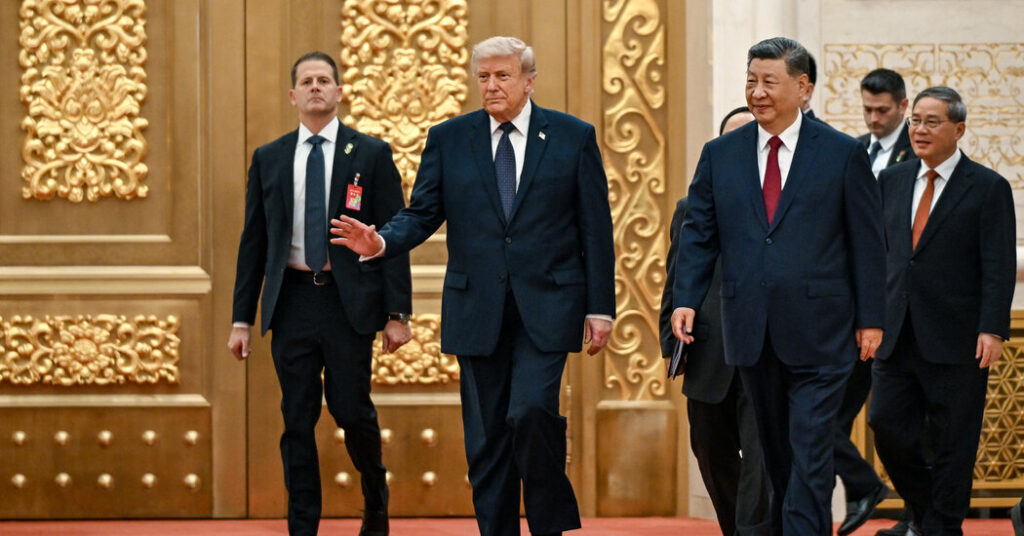
The whiplash that followed culminated in the pageantry in Beijing this week.
As Air Force One took off from the Chinese capital on Friday, it remained unclear what deals, if any, President Trump had clinched with Mr. Xi. But the two-day summit in Beijing underscored how far he has shifted the foundations of American policy toward China in the wake of his humbling retreat from last year’s trade war. He has thrown aside the adversarial approach of his first years in office, the Biden administration and the beginning of his own second term.
What’s more, he has largely waved aside the warnings outlined in the Pentagon’s annual, unclassified accounting of China’s capabilities and intentions, which lays out a plan to push the United States out of the Western Pacific, engulf Taiwan, claim more territory in the South China Sea and escalate cyberattacks on the United States. He acknowledges that these threats are real. He has just reversed his view of how to deal with them.
In Beijing, Mr. Trump clapped for Chinese children waving American flags, toasted the “special relationship” between the American and Chinese people, called Mr. Xi a “great leader” and exclaimed that the garden where he walked with Mr. Xi held “the most beautiful roses anyone’s ever seen.” When Mr. Trump introduced the Chinese leader to the 17 or so American executives who came to Beijing, he said they had joined him “to pay respects to you, China.”
Mr. Trump said nothing in public in Beijing about Taiwan, even as Mr. Xi sharply warned that disagreement over the self-governing democracy could lead to a “clash.” Mr. Trump boasted of big Chinese purchases of Boeing airplanes and soybeans, though details were slim — just his own accounting of his wins, conveyed to reporters on Air Force One soon after liftoff from Beijing. Mr. Xi’s government did not confirm the purchases.
And Mr. Trump insisted that Beijing and Washington were on the same page on Iran, even as the Chinese Foreign Ministry on Friday reiterated its position that his war “should not have happened in the first place.”
Taken together, the picture of a deferential American president and a confident Chinese leader reflected Mr. Xi’s success, despite his country’s bleak economic picture, in derailing the hawkish approach to China that Mr. Trump adopted at the start of his second term.
The tone the two men set, in what could be the first of four meetings this year, was one in which they would work to defuse years of built-up tension — some of which Mr. Trump built up himself — even as the Iran war has created a new potential flashpoint.
John Delury, a historian of East Asia, said that even though the summit had produced few tangible outcomes in terms of economic deals or political agreements, it had the potential to affect the geopolitical mood, both in China and the United States. Mr. Trump’s friendly statements toward Mr. Xi and the Chinese people were being amplified in China’s state-controlled media, sending the message that “we’re getting along better with the Americans,” said Mr. Delury.
And in the United States, Mr. Trump was telling voters who previously heard him describe China as a sinister, destructive force that it was a country America should do business with. The Washington narrative about “decoupling” — the idea that the United States should unwind its economic ties to China — seemed part of a bygone era.
“You don’t pack Air Force One with your biggest business leaders when you’re decoupling,” said Mr. Delury, a senior fellow at the Asia Society. “Trump is sending that message to his people — to some extent the whole country — that we can get along with China even though we’re still going to compete.”
But there are dangers in that approach, in the view of some former American officials who have served in Beijing. R. Nicholas Burns, the ambassador to China during the Biden administration, said it was understandable that Mr. Trump wanted to be polite to Mr. Xi, but that the American president’s gushing approach “weakens Trump and the U.S.”
“Xi did not hesitate to warn Trump over Taiwan,” Mr. Xi said. “Trump should not hesitate to be frank about our concerns, too.”
The summit produced little clarity about the policy details of the new relationship that Mr. Trump and Mr. Xi were shaping. Da Wei, the director of the Center for International Security and Strategy at Tsinghua University in Beijing, said the United States did not appear to have “put enough energy” into the visit.
“The U.S. side looked a little passive,” Mr. Da said, asserting that Mr. Trump had said little of substance on the trip. “The Chinese side prepared very well.”
The United States went into the summit hoping to convince China to do more to get Iran to reopen the Strait of Hormuz and stabilize global energy markets, Secretary of State Marco Rubio said on the flight to Beijing this week. And China had hopes that Mr. Trump might nudge American policy on Taiwan in Beijing’s favor.
There was no evidence that China had changed its position on Iran, even though Mr. Trump asserted that he and Mr. Xi “feel very similar” about it. On Air Force One, Mr. Trump did not name a single way in which Mr. Xi had agreed to change the situation on the ground — or whether it had agreed to stop giving Iran access to satellite imagery that helps it target U.S. forces and Gulf states.
China’s foreign ministry said that Middle East “shipping channels should be reopened as soon as possible,” but it did not indicate it would put more pressure on Iran, which relies on China as the main buyer of its oil.
Mr. Trump did not comment on Taiwan until reporters asked him about it on the flight from Beijing, at which point he offered little reassurance to those hoping for a robust American defense of Taiwan’s democracy.
He suggested that he might reconsider a $14 billion arms package for Taiwan that has been awaiting his final approval. When a reporter noted that President Ronald Reagan had assured Taiwan, more than 40 years ago, that no president would consult Chinese leaders on the size or nature of such arms packages, he dismissed the whole notion, saying that was a long time ago.
“I’ll be making a decision” about arms sales, Mr. Trump said, suggesting he would announce something soon.
He said Mr. Xi had asked whether the United States would defend Taiwan if China attacked it, and that he had not given the Chinese leader a response. “I said, ‘I don’t talk about those things,’” Mr. Trump said.
Mr. Xi accompanied Mr. Trump at all his public events across Beijing on Thursday and Friday. It was an extraordinary time commitment by the Chinese leader, according to Yun Sun, director of the China program at the Stimson Center in Washington. Mr. Trump told reporters on his plane that the secretive residential compound Mr. Xi showed him on Friday was “amazing” and marveled that he had gotten to see it.
Chinese officials “realize that this current moment of positivity is a very Trump-specific phenomenon that may not be sustainable,” Ms. Sun said.
Analysts in Beijing said they recognized that U.S. policy could turn on a dime, and Mr. Xi signaled that he was tailoring his foreign policy to Mr. Trump specifically.
Mr. Xi presented Mr. Trump with a new concept for the U.S.-Chinese relationship called “constructive strategic stability,” according to Chinese state media, but specified a time frame that coincided with the end of Mr. Trump’s term: “the next three years and beyond.” And as he met with Mr. Trump on Friday at the residential compound, Zhongnanhai, Mr. Xi compared his “great rejuvenation of the Chinese nation” to Mr. Trump’s “Make America Great Again” slogan, according to a Chinese government statement.
A question looming over all the camaraderie was how long the upbeat tone would last. Early in Mr. Trump’s first term, a similarly convivial Beijing summit in 2017 was followed by a hawkish turn against China.
But analysts in both China and the United States said Mr. Trump’s attitude to Beijing was different now. For one thing, he has seen China’s ability to retaliate against the United States, as it did by throttling rare earth exports last year, forcing Mr. Trump to back down in his trade war.
“Everyone has a learning curve,” said Sun Chenghao, a specialist in U.S.-China relations at Tsinghua University. Now, he said, “Mr. Trump knows how to deal with China.”
Anton Troianovski writes about American foreign policy and national security for The Times from Washington. He was previously a foreign correspondent based in Moscow and Berlin.
The post Trump’s ‘Learning Curve’ on China Ends With Conciliation at Summit appeared first on New York Times.