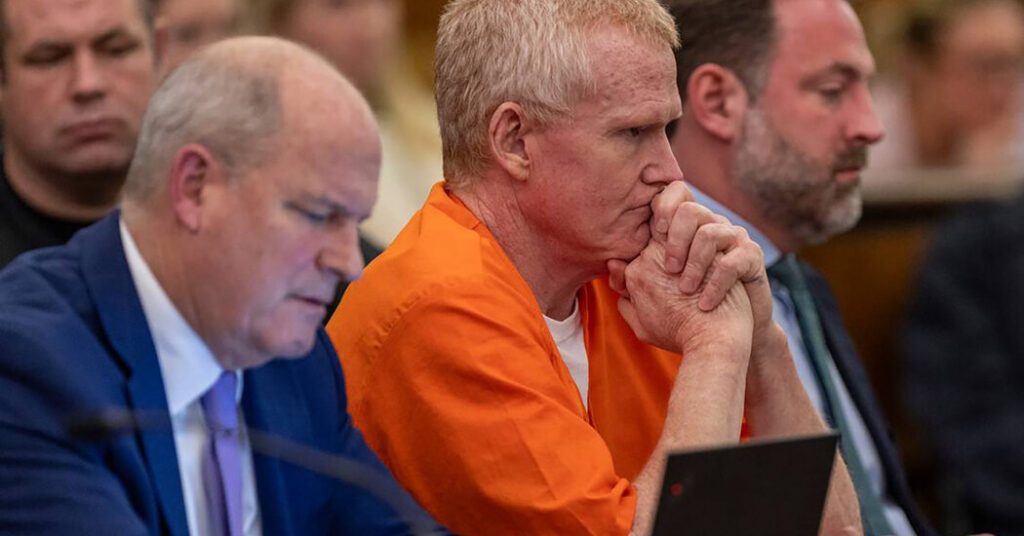
Alex Murdaugh seemed as surprised as anyone this week when he found out that South Carolina’s top court had thrown out his convictions for murdering his wife and one of his sons.
“I still don’t believe it,” his lawyers said he told them from prison, where he is serving sentences for financial crimes that are likely to keep him behind bars for decades.
Mr. Murdaugh, 57, had grown used to losing court rulings over the last several years, and felt that “under no circumstances would he get a new trial,” said one of his lawyers, Jim Griffin, in an interview on Thursday.
But a new trial could be on the horizon, after the State Supreme Court overturned the convictions this week, citing “shocking jury interference” by a court clerk in what was one of the most-watched trials of the last decade.
It’s not yet clear when, where or how a second trial would take place.
Alan Wilson, the South Carolina attorney general whose office prosecuted the first case, said on Thursday that he hoped to retry the case by January, although Mr. Murdaugh’s lawyers said they did not think that time frame was likely.
Mr. Wilson also left open the possibility that his office might not move ahead with a retrial. He and his legal team have to evaluate several factors, he said in an interview on Thursday, including the desires of the victims’ relatives and which witnesses could testify more than three years after the last trial.
That trial, in early 2023, received enormous attention from people around the globe enthralled by the livestreamed testimony and the idea that Mr. Murdaugh — a fourth-generation lawyer from a rural corner of South Carolina — might have carried out such a lurid crime.
There would certainly be fewer revelations about the facts of the case this time. But both the prosecutors and defense lawyers said they would be forced to revise their legal strategies.
“They’ve seen our playbook; we’ve seen their playbook,” Mr. Wilson said. “We have to evaluate the trial through a very different lens.”
One key difference is that jurors would hear less testimony about Mr. Murdaugh’s financial crimes, or perhaps none at all. In its unanimous ruling on Wednesday, the State Supreme Court said the judge who oversaw the first trial had allowed prosecutors “to go far too long and far too deep” into the financial wrongdoings.
Prosecutors had done so to bolster their theory of Mr. Murdaugh’s motive: that he had fatally shot his wife, Maggie, 52, and younger son, Paul, 22, to create a distraction from inquiries into his own finances.
But the State Supreme Court said the extensive testimony about financial malfeasance had “high potential for unfair prejudice” and should not be allowed in Mr. Murdaugh’s next trial.
Another big question is where the trial would take place. The last was held in Walterboro, in Colleton County. That is the same county where the killings occurred, on the Murdaugh family’s secluded hunting estate, known as Moselle.
But Mr. Murdaugh’s lawyers said on Thursday that they planned to file a motion asking for a change of venue, believing that he would not be able to receive a fair trial in Walterboro after all of the attention.
Mr. Wilson declined to discuss whether the state would oppose such a motion, and it is likely that the final decision would not be up to him. He is running in the Republican primary for governor, and his term as attorney general ends in January. All of the candidates running to fill his seat have indicated that they would retry Mr. Murdaugh.
At his first trial, Mr. Murdaugh gave two days of tearful testimony in which he admitted to repeated embezzlement, drug use and lies but adamantly denied that he was a murderer. His lawyers declined to say whether he would testify again. One lawyer, Dick Harpootlian, said it would be a “game-day decision.”
After Mr. Murdaugh’s murder convictions, he made plea deals over his financial crimes with state and federal prosecutors, agreeing to a 27-year state prison sentence and a 40-year federal sentence. Even if he receives credit for good behavior, he will most likely be in prison until his late 80s for his financial crimes.
When Mr. Murdaugh took those plea deals, he joked that perhaps he would one day play golf upon his release, his lawyers said.
“He has hope,” Mr. Griffin said. “No one wants to give up hope.”
Amie Williams, a juror in Mr. Murdaugh’s first trial, said on Thursday that she was grappling with the thought that her time and deliberation — in a trial that lasted nearly six weeks — had been invalidated.
“I don’t ever want to be called by anybody else to be on a jury again, because I’m not going to do it,” Ms. Williams said. “Why should I, if at some point it might get thrown out?”
It feels, she said, as if “my decision doesn’t matter.”
Ms. Williams said she was not influenced by any comments from the court clerk, Becky Hill. Instead, she said, one of the most important factors was Mr. Murdaugh’s demeanor, both in the audio of his 911 call on the night of the 2021 killings and in his testimony.
But with many questions lingering about the future proceedings, Ms. Williams said she knew anything was possible.
“I will be in prayer the whole time,” she said, adding that she hoped for another guilty verdict.
Christina Morales contributed reporting.
Nicholas Bogel-Burroughs reports on stories across the United States, including natural disasters, protests, unsolved mysteries, high-profile criminal cases and more.
The post Why a Retrial of the Murdaugh Case Could Look a Lot Different appeared first on New York Times.