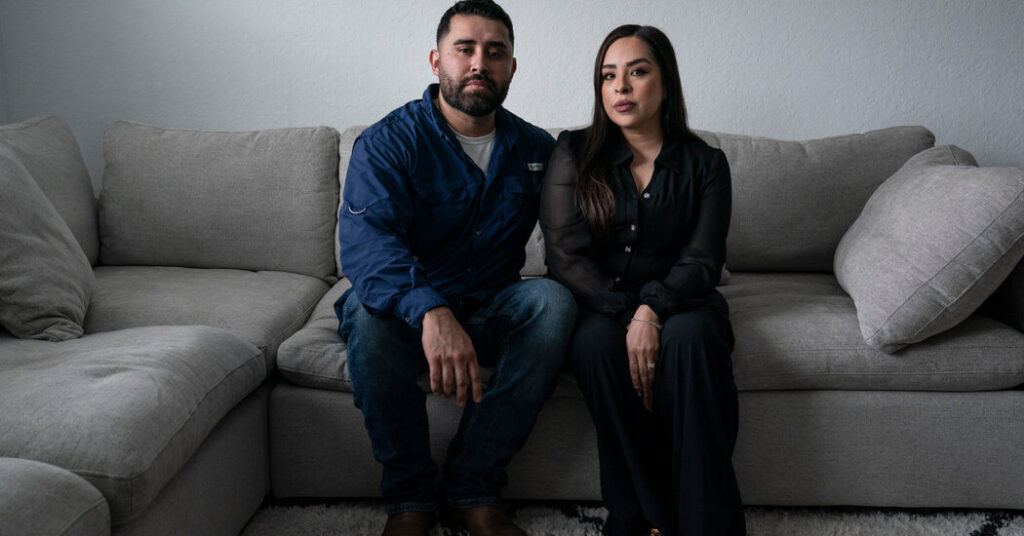
There had to have been a mistake, Martin Padilla recalled telling the immigration agents.
An inspector in the oil and gas industry, he was about to fly to Sacramento for work when the agents pulled him aside at Corpus Christi International Airport in Texas last August. Stopped at the security X-ray scanner, he told them he had DACA status, referring to the Obama-era program designed to protect undocumented immigrants who were brought to the United States as young children. His DACA card, he said, was in his wallet.
It didn’t matter.
Within hours of the Aug. 5 encounter, Mr. Padilla had been detained. Days later, he was deported to his native Mexico, leaving behind his American wife, their three children and the family’s new home.
Mr. Padilla, 35, is among about 500,000 people enrolled in DACA — the Deferred Action for Childhood Arrivals program — which is supposed to shield them from deportation and allow them to work legally. And he is one of the dozens of DACA recipients who have been expelled from the country by the Trump administration.
The swift effort to deport Mr. Padilla underscores the tenuous state of many immigration protections under President Trump as he seeks to deliver on his pledge to deport millions of people and remake the country’s immigration system.
The federal government has all but ended the resettlement of refugees. The system for weighing asylum claims has been brought to a near standstill. And the Supreme Court will soon decide whether the Trump administration can end Temporary Protected Status for more than a million people from some of the world’s most troubled nations.
Mr. Padilla’s lawyers challenged his deportation, arguing in a federal court filing that his due process rights had been violated. After seven months, Mr. Padilla was allowed to return to the United States.
“My focus is getting back to work and providing for my family,” he said in an interview.
But Mr. Padilla is hardly out of jeopardy. There is an outstanding deportation order that was issued to his family when he was a child. The Department of Homeland Security said that order was a basis for his detention last year, even though DACA was intended to protect him. And the agency also cited two D.W.I.s over the last 14 years, which can be considered by immigration authorities even though neither led to a criminal conviction.
With the Trump administration working to weaken a wide range of protections, DACA recipients are realizing that the program, born of bipartisan support for a generation of young undocumented immigrants, is no longer the reliable shield it seemed to be for most of the last two decades.
Mr. Padilla’s experience makes clear just how much has changed and just how uncertain the future may be for the half million people who currently have DACA.
Since Mr. Trump took office last year, 650 DACA recipients have been taken into custody by ICE, and nearly 90 percent of the people arrested had previously been charged with or convicted of a U.S. crime, according to D.H.S. Lawyers contend the Trump administration is relying on minor infractions and decades-old deportation orders to justify detentions and removals of a protected group.
Neither Mr. Padilla or his lawyer received an official explanation for his deportation, they said.
“It seems so arbitrary that they decided to pick him up,” said his lawyer, Danielle Claffey. “The whole purpose of deferred action is to defer someone’s removal, even if they have a removal order.”
In response to an inquiry from The New York Times, D.H.S. said Mr. Padilla was a “criminal,” citing two D.U.I. charges and a deportation order from 2003, when he was 12. Records show that a D.W.I. charge in 2012 was dismissed. A 2023 guilty plea for another D.W.I. was discharged by a judge without a conviction.
The case challenging his deportation never reached a hearing in court, Ms. Claffey said, because the Department of Homeland Security chose to resolve the matter by facilitating Mr. Padilla’s return.
Created by the Obama administration in 2012, DACA was intended as a stopgap until Congress could pass legislation, known as the Dream Act, to provide legal status for a generation of young immigrants who were brought to the United States through no choice of their own.
For many so-called Dreamers, the United States is the only home they’ve known. Former President Barack Obama described them as “Americans in every way but on paper.” DACA enabled them to obtain driver’s licenses, pay in-state college tuition and build careers. Many are now in their 30s.
But the program has been legally vulnerable because it was established by executive action, not by Congress. Arguing that Mr. Obama had overstepped his authority, opponents have been challenging DACA in federal court since the program’s inception.
Still, across the previous three presidential administrations, recipients were assured “deferred action,” meaning the government would not pursue their deportation.
In a letter to Senate Democrats in February, Kristi Noem, then the homeland security secretary, justified the arrest and deportation of DACA recipients by saying that the program “comes with no right or entitlement to remain in the United States indefinitely.”
In a statement, D.H.S. said that any person covered by DACA “may be subject to arrest and deportation for a number of reasons including if they’ve committed a crime.”
Last month, the Board of Immigration Appeals, which is part of the Justice Department and oversees immigration courts, ruled that DACA status doesn’t prevent recipients from being deported.
The decision deepened the fear and uncertainty gripping Dreamers.
Many were already facing delays in renewing their “deferred” status and accompanying employment authorization. Historically, these renewals, required every two years, have taken weeks to process. But monthslong waits have become common, and that is costing some recipients their livelihoods. Lawyers and advocacy groups report a surge of calls from panicked nurses, teachers and others forced out of jobs.
Yadira Valles, a nurse in Albuquerque awaiting her renewal, cared for patients recovering from brain and spinal surgeries — until her work permit expired a month ago.
“I left my unit short a nurse, not because I wanted to but because I was forced to,” she said. “Without help from my family, I couldn’t keep my home, pay utilities and buy groceries.”
While a lapsed work permit can mean a career on hold and earnings lost, for DACA recipients like Mr. Padilla, the Trump administration’s approach meant sudden expulsion.
In the early hours of Aug. 18, he stood on the tarmac at an airport in Harlingen, Texas, a deportation hub. Chained at the waist, wrists and ankles, he tried once again to plead his case. His DACA was current, he told the people transporting him, to no avail.
“I was like, oh my God, I have been here all my life, I have a home, I have a U.S.-citizen wife and three U.S.-born kids,” he recalled thinking as he shuffled up the stairs to the plane.
He landed in southeastern Mexico disoriented, a stranger in the country of his birth. His wife sent him money, and he flew north to Reynosa, across from McAllen, Texas, to be closer to his family.
Mr. Padilla and his wife, Cynthia, have been married since 2015. But it was not until June 2024 that she started the paperwork to sponsor him for a green card, a process that can take years.
As his lawyer worked to have him returned to the United States, Mr. Padilla found a job at an American-owned manufacturing plant.
His wife locked up their house near Corpus Christi and moved in with relatives near McAllen. Relocating allowed her and their children, 10, 7 and 4, to cross the border on weekends to visit Mr. Padilla. Their youngest, a girl, cried every time she parted ways with her father.
Mr. Padilla’s lawyer filed a complaint in federal court in December. Before the judge ruled, government lawyers agreed in February to admit Mr. Padilla back into the United States. A week later, an ICE official emailed Ms. Claffey, saying that Mr. Padilla would be detained on arrival. This led to several more weeks of limbo, until ICE agreed not to immediately detain him.
On April 24, Mr. Padilla was admitted through the port of entry at Brownsville, Texas.
When U.S. agents dropped him off at a bus stop, they wished Mr. Padilla good luck, he said. One reminded him to keep his DACA active. Mr. Padilla remembers thinking, “It was active.”
With Mr. Padilla able to earn only a fraction of what he had been making before his deportation, his family relied first on savings, then on credit cards, to keep up mortgage and car payments during his absence.
“If this had gone on another month or two, we would have been in serious trouble with our home,” he said.
He and his wife are aware his immigration saga won’t be truly over until he has a green card.
“All I want to do is fix his status,” Ms. Padilla said. “He is a great husband, father and worker.”
Sheelagh McNeill contributed research.
Miriam Jordan reports from a grass roots perspective on immigrants and their impact on the demographics, society and economy of the United States.
The post Deported Despite DACA: Dreamers Face Uncertainty Under Trump appeared first on New York Times.