In an almost heroic moment, outgoing Republican South Carolina Gov. Henry McMaster said he wouldn’t call for a special session to pass a new congressional redistricting plan, thus defying his benefactor, President Donald Trump.
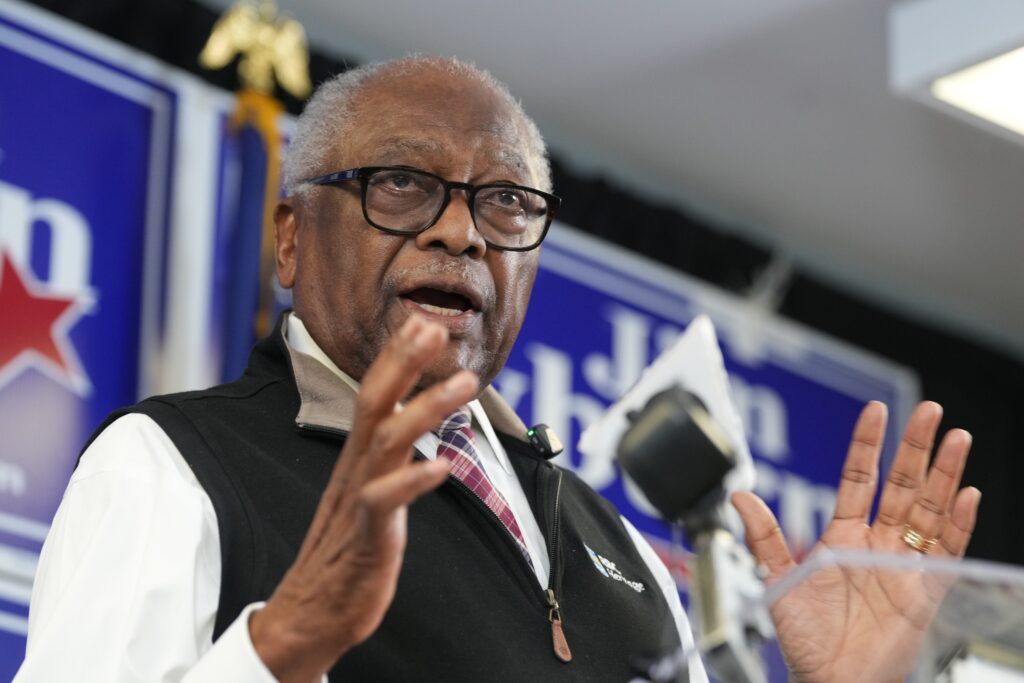
It felt good for a minute. Trump’s redistricting war to create more Republican congressional seats ahead of the midterms has produced ugly collateral damage nationally, and it looked as though McMaster wouldn’t be a part of it. Among other offenses, earlier redistricting in the secessionist state has meant redistributing Black voters to reduce their voting power. The proposed congressional map targets the venerable Democratic Rep. James E. Clyburn, who is Black, and his 6th Congressional District, whose voters first elected him in 1992.
“Almost” being the operative word, McMaster suddenly pivoted Wednesday and said he would call for a special session. The South Carolina Senate on Tuesday refused to extend the regular session, which ended Thursday, to consider the redistricting measure. The extension required a two-thirds majority, but it fell two votes short when five Republicans joined Democrats to quash the measure. But on Thursday, McMaster signed an order calling for a special session to redraw the map.
I’d be surprised if the governor’s reversal didn’t follow a late-night call from Trump, who probably believed the term-limited McMaster owed him one last favor before leaving office. After all, Trump set McMaster on this path in November 2016 when he chose then-Gov. Nikki Haley (R) to serve as ambassador to the United Nations, elevating McMaster, who was lieutenant governor, to the governor’s mansion in 2017. McMaster later won two terms, becoming the longest-serving governor in South Carolina history.
The redistricting map, which redraws the lines of all seven districts, could end the 85-year-old Clyburn’s storied career. Clyburn might not lose in a new district if he decides to run again. He is respected across a spectrum of voters.
“There’s no way Henry would take away Clyburn’s district,” a former McMaster staffer told me Wednesday. “Henry loves Clyburn. Everybody loves Clyburn.”
But Trump doesn’t love Clyburn, the first Black congressman to be elected in South Carolina since Reconstruction. Trump sees only a Democratic leader so powerful that he effectively ushered Joe Biden into the White House with his crucial Democratic primary endorsement in 2020. Moreover, Clyburn represents the state’s only Democratic district, and Trump wants to control them all, here and elsewhere. Really, everywhere.
Under South Carolina’s redrawn maps, Black voters in the 6th district would be distributed across multiple new districts, effectively diluting their influence. This may include some or all of the 30,000 Black residents who were transferred in January 2022 from Charleston County in the 1st Congressional District, represented by Republican Rep. Nancy Mace (also now a gubernatorial candidate), to the 6th district following the 2020 Census. This translated to the removal of about 62 percent of Black residents from Charleston County, reducing its Black voting-age population to 17 percent.
You begin to see a trend, no? Though a lower federal court said this was an unconstitutional racial gerrymander and ordered a redraw, the U.S. Supreme Court ruled in May 2024 that the transfer of Black voters was primarily “partisan” and not “racial” and therefore none of the high court’s business. Southern states soon began breaking up Black voting strongholds and dispersing voters to other districts.
With all due respect to the conservative-majority high court: Really?
Sure, the redrawn map was partisan redistricting. And, true, the Supreme Court doesn’t rule on partisan cases. But, when roughly 78 to 90 percent of Black voters in South Carolina vote Democratic, isn’t the gerrymander ipso facto racial? Purposely reducing Black voter power is forbidden by the Constitution and is, therefore, very much the beeswax of the justices.
Targeting Clyburn was never a smart move. A highly regarded kingmaker and voice of reason, Clyburn is one of the most influential leaders in America. He warned Republicans that the new map could backfire, and South Carolina Senate Majority Leader A. Shane Massey — one of the five Republicans who joined Democrats in Tuesday’s vote — agreed. Massey expressed concern that Republicans may be creating what political scientists call a “dummymander,” drawing lines to help one party’s candidates that end up boosting the opposite team.
Before the vote, Massey received two calls from Trump but was not persuaded on grounds of pragmatism and pride. Arguing on the Senate floor against submitting to federal pressure, Massey said, “I have too much Southern blood in me to surrender.” Trump had also posted on social media that he was “watching closely,” and capitalized his commandment for state Republicans to “BE BOLD AND COURAGEOUS.”
Apparently, McMaster finally got the message — LOUD AND CLEAR. Lawmakers returned to the State House in Columbia Friday morning to start the special session. As for Massey, he and the other four Republicans who voted with Democrats may want to start looking for other work. Five of the seven Indiana Republican legislators who rejected their party’s redistricting plan lost their jobs in last week’s primary.
The post Trump’s redistricting war forces a surrender in South Carolina appeared first on Washington Post.