China’s leader, Xi Jinping, has spent the last year standing up to President Trump. He met triple-digit tariff with triple-digit tariff and restricted rare earth exports, forcing the Trump administration to back down. Both sides suffered, and so did the global economy.
But having made his point, and established China as America’s peer, Mr. Xi is now pivoting from retaliation to conciliation. At a summit in Beijing this week that he billed as historic, Mr. Xi offered Washington a choice: Accept China as an equal power with red lines that must not be crossed or continue in a cycle of conflict that risks a global “Thucydides Trap” of superpower collision.
He has given this new blueprint a new, if somewhat stilted, name: “constructive strategic stability.”
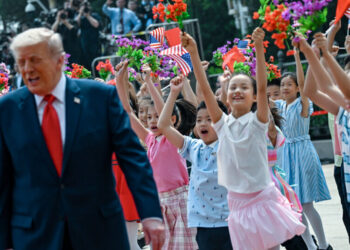
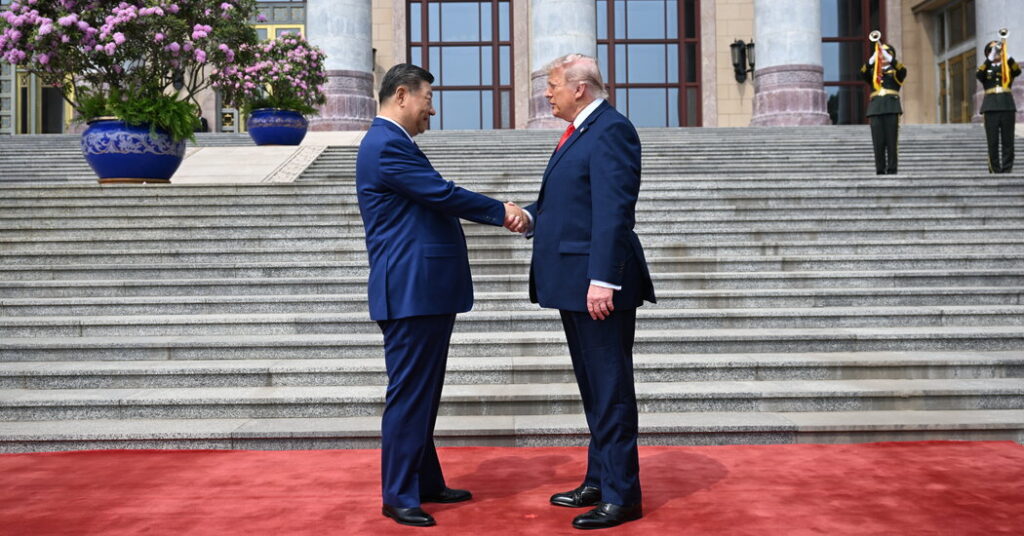
He trotted out the term throughout the summit, a visit designed to show Mr. Trump what friendship could look like between the two countries, with pageantry in the cavernous rooms of the Great Hall of the People, a private tour of the Temple of Heaven and talks inside Zhongnanhai, the secretive walled compound of the Chinese leadership.
In some ways, the Trump administration was already playing by China’s rules on this visit. The American president was largely deferential to Mr. Xi. Mr. Trump lavished him with praise and refrained from pushing back when the Chinese leader issued a warning to the United States about treading carefully on the subject of Taiwan, the self-governed island claimed by Beijing.
Redefining the terms of engagement
Mr. Xi spoke in lofty, abstract terms about what exactly constructive strategic stability entailed. He spoke of “cooperation” being a “mainstay”; “competition within proper limits”; “manageable differences” and “expectable peace.”
What that boils down to, said Xin Qiang, a U.S.-China expert at Fudan University in Shanghai, is the acknowledgment that competition is part of the relationship.
Despite that, the two countries can hold out hope that there are more reasons to cooperate than there are to clash. The summit underscored some of the ways in which they could potentially work together, such as combating the flow of fentanyl to the United States, setting ground rules for artificial intelligence and resolving the standoff in the Strait of Hormuz.
Is Washington on board with this?
China’s official summary of the meeting said Mr. Trump agreed to Mr. Xi’s new definition of the relationship. Though the White House made no mention of it in its own summary, Secretary of State Marco Rubio suggested in an interview with NBC on Friday that the Trump administration had endorsed the concept.
“One of the things the Chinese emphasize, which we agree, is strategic stability in our relationship, a constructive relationship, but also one that establishes strategic stability so that we don’t have misunderstandings that could lead to broader conflict,” Mr. Rubio said.
Just a few years ago, Beijing was vehemently opposed to a policy of the Biden administration called “managed competition” that has echoes of what Mr. Xi is proposing now. It entailed accepting that the two sides were rivals, but also imposing guardrails to prevent the relationship from veering into conflict. Beijing rejected that framework as a bid to contain China.
Why Mr. Xi is comfortable with the idea today could have much to do with the growing parity in power between China and the United States. Beijing feels as though it can no longer be pushed around by Washington after fighting the Trump administration to a draw during last year’s trade war by threatening to throttle global supplies of critical minerals needed to make modern technologies.
Why Xi is ready to talk
At the same time, confrontation with the United States does China no favors. Its economy has been stagnant for years because of a property crisis, and it cannot afford any disruptions to global trade, its chief engine of growth.
Mr. Xi is signaling that he wants to lock in the current stalemate so that the Trump administration will not interfere with his greater vision for China’s future: a country brimming with technological and industrial might poised to overtake a declining United States as the premier global power.
“For China, this phrase is about buying time and playing for advantage as Beijing tries to wait out the Trump administration,” said Evan Medeiros, a Georgetown professor who was senior Asia director on the National Security Council under President Barack Obama.
“China wants to manage what they see as gradual U.S. decline in the hopes of both expediting it but also making it as non-disruptive as possible,” he added.
China is playing the long game
The United States is no stranger to China’s attempts to frame the two countries’ relationship to its advantage.
Mr. Xi tried to sell Mr. Obama on what he called “a new model of great power relations” in 2013 that called on the United States to respect what China considers its core interests such as its claims to Taiwan and the South China Sea.
The Obama administration ultimately refused to endorse the concept, recognizing that it required ceding power in Asia and leaving allies and partners vulnerable.
“This is a classic Chinese move which they try to get the United States to agree to a framework as a way to bind Washington and set the terms of the bilateral relationship going forward,” Mr. Medeiros said of Mr. Xi’s latest attempt.
“These phrases are geopolitical quick sand,” he added. “Once you step in you cannot get out, and the more you try, the deeper you get pulled in by China.”
How China will use this reset
This is a reframing of the relationship, but on Beijing’s terms, said Shen Dingli, an international relations scholar in Shanghai.
China, for example, could later claim that the Trump administration had violated the tenets of constructive strategic stability by continuing to sell more arms to Taiwan.
“What China wants is for the China-U.S. relationship to be good and stable, but with the condition that China says, ‘I am the one providing the path and I am the one pointing the way,” Mr. Shen said.
Other Chinese analysts say a new framework is necessary to dampen the influence of China hawks in Congress, who threaten to derail the détente. There is also a fear that Mr. Trump could change his position on China after the 2026 midterm elections.
“The worry is always there. It’s something he’s quite known for,” said Dr. Xin of Fudan University.
Berry Wang and Pei-Lin Wu contributed reporting.
David Pierson covers Chinese foreign policy and China’s economic and cultural engagement with the world. He has been a journalist for more than two decades.
The post Xi Pitches His Vision for Avoiding a Superpower Collision appeared first on New York Times.