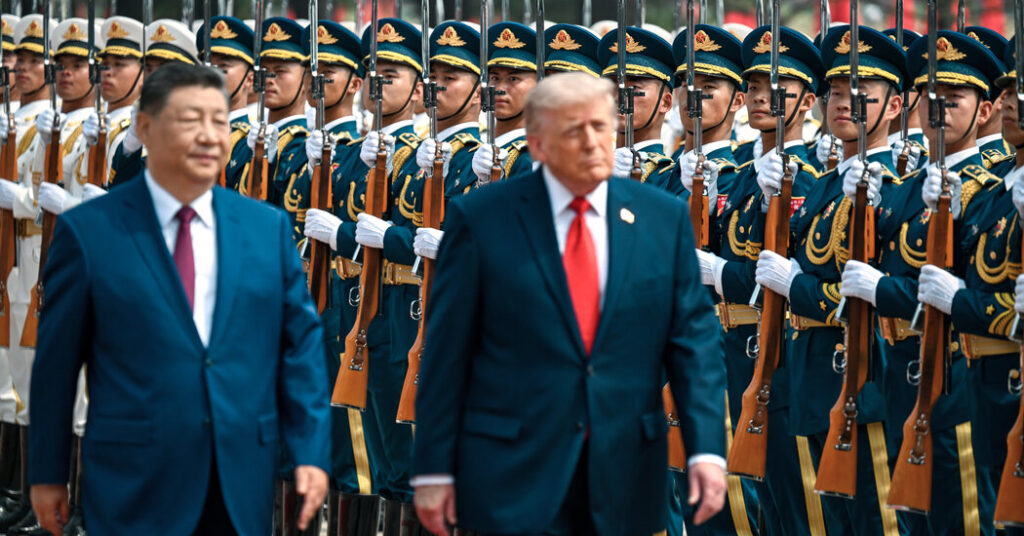
Oil prices jumped on Friday and stocks tumbled as the markets contended with persistent supply disruptions in the Middle East and the absence of meaningful breakthroughs at the summit in Beijing between President Trump and China’s leader, Xi Jinping.
The leaders of the world’s two biggest economies emphasized stability on Friday as their high-stakes talks ended. Mr. Trump said he had not asked Mr. Xi to pressure Iran to reopen the Strait of Hormuz because “I don’t need favors.” The president added: “I think he will. I think automatically he’d like to see it opened up.”
The strait, a narrow waterway that carries a fifth of the world’s crude oil, has remained effectively closed since the United States and Israel went to war with Iran in late February.
Oil prices climb again.
-
The price of Brent crude, the international benchmark, jumped more than 2 percent on Friday, to about $108 a barrel. Oil prices have climbed 50 percent since war broke out in the Middle East.
-
A barrel of West Texas Intermediate, the U.S. benchmark, rose about 3 percent to roughly $104.
Stocks tumble as tech rally fades.
-
The S&P 500 fell more than 1 percent after it opened on Friday. A strong rally in tech shares in recent weeks had sent the index to record highs.
-
In Asia, stocks fell broadly, led by a sell off in South Korea, where the benchmark Kospi index tumbled more than 6 percent. The Nikkei 225 in Japan and the Hang Seng in Hong Kong both fell nearly 2 percent.
-
The selling spread to markets in Europe. The Stoxx 600, a broad European index, declined more than 1 percent, as did the FTSE 100 in Britain. The DAX in Germany was down nearly 2 percent.
Gas prices remain elevated.
-
The average price of a gallon of regular gas held steady at $4.53 on Friday, according to the AAA motor club. Gas prices are up 52 percent since the war began.
-
Gas prices typically lag behind changes in oil prices by a few days.
-
The average price of a gallon of diesel fuel fell a penny to $5.66, 50 percent higher than when the war started.
What they are saying: Expect a “protracted energy shock.”
-
Markets have lost momentum because Mr. Trump has said the United States does not need the Strait of Hormuz to be reopened, analysts at Deutsche Bank wrote in a research note.
-
Mr. Trump’s comments have added to investors’ fears that the waterway will remain blocked for some time, which would lead to a “more protracted energy shock,” they added.
The post Oil Prices Climb on Fears of Broader Energy Crunch appeared first on New York Times.