There are luxuries Mike Ness is willing to pay for, and there are luxuries for which he’d rather find a workaround.
It’s a Monday morning in mid-March, and the 64-year-old frontman of Social Distortion is at his producer Dave Sardy’s studio in Los Angeles. Ness, whose band helped invent Orange County punk in the late 1970s, spends much of his time these days on California’s Central Coast, where he and his wife, Christine, bought a place years ago. Yet the couple recently became grandparents to a kid in L.A., which means they’ve been making frequent trips here.
“He’s 2 now, so we can’t be four hours from our grandson,” Ness says. “It’s clear to me that this is gonna be one of the most important relationships of my life.”
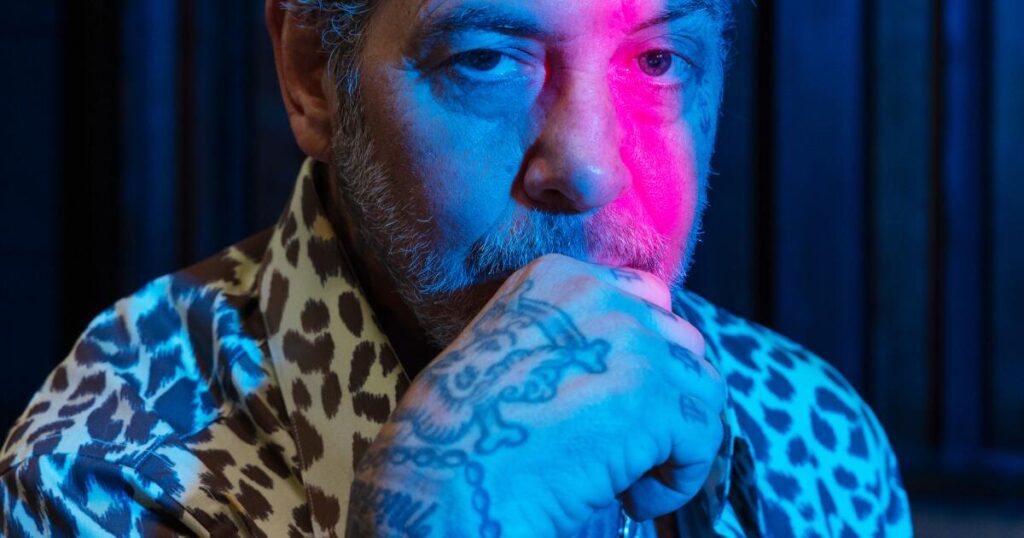
As he talks, Ness idly strums the latest addition to his collection of guitars: a 1956 Gibson Les Paul Custom that he says cost him $50,000. He’s wearing a silky leopard-print shirt open at the neck to reveal several gold necklaces and a tattoo of Christine’s name — one of five such shirts he had made to wear onstage every night during Social Distortion’s upcoming tour.
“What I really want to do is see if I can find some Dolce & Gabbana leopard-print fabric,” he says. “Then I’ll have a Dolce & Gabbana shirt without the heavy price tag.”
Christine, who’s been making coffee in the studio’s kitchen, enters the lounge and scoffs. “It’s not like they sell it by the bolt,” she says.
“I’m not gonna go to the Yarn Barn,” Ness replies. “‘Excuse me, can you please point me to your fine Italian fabrics?’” He laughs. “Someone’s gotta be able to get it.”
Hidden behind a rickety gate on a quiet residential street, Sardy’s studio is where Social Distortion — Social D to its many fans — recorded most of “Born to Kill,” the band’s first album in 15 years. The gap wasn’t intentional, says Ness, who runs down a litany of family upheavals that includes his older son’s drug problem, his younger son’s battle with depression and the death of both of his parents.
“Life just comes at you sometimes,” he says. “It wasn’t that I was in the French Riviera getting suntanned with Keith Richards.”
In talking about what took the album so long, Ness doesn’t even get to his experience with tonsil cancer, which required surgery in 2023. Yet “Born to Kill” thrums with the pent-up energy of a guy who glimpsed the possibility that he might not sing again.
Extending Social D’s blend of punk rock and American roots music, the LP features guest spots by Lucinda Williams and by Benmont Tench of the late Tom Petty’s Heartbreakers; it’s also got a rendition of “Wicked Game,” the sultry Chris Isaak hit previously covered by acts ranging from G-Eazy to Lana Del Rey.
“Is she the one that does ‘Summertime Sadness’?” Ness asks of Del Rey. “I love that song.”
Lyrically, Ness’ originals ponder a world on fire in an age of diminishing freedoms; “Partners in Crime” draws a comparison to the band’s hardscrabble beginnings, when Ness invited Dennis Danell, a classmate from Fullerton’s Troy High School, to join him in “fighting for what you believe,” as the song puts it. Danell, who learned to play guitar as a member of Social Distortion, died in 2000; today, Ness is the only founding member left in the group. (His bandmates are guitarist Jonny Wickersham, bassist Brent Harding and drummer David Hidalgo Jr.)
Asked whether he’s surprised to find himself still playing in a punk band in his mid-60s, Ness shrugs. “Not really,” he says. “Maybe it’s arrested development. Or maybe youth and rebellion are just part of my personality. They’re never gonna go away.”
Ness wrote the songs on “Born to Kill” before he was diagnosed with cancer but recorded his vocals after he recovered.
“It wasn’t my first brush with death,” says the singer, who struggled with a heroin addiction in the early ’80s. “But it was probably the most profound. I couldn’t even talk after surgery. I mean, I’m pretty sure they had my tongue out on a table.”
“No, they did not!” Christine pipes up. “This is urban lore in the making right now.”
“Then why is my tongue shorter?” Ness shoots back. The couple, who’ve been married for decades, have a daffy Lucy-and-Desi vibe. Christine shows me a video on her phone of the two dancing before a funhouse mirror during one of their antiquing excursions; Ness jokes that they’re considering pitching a reality series called “Happi-Ness.”
He picks up the story of his tongue: “They laid it out there and it was wiggling around,” he says, grinning before turning serious again. “I was on a tube feeder then a puréed diet for a couple months. Then speech and swallow therapy. Then a vocal coach.” He recalls celebrating Thanksgiving 2023 with his family at one of his sons’ home with a tour booked to start the following April.
“I told them — I remember saying it like it was yesterday — ‘If I’m singing by then, it’ll be a f— miracle,’” he says. “First day of rehearsal, I was super nervous because it was in front of the guys. But we started and it was like I got back on a bicycle.”
Brett Gurewitz, who released “Born to Kill” through his Epitaph label — and whose band Bad Religion played its first-ever show on a bill with Social D in 1980 at a warehouse in Orange County — describes the LP as “a record about survival — about hard-earned wisdom.”
Yet Gurewitz adds that the anger in the music reminds him of punk’s early days as America lurched rightward at the outset of the Reagan era.
Says Ness with a laugh of Donald Trump: “Look, I loved the guy in ‘The Apprentice,’ but as a president? No.” He’s troubled by what he sees as Trump’s threats to free speech — “It’s insanity,” he says — and by “a lack of empathy” that he thinks trickles down to average Americans.
“Mike’s music isn’t political but his stance is,” Gurewitz says. “I’m proud to work with him.” He may soon be prouder still: At Sardy’s studio, Ness says he’s been working on a song he plans to release in the run-up to this fall’s midterm elections.
Before that, Social D will crisscross Europe and the U.S. starting next month (including two shows in October at the Hollywood Palladium). Four decades after the band broke out with albums like “Mommy’s Little Monster” and “Prison Bound,” the scene backstage can be pretty boring, Ness admits.
“You can see the look of disappointment when someone comes back,” says the singer, who got sober around 1985. “At noon, the gear comes out of the truck and they turn it into a boxing gym. I’ll do a good hour workout no matter how hot it is. Then before the show we’ll get the blender going for some smoothies.”
Yet as soon as he steps onstage, the adrenaline still surges like it always has.
“It makes me think of seeing this guy Ronnie Dawson — they called him the Blond Bomber back in the day — at the Palomino like 30 years ago,” Ness says, referring to the legendary country joint in North Hollywood. “He must have been 67 or 68 at the time, but he had more energy than a 25-year-old.”
In fact, Dawson would only have been in his mid-50s in the early ’90s.
Ness laughs. “Well, look at me now,” he says.
The post Social Distortion is the job Mike Ness can’t quit appeared first on Los Angeles Times.