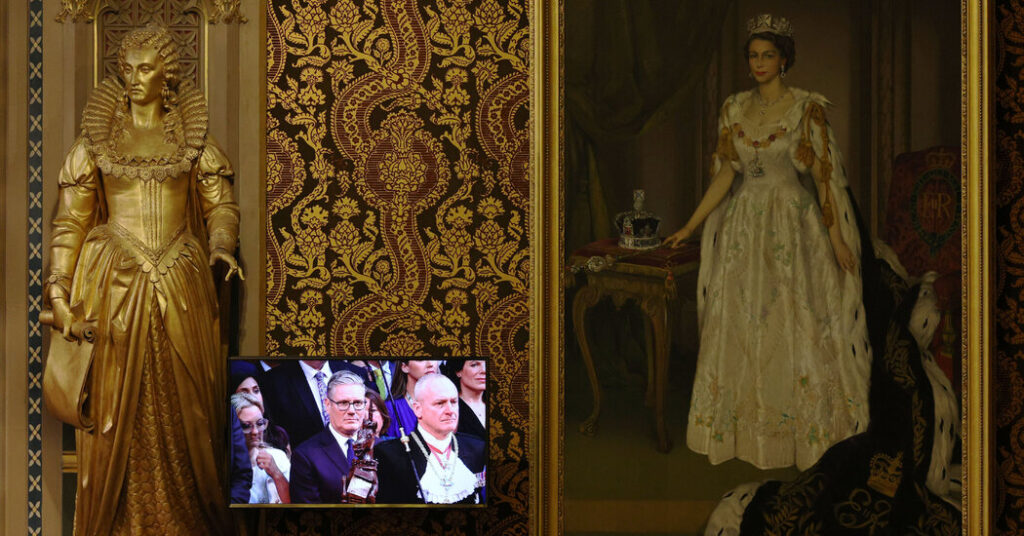
On the face of it, the British prime minister, Keir Starmer, is one of the most inoffensive politicians imaginable. A middle-of-the-road social democrat who believes in human rights, international law and public services, and who, as prime minister, has not overseen a major calamity abroad nor a recession at home.
And yet, in less than two years in power, having won a landslide general election victory in 2024, Mr. Starmer has become so viscerally disliked in Britain that he is a figure of open contempt. Over the last week, the mood in Westminster soured with astonishing speed. Almost 100 Labour lawmakers have publicly called on him to resign. Most of his cabinet has lost confidence in his leadership. And by Thursday the leading contenders to replace him were taking their positions. The health secretary, Wes Streeting, resigned with a blistering letter; and Andy Burnham, the popular mayor of Manchester, confirmed that he’d seek to return to Parliament in a by-election in order to challenge for the leadership.
Why has this most mild-mannered of countries turned so quickly on this most mild-mannered of leaders? For some, the rebellion against Mr. Starmer, which began after his Labour Party suffered a disastrous set of midterm elections last week, is a sign of a country that has taken leave of its senses. It is certainly true that Britain is currently burning through leaders at a rate that would have been seen as absurd for much of the 20th century. Since the Brexit referendum in 2016, Britain has had five prime ministers, with a sixth seemingly just around the corner.
There are many theories as to why Britain has entered this accelerating spiral of disorder, which threatens to completely remake the political map by destroying the two-party system that has dominated British politics since 1945.
Some point to the pandemic and its aftermath: the inflation that cost incumbent governments elections across the world and tanked the popularity of those that followed. In Germany, the Starmer-like chancellor, Olaf Scholz, was dispatched from power last year only for the popularity of his replacement, the conservative Friedrich Merz, to collapse soon after. Britain, in this telling, is suffering from an intense strain of political long Covid.
A second explanation is that Britain continues to elect prime ministers who are utterly unsuited to the job. Theresa May, who became leader of the Conservative Party and prime minister soon after the Brexit referendum, was a serious politician who lacked the dexterity, nous and charisma to lead the country in the direction she believed was right. These deficiencies cost her the general election of 2017. Her successor, Boris Johnson, had the dexterity, nous and charisma but not the seriousness. Things only deteriorated from there. Liz Truss — who served just under 50 days — proved herself catastrophically ill-suited to power, sending markets spiraling in her first act as prime minister when she promised tax cuts Britain could not afford. That left her successor, the capable Rishi Sunak, with the almost impossible task to restore the Conservative Party’s fortunes.
Though he is the first Labour prime minister on this list, Mr. Starmer could be understood as just the latest in a long line of duffers. Like Ms. May and Mr. Sunak before him, he is a competent professional, but his flaws are, if anything, more pronounced. Mr. Starmer has never known what he wanted to do in the job. He did not arrive in government with a plan or a theory for why things had gone so badly wrong before him. As he told me in interviews for the New Statesman a little less than a year ago, he did not believe the country was in need of overhaul; the basics of the British state and its economy were broadly sound, he said. Britain just needed serious people committed to making serious decisions in the long-term national interest. Then investment would pour into the country, the economy would grow, living standards would recover and sanity would prevail. Mr. Starmer, in a fundamental sense, wanted to take the politics out of being prime minister. In an easier climate, this might have sufficed. Perhaps. But not today. Politics is king.
Britain’s troubles are deeper than post-pandemic blues and an unlucky run of leaders. Our current political volatility is a reflection of an economic and a geopolitical upheaval that has been playing out for almost 20 years. At the turn of the 21st century, Britain looked as if it had all the answers for the new world being born. It was in the European Union, but not its troubled single currency; close to the world’s only super power but less scarred than America by divisions of race and wealth. Britain had gotten the pain of deindustrialization out of the way early and was well placed to prosper as an English-speaking, open, liberal economy in the globalized world. The political project of Tony Blair, Britain’s Labour prime minister from 1997 to 2007, was built on those assumptions.
In 2008, a year after Mr. Blair’s retirement, the Blairite political economy collapsed. The City of London imploded, the banks were bailed out and the government deficit ballooned. In 2010, the Conservatives, with David Cameron as leader, were elected to balance Britain’s books. Mr. Cameron did not believe the economy needed radical reorientation, but when the global financial crisis metastasized into the Eurozone crisis and immigration from the continent increased, public consent for Britain’s membership in the European Union began to deteriorate. To protect Britain’s place in the bloc — and its economic model — Mr. Cameron gambled on an infamous referendum and lost. Over the course of eight years, Britain had watched both its political economy and its place in Europe blow up.
Brexit is both a source and symptom of Britain’s current era of political turmoil. The referendum cut across traditional party lines, shattering the old electoral coalitions. But these coalitions were already fraying from years of high immigration and stagnating living standards. The decade since Brexit has been one long, painful process of trying — and failing — to make sense of this new reality. The old certainties are gone, but nothing has been found to replace them. Britain is outside the European Union, but intimately connected by geography, trade and interests. The special relationship with the United States appears to be deteriorating, and yet it remains the cornerstone of Britain’s security. Britain’s energy security is threatened by the upheaval in the Middle East, with no alternative ready to go. Economically, the certainty that once existed about an ever more open, globalized world order has vanished.
The result is party politics that looks as lost for answers as the country feels. No government seems to know what to do or how to do it. Each has tried, in its own way, to retrieve the old world Britain knew and understood. Each has failed. Naturally, parties demanding radical change are surging in popularity, further destabilizing the old order. On the left, the Greens want wealth taxes at home and a newly skeptical approach to NATO. On the right, Reform U.K., which had the largest gains in last week’s elections, wants ICE-style mass deportations and to withdraw the country from the European Convention on Human Rights.
As of yet, neither of these parties has enough support to succeed on its own. In Wales, Scotland and Northern Ireland, the largest parties are nationalists in favor of leaving the United Kingdom, but they lack the support to actually secede. In London, backing for the insurgent parties is growing, but is not large enough for them to win outright — not yet.
Everything has changed, and everything remains the same: stuck. Whether Mr. Starmer stays or goes — and he’s not likely to stay — instability is now baked into British politics. Britain is searching for a new way to pay its way in the world. Until it finds it, the unhappiness of the country will find its outlet in the unpopularity of its political class.
Tom McTague is the editor in chief of the New Statesman magazine and the author of “Between the Waves: The Hidden History of a Very British Revolution 1945-2016.”
The Times is committed to publishing a diversity of letters to the editor. We’d like to hear what you think about this or any of our articles. Here are some tips. And here’s our email: [email protected].
Follow the New York Times Opinion section on Facebook, Instagram, TikTok, Bluesky, WhatsApp and Threads.
The post Keir Starmer and the End of the Old Certainties appeared first on New York Times.