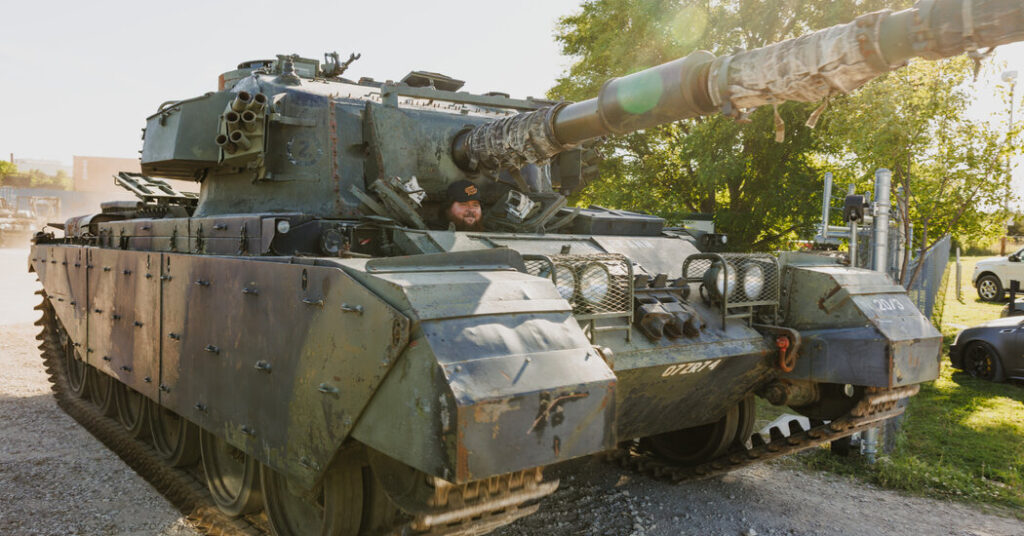
Westen Champlin, an auto enthusiast and YouTube personality in Kansas, owns a tank. Specifically a 1962 Centurion battle tank. It can’t fire anymore, but it sports a power-operated turret, periscopes and a beefy Rolls-Royce Meteor V12 engine. It seats four.
“I was raised on a farm,” said Mr. Champlin, 27, whose YouTube channel has 5.3 million subscribers who tune in for his auto stunts and more, akin to a backwoods “MythBusters.” “Big equipment has always been interesting to me.”
The tank wouldn’t start, but he paid $130,000 for it, winning it in an online auction via Bring a Trailer, a site where military vehicles make regular appearances: Humvees and ambulances, tanks and Jeeps, the occasional plane.
Now that the tank is running, its chief use is as a showpiece. Mr. Champlin said it’s “just a big tractor” that he breaks out for parades and “doing cool stuff” with.
Bring a Trailer got its start in 2007 as a blog that posted interesting cars for sale. The site’s auctions section was created in 2014, posting a few cars weekly, said Randy Nonnenberg, its president and a co-founder.
Last year, it hosted just under a thousand auctions a week, including classic cars, memorabilia and military gear, said Howard Swig, the head of auctions for the site, which has over 1.7 million registered users.
Robert Dietz, 43, has sold tanks, including one like Mr. Champlin’s, and hundreds of other decommissioned military vehicles on Bring a Trailer via his business, WOB Cars. “The money is almost beside the point,” said Mr. Dietz, who added that he had “always had a deep, personal interest in World War II armor and military memorabilia.”
“What matters most to me,” he said, “is connecting a real piece of history with a collector who is going to research it, preserve it and share it.”
Some of these owners are collectors. Others put their equipment to work. In Washington State, Branden Powell, who goes by Ben and is the president of King County 4×4 Search & Rescue, owns a Swiss Army 1972 Pinzgauer 710M.
Mr. Powell in 2011 was on a rescue mission for an injured person on a rough trail to Goldmyer Hot Springs in the foothills of the Cascade Mountains. His custom Jeep, even outfitted for search and rescue, was not up to the task. His four-person team had to squeeze, uncomfortably, into that Jeep.
“While we got the job done,” he said, “it exposed just how poor of a fit the four-door Jeep was for doing search and rescue.” He hunted for something to tackle tight trails but still carry six-plus people and their gear.
The Pinzgauer cost $24,000 — and is now in use after spending most of its post-military life garaged in Southern California, maintained by Fat Fabrications, which specializes in Pinzgauers.
“It’s really difficult to know what you can expect from any old military vehicle,” Mr. Powell said. “They were built for purpose. When you buy one, you aren’t the person or purpose the vehicle was designed for.”
Mr. Powell’s Pinzgauer is believed to have originally been a troop transporter or cargo carrier for the Swiss Army. Now, outfitted with custom storage and critical communications systems, it’s part of Washington State’s all-volunteer search-and-rescue program.
While some former military vehicles are deployed in the field, others just need to look ready for combat.
In Savannah, Ga., Thomas Carlson turns them into props for Basecamp Creative Group, a business specializing in military-minded marketing that he and his wife, Molly Carlson, founded.
They work with brands across the industry, including maritime manufacturers like SAFE Boats International, tactical gear companies such as Ferro Concepts, and makers of night vision equipment and body armor.
Mr. Carlson said active military units are “not permitted to endorse or directly collaborate with private companies in a way that could suggest favoritism.” So brands often need to recreate realistic scenarios for ads. That’s where Basecamp comes into play.
Mr. Carlson, 40, bought two former Marine vehicles from Gov Planet, a site that auctions off surplus military items. He paid around $23,000 for his Humvee and roughly $33,000 for a Polaris military MRZR.
“A word of caution, buying off government auction sites: You don’t know what you’re going to get,” he said.
He sank about $25,000 more into his Humvee to make it reliable. If “people aren’t mechanically inclined,” he said, “I’d suggest they buy one that’s already been restored.”
His 4-year-old son, Trent, is always eager for a ride in the vehicles, even if it’s just a trip to the garage from the driveway, and Mr. Carlson takes him to Cars and Coffee events in the Humvee.
“As he gets a little older, I think it’ll be a great way to teach him about vehicle maintenance, responsibility and the things that go into maintaining a normal vehicle or Army truck,” Mr. Carlson said.
“I’ve volunteered on several occasions for career days at underprivileged inner-city schools,” he added, teaching students about video cameras and drones. The Army truck is a frequent prop, and he shows how he uses the vehicles for photo shoots.
“Most of them have never seen an Army truck close up, so they get pretty excited,” he said of the students. “I let them sit in the driver’s seat, climb around on it and take photos with it.”
Sometimes people who served in the military want to bring a slice of their experience with them. Matt Verley, a former Navy nuclear electronics technician and reactor operator and instructor, served on aircraft carriers and submarines.
Mr. Verley, who is 48 and lives in Oregon, also has a popular YouTube channel, which he started while buying surplus military equipment.
He owned a 1971 M35A2 cargo truck, commonly called a Deuce and a Half, which he “stumbled across” at a wrecking yard in Willamina, Ore. He paid $1,800 for the vehicle, equipped with an SF-97 government title and “not much else,” he said.
“I drove it weekly,” he added, “to my local jujitsu gym, into town for parts, to the fire department for weekly training, et cetera.”
He upgraded his Deuce over 10 years, including a custom flatbed with integrated 10-foot ramps for loading vehicles, LED lighting, winches, locking axles, full-hydraulic steering, a bespoke front bumper and engine monitoring gauges.
“I sold it to somebody who used it as a daily commuter for about two years,” he said, adding, “Then he road-tripped it to Texas and sold it.” He still keeps in touch with the current owner.
In Sheridan, Ore., every year, an event called Northwest Mogfest showcases European megatrucks like Unimogs, Haflingers and Pinzgauers. Chris DeLong of Washington State was introduced to this scene by a friend.
“The Haflingers were my first poor choice,” he quipped. His first two vehicles were from Switzerland, and he kept a military-issued one.
For Mr. DeLong, 51, the owner of an automotive performance and maintenance shop, Fine Tuning, the interest dates back even further.
“My dad had a 1956 Volkswagen Beetle when I was 6 years old,” he said. “It was the coolest thing to load groceries in the front of the car, not the back, particularly at the North Tacoma Piggly Wiggly.”
In 2024, Mr. DeLong bought a 4×4 MAN truck, originally from the Danish military. It was outfitted with a crane, an onboard air compressor and a three-way winch.
“The MAN was a fairly easy import,” he said, “aside from the U.S. military putting it on hold to make sure it didn’t have some secret technology from 1989 I was trying to ‘smuggle’ into the United States.”
He uses it to log his family’s 31-acre undeveloped property and for “scaring other drivers, thrilling children and getting me to work,” he said.
Mr. DeLong said taxes for former military vehicles were putting them out of reach. But he has other ideas, he said: “Fire trucks are exempt.”
The post Backyard Battalions appeared first on New York Times.