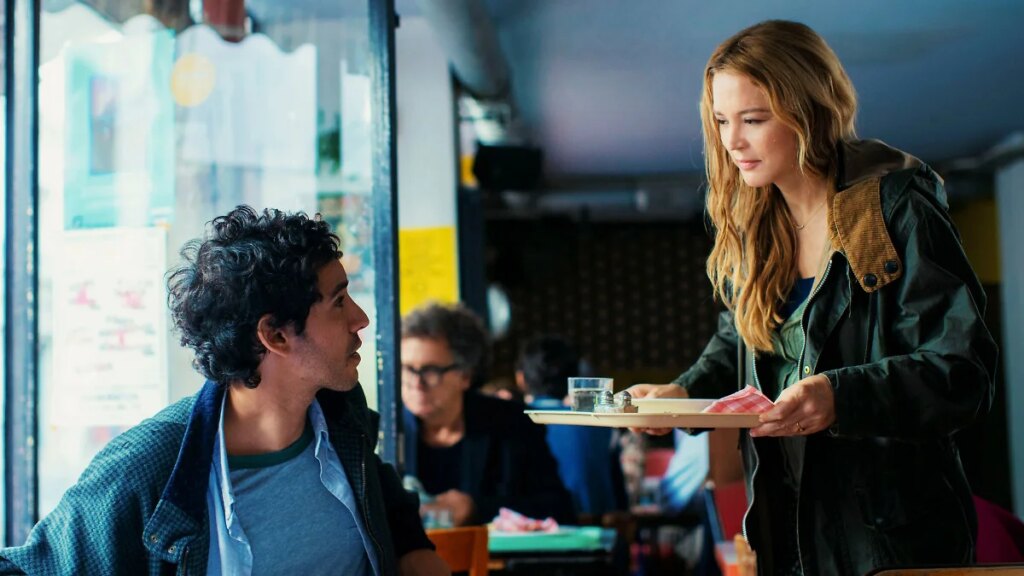
Director Asghar Farhadi’s “Parallel Tales (Histoires Parallèles)” features plenty of rear window spying and voyeuristic uses of audio equipment, but despite easy comparisons to the works of Hitchcock, Coppola, and De Palma, the Iranian director has crafted a treatise uniquely his own about the messy entanglement of unspoken fantasy and embodied life.
It’s a story about people who speculate about the lives of the people around them and, by feeding those conceits back into the world in the form of the written word and sound, are able to alter the course of reality itself. But despite being impressively acted and thematically compelling, it avoids wholehearted recommendation due to its uneven repetition of sequences and ideas that make this feel more lugubrious than cohesive.
The catalyst (critically, not the origin) of the relational, psychological and sexual mischief that follows is thanks to Isabelle Huppert’s recluse writer character, Sylvie. Huppert plays Sylvie with the curmudgeonly charm we’d come to expect of this archetype (in one sequence in the absence of a working lighter, she uses the toaster to ignite her cigarette) and it’s evident that while her house may be in disarray, much to the chagrin of her niece, Laurence (India Hair), it’s in service of her imagination, which is sharp and teeming.
As part of her ritual, she spies on the trio of sound engineers across from her house — Nita (Virginie Efira), Théo (Pierre Niney), and Nicolas (Vincent Cassel) — and develops her latest story about their dynamic. She imagines that Nita (named Anna in her story) and Théo (named Christophe) are in a relationship, but that Nita and Nicolas (named Pierre) begin to have an affair, threatening not only their professional but also their personal lives as a vengeful and unstable Christophe plans his revenge.
At her niece’s insistence, Sylvie accepts help around the house from Adam (Adam Bessa), whom Laurence encountered by chance when he stopped a pickpocket from stealing her wallet. As Adam helps clean the clutter, he develops a kinship with Sylvie and finds himself enthralled by the story she has written about their neighbors. Taking up her telescope for himself, he too begins to spy on the trio and becomes obsessed with finding out whether there might be any truth to Sylvie’s speculation about their interactions or if it is all truly just fantasy.
Of course, at least at the start, the truth is much less interesting than fiction: Théo and Nicolas are brothers, Nita is not a prurient muse but a worn-down worker who barely has time to eat lunch during intense work days, and the most she’s allowed to exert her autonomy is through her journal entries. Still, there’s a tantalizing power to projection, and as Adam pushes himself further into their orbit, it becomes clear that there may be more truth to Sylvie’s stories than was on the surface.
Given the film’s protracted runtime and that Farhadi indulges in repeating certain beats to underscore the synergy with earlier scenes, it can feel tedious to go through since we know which characters hold secrets, and the film takes its time to bridge that gap.
Most of the performers assembled have the opportunity to play more than one character due to Farhadi’s crosscutting of the action, which shows what’s going on in the real world with reenactments of Sylvie’s words. Farhadi trusts the ensemble he’s crafted, and that faith is felt most in the moments where the perspective switches to a handheld camera and he documents his actors’ natural reactions to exposed secrets and hidden revelations. Each performer holds pregnant silence strikingly, showcasing how hurt and shame aren’t interior emotions but feelings that brand themselves in the flicker of our eyes or the wrinkles on our brow.
Farhadi also makes interesting parallels between the vocation of the sound engineer and the power of the writer. As we witness the trio work, from Nita crunching and stroking celery to mimic the sounds of these animals eating to Théo slapping a bowl of water whenever the animals on screen stomp through a puddle, they’re creating sounds and passing them off as other audio. They make associations and connections between things that have nothing to do with each other, not unlike the imaginative work of writers.
In many ways, Farhadi is dealing with himself as a creative, and what it means to steward the lives of those we know, those we meet in passing and also those whom we may never see. From writers who take anecdotes and spin them into novels to sound engineers who take one sound and overlay it on another, these characters are all adults playing telephone. The result isn’t just a wrong sentence but a changed life.
While there’s an intoxicating draw in filling new details into the contours of people we barely know, Farhadi seems to understand that this needs to be done responsibly. As Nita, Théo, and Nicolas’ lives begin to more and more resemble what Sylvie has written, it’s an apt reminder: art imitates life, but how we live our one precious and wild lives is often inspired by art. We ought to be mindful of the stories and sounds we put out into the world.
The post ‘Parallel Tales’ Review: Asghar Farhadi Reckons With Being a Steward of Stories Real and Imagined appeared first on TheWrap.