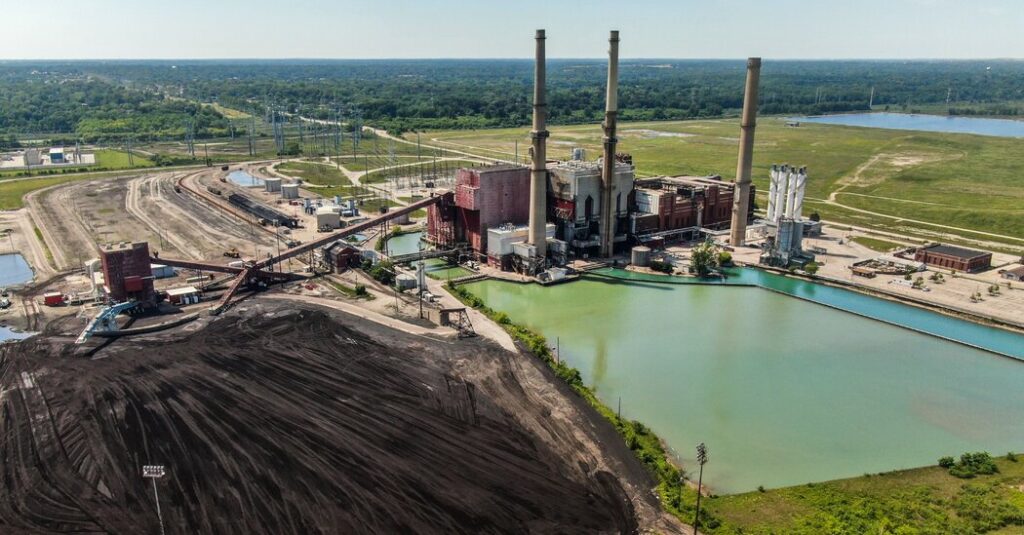
The Environmental Protection Agency on Thursday proposed to repeal a Biden-era rule that prevents coal-burning power plants from releasing hundreds of millions of gallons of toxic metals into nearby waters.
The rule, issued in 2024, imposed the strongest-ever pollution limits on wastewater from U.S. coal plants. It requires plants to do more to filter metals such as arsenic, mercury and selenium from their wastewater before releasing it into nearby lakes, rivers and streams.
Lee Zeldin, the E.P.A. administrator, said in a statement that the regulation was difficult, if not impossible, for many coal plants to meet. He said that repealing the rule would prevent coal plants from shutting down and depriving data centers of much-needed electricity.
“The A.I. and data center revolution is creating an electricity and baseload power demand that cannot be met under the overly restrictive policies of past administrations,” Mr. Zeldin said. “The Trump E.P.A. will continue doing its part to address these burdensome regulations on the coal-fired power plant sector that hold American communities back.”
The proposal was the latest attempt by the Trump administration to help the U.S. coal industry, which has struggled to compete with an influx of cheaper natural gas and renewable energy sources such as wind and solar power.
In recent months, the administration has ordered units at five aging coal plants to stay open instead of shutting down as planned, an effort that has cost hundreds of millions of dollars. It has also weakened limits on hazardous air pollution from coal plants, a move that has led to more emissions of mercury, a powerful neurotoxin.
The 2024 rule required coal plants to clean up their wastewater as soon as possible, but no later than Dec. 31, 2029. It effectively gave coal plants up to five years to design, permit and install new pollution controls or wastewater treatment systems.
The Biden administration had estimated in 2024 that the rule would prevent the release of roughly 584 million pounds of pollutants each year. It had predicted that complying with the regulation would cost plant operators between $140 million to $155 million annually.
In a news release on Thursday, though, the E.P.A. said that repealing the rule would “reduce electricity generation costs by as much as $1.1 billion annually,” leading to cost savings for consumers and businesses. An E.P.A. spokeswoman did not immediately respond to questions about how the agency calculated the $1.1 billion figure.
Coal industry groups applauded the announcement.
“The industry is focused on supporting affordable and reliable electricity generation, while protecting our nation’s water resources; the prior rule resulted in early coal retirements that raised electricity prices and harmed grid reliability,” Tawny Bridgeford, the general counsel and senior vice president for regulatory affairs at the National Mining Association, said in a statement.
Environmental groups sharply criticized the move, saying it would harm the health of poor neighborhoods and communities of color that are disproportionately located near coal plants and other sources of industrial pollution. They also said the proposal appeared to undermine the goals of the “Make America Healthy Again” movement led by Robert F. Kennedy Jr., the health secretary.
“E.P.A. is proposing to strip away protections that keep mercury and arsenic out of our drinking water — with no credible scientific or legal justification,” Patrick Drupp, the climate policy director at the Sierra Club, said in a statement. “An administration that claims to want to ‘Make America Healthy Again’ just made it easier for coal plants to poison our water.”
The E.P.A. will solicit public comments on the proposed rollback for 30 days. Then the agency will work to finalize the proposal, likely within the next year.
In the coming weeks, the E.P.A. is also expected to relax limits on some types of perfluoroalkyl and polyfluoroalkyl substances, or PFAS, in drinking water. These compounds are often called “forever chemicals” because they do not break down, lingering in the environment and accumulating in the human body. They are linked to an array of health problems, including liver disease and certain cancers.
Maxine Joselow covers climate change and the environment for The Times from Washington.
The post E.P.A. Moves to Weaken Water Pollution Rule for Coal Plants appeared first on New York Times.