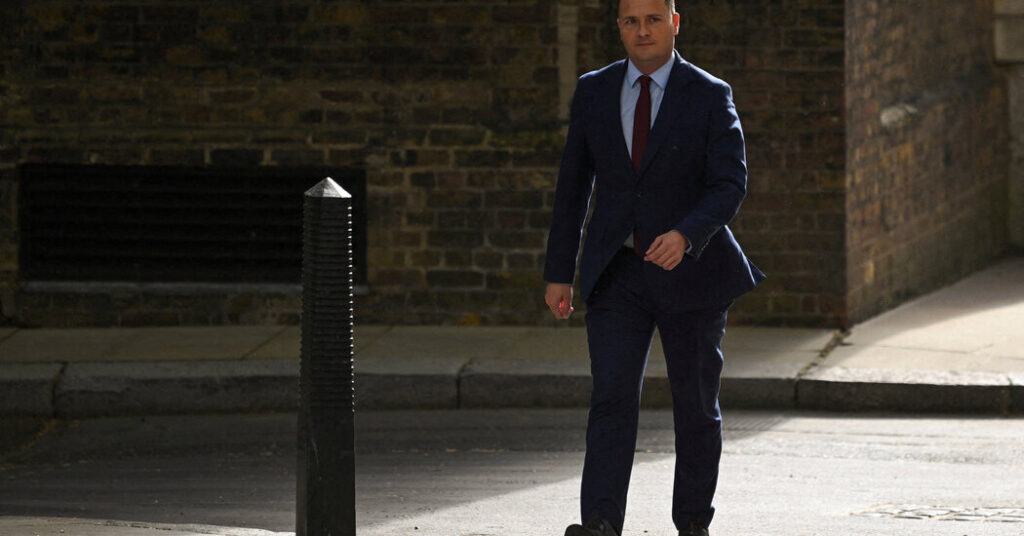
Wes Streeting, the British health secretary, resigned from the government on Thursday, issuing a stinging indictment of Prime Minister Keir Starmer’s premiership and calling for a broad Labour Party contest to replace him as the country’s leader.
“Where we need vision, we have a vacuum. Where we need direction, we have drift,” he wrote in his resignation letter, which he posted to X. “The heavy-handed approach to dissenting voices diminishes our politics.”
Mr. Streeting called for a wide-ranging debate inside the party to replace Mr. Starmer, who is 22 months into a five-year term in office. He said a leadership contest should be a “battle of ideas, not personalities or petty factionalism,” and that a wide range of candidates should participate.
Mr. Streeting said his record as health secretary offered reasons to stay in his post, but added that “having lost confidence in your leadership, I have concluded that it would be dishonorable and unprincipled to do so.”
The move was the most significant declaration of no-confidence in Mr. Starmer since the Labour Party was plunged into turmoil one week ago in the wake of devastating losses in elections across the country. Close to 100 lawmakers and several junior government ministers have called on the prime minister to step aside.
Mr. Streeting’s actions escalated months of doubt about Mr. Starmer’s leadership into a political crisis for the prime minister and his team. On Tuesday, the prime minister had vowed to fight any challenge to his leadership and dared rivals in his cabinet to run against him if they had the nerve to do so.
Mr. Streeting’s resignation ended days of speculation about his intentions. But he did not announce an immediate leadership challenge, suggesting that he had not yet gathered enough support from his colleagues to trigger a leadership contest in the Labour Party.
Under the party’s rules, a challenger needs the endorsement of 20 percent of all Labour members of Parliament, which equates to 81 Labour lawmakers at present.
In his resignation letter, Mr. Streeting hinted that he expected a leadership contest to take place, but did not say he had the support for it to happen.
“It is now clear that you will not lead the Labour Party into the next general election,” he wrote. He said a party contest to change prime ministers “needs to be broad, and it needs the best possible field of candidates. I support that approach and I hope that you will facilitate this.”
His reference to the “best possible field of candidates” was seen by many political observers as a reference to Andy Burnham, the popular left-leaning mayor of Greater Manchester who is seen as a strong contender in any future contest.
But party rules say leadership candidates must be members of Parliament, which means that Mr. Burnham would have to run for an open seat in Parliament and win, a process that could take several months.
In his letter, Mr. Streeting seemed to be endorsing a contest that would not take place until after Mr. Burnham had the chance to make his way back to Parliament. That could help ease the suspicion among many of Mr. Burnham’s supporters that Mr. Streeting had been plotting a leadership challenge that would block Mr. Burnham from participating.
Other rivals inside the party could also jump into the race.
Al Carns, a former marine who is now in Parliament and is viewed as another possible candidate, wrote in The New Statesman on Thursday that “we do not need more slogans, strategies, press releases or commissions. We need action.”
Angela Rayner, the former deputy prime minister in Britain, could potentially decide to challenge Mr. Starmer after announcing Thursday that she had been cleared of any wrongdoing after she failed to pay the correct tax rate when she bought a seaside apartment.
Ms. Rayner is a popular politician on the left of the Labour Party and has been viewed in the past as a possible leadership candidate. But she has not said directly that she intends to challenge Mr. Starmer and she voiced her support for Mr. Burnham earlier this week.
In a statement after the party’s dire election results last week, she said that “Labour exists to make working people better off. That is not happening fast enough, and it needs to change — now.”
The possibility of a leadership clash plunges the Labour Party into a place they assured voters they would not be — a chaotic power struggle of the kind that consumed the Conservative Party for its final years in power.
When he was elected in the summer of 2024, Mr. Starmer promised stability and calm.
But saddled by a sluggish economy, the prime minister flip-flopped on a series of policy approaches, earning a reputation for weakness and indecision. He was fiercely criticized for months for appointing Peter Mandelson to be ambassador to the United States despite knowing of Mr. Mandelson’s relationship with Jeffrey Epstein, the convicted sex offender.
It was last week’s elections that accelerated the political crisis for the prime minister. Labour candidates were defeated in local municipal elections across England and were trounced in contests for the devolved parliaments in Scotland and Wales. Taken together, it was the worst set of local elections for Labour in more than 100 years.
In a speech on Monday, Mr. Starmer said he took responsibility for the results, but insisted that resigning to address the anger and frustration expressed by voters would be damaging for the country.
“This hurts, not just because Labour has done badly, but because if we don’t get this right, our country will go down a very dark path,” he said in that speech. “So just as I take responsibility for the results, I also take responsibility for delivering the change that we promise for a stronger and fairer Britain that we must build.”
Michael D. Shear is the chief U.K. correspondent for The New York Times, covering British politics and culture and diplomacy around the world.
The post Wes Streeting Resigns and Calls for Leadership Contest to Replace Starmer appeared first on New York Times.