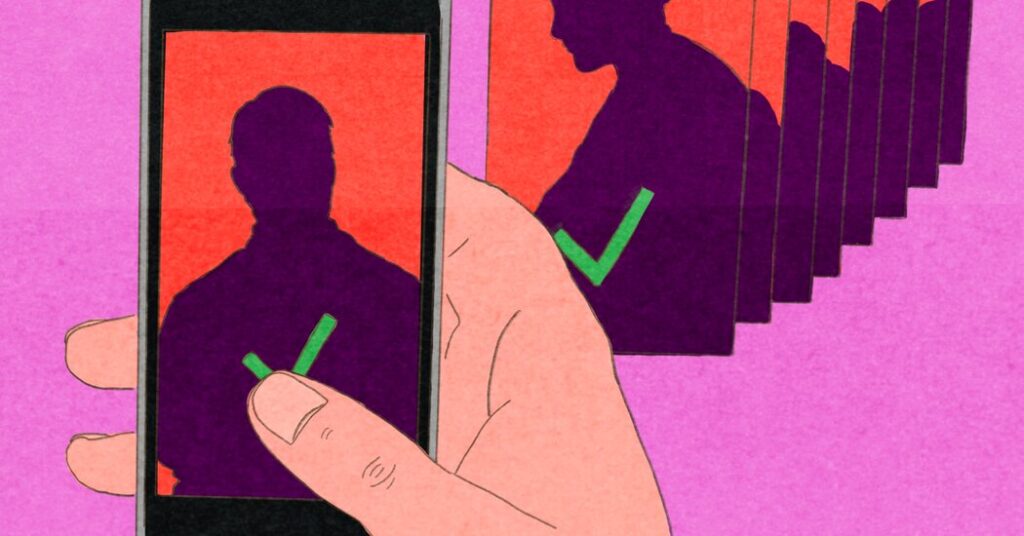
Shefa Ahsan, 29, thinks online dating is a slog for many reasons. Writing a profile is tedious and confusing. Which photos should she post? Which brief anecdotes should she share to convey who she is and what she’s all about?
Then there’s the relentless swiping. Ms. Ahsan finds the process “dehumanizing,” she said.
“People’s faces pop up, and you have to just swipe?” she said. “I can’t do that. I don’t know anything about them.”
Bumble made headlines last week when it announced plans to kill off the swipe feature and shift toward matchmaking driven by artificial intelligence, a move meant to address rampant dating-app fatigue.
Bumble didn’t pioneer the swipe (Tinder did), but as one of the most popular dating apps on the market, its decision to eliminate swiping could alter the dating habits of millions of users who have grown used to vetting partners with the flick of a finger.
“Swiping primes people to make superficial, snap judgments,” said Jenny Taitz, a clinical psychologist and author of “How to Be Single and Happy,” who has written for The New York Times. “It really has turned dating into gaming.”
But what is the alternative?
Burned out on swiping
Over the past few decades, dating apps have transformed how Americans hunt for love. Three in 10 adults in the United States say they have used them at one point or another, according to the Pew Research Center — many successfully. One in 10 committed relationships now starts online, Pew also found.
Still, dating app burnout has become rampant. A 2024 Forbes survey found that nearly 80 percent of daters felt emotionally, physically or mentally exhausted by the apps at least some of the time. Swiping is not the sole culprit, but experts say it can certainly contribute to the existential fatigue some daters feel.
Kelsey Wonderlin, a licensed therapist and dating coach in Nashville, says she sometimes sees her clients get caught up in a kind of frenzied state of swiping left to reject matches.
“People don’t really see each other as real humans on the apps,” she said.
Perhaps surprisingly, she will sometimes encourage her overwhelmed clients to swipe right liberally, then promptly send those potential matches a “weed-out” question to get a more meaningful conversation going. (For example, “What’s something you’ve done lately that you’re proud of?”) The goal, she said, is to move away from the more gamelike aspects of the apps and into actual connection.
“Swiping was great for people at first,” Ms. Wonderlin said, noting that the technology was efficient and decisive. “But over time, what I hear from a lot of people is that it’s inundating, and it just creates this sense of disposability.”
Hopes for more ‘intentional dating’
Bumble plans to move away from swiping and lean further into A.I. — much like nearly every other dating app looking to harness the technology to make users stay and revive profits.
The company is testing an A.I. assistant it calls “Bee” aimed at understanding things like users’ values and relationship goals, then suggesting matches and explaining the rationale behind those matches, the company says.
There is reason for the app to shake things up. Bumble and other dating sites have struggled in recent years; it reported a 14 percent drop in total revenue and a 21 percent decline in paying users for the first quarter of the year, compared to the same period in 2025.
Bumble’s new feature may change the way users physically interface with the app, but it remains to be seen whether it will meaningfully change the user experience.
“A lot of these companies think that A.I. is going to save their apps, or change the dating experience,” said Kathryn Coduto, an assistant professor of media science at Boston University who studies online dating. “I think that users are actually very hesitant about that. It goes to concerns about privacy. People don’t know how A.I. is going to use their data.”
Daters already have concerns about how dating app algorithms work and whether they treat users fairly, she added.
“I do think there is something to be said for moving away from the swipe feature, because people do want a more intentional dating experience,” Dr. Coduto said.
Lately, the idea of dating intentionally has gathered buzz, as daters crave an experience that feels less overwhelming and more purposeful. Dating apps are betting A.I. can help bridge the gap at a time when some daters are going fully analog — deleting the apps in the hopes of finding love the old-fashioned way.
That’s what Ms. Ahsan would prefer — to strike up a conversation in a coffee shop or meet someone new through friends. She acknowledges, though, that the apps can work. Ms. Ahsan, a wedding photographer, estimated that at least 80 percent of the couples she works with had met online.
But would the elimination of the swipe feature be enough to entice her to download a dating app again? Probably not, Ms. Ahsan said.
“There are so many other ways to meet people,” she added. “Dating apps are just one of them.”
John S.W. MacDonald contributed reporting.
Catherine Pearson is a Times reporter who writes about families and relationships.
The post Dating in a Swipeless World appeared first on New York Times.