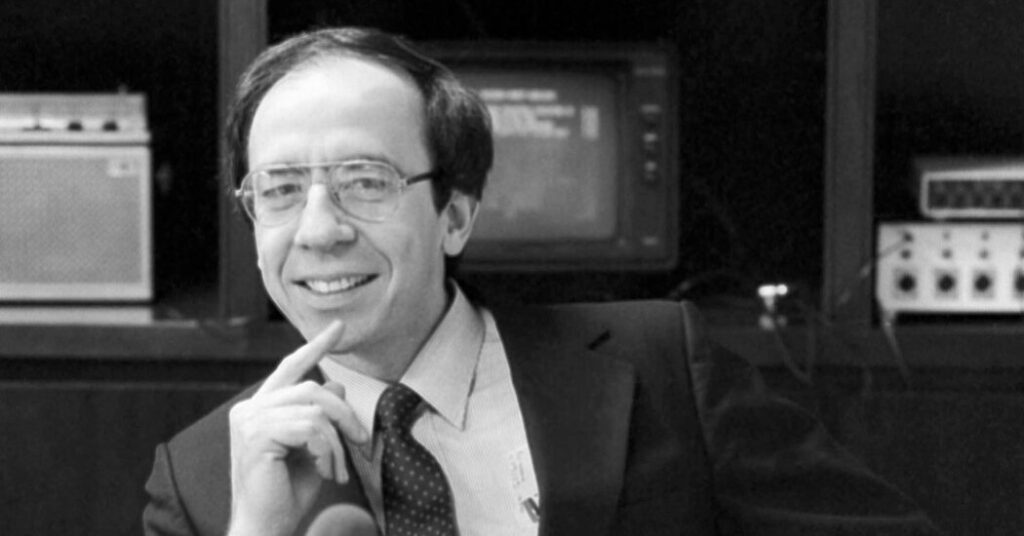
Conservatives used to oppose government meddling in broadcast television.
Consider Mark Fowler, who was named chairman of the Federal Communications Commission by President Ronald Reagan and led a successful fight to abolish the Fairness Doctrine, which required broadcasters to offer differing viewpoints on matters of public concern.
“There’s no room in our society, which is founded on freedom of speech and the press under the First Amendment, to tolerate the Federal Communications Commission acting as a censor over what is broadcast over radio and television stations,” Fowler said in a 1985 interview.
Brendan Carr, the current chairman of the agency, has disavowed what was once conservative orthodoxy: that the government has no business interfering with the editorial choices broadcasters make.
“This isn’t Ronald Reagan’s F.C.C.,” Carr said in February. “And I think that’s a good thing.”
A Fresh Approach
President Trump’s F.C.C. is indeed different. In guidance issued in January, it warned late-night hosts who mock the president that they risk retaliation if they book political candidates without offering their opponents equal time. The agency is investigating “The View,” the ABC morning talk show, on the same theory.
Carr relies on a federal statute animated by the same values as the abolished Fairness Doctrine but more limited in scope. It calls for granting political candidates “equal opportunities” to appear on programs that featured their rivals, though it makes exceptions for “bona fide news interviews.”
The agency’s newfound interest in that law is a response to conservative complaints that some shows have tilted too far to the left and are far more likely to have Democrats than Republicans as guests.
In a filing submitted last week in response to the agency’s investigation of “The View,” ABC raised a host of objections. It said the F.C.C. had already determined, in 2002, that the program qualifies for the news exception. It said the exception should apply even if the agency takes a fresh look. It argued that the administration’s enforcement of the statute was extremely selective, ignoring, for instance, conservative talk radio.
ABC is represented by Paul Clement, who was solicitor general in the George W. Bush administration and whose hiring underscores the split among Republicans on First Amendment issues. In the filing, Clement included an argument Reagan would have endorsed: that the statute is unconstitutional.
After the agency abandoned the Fairness Doctrine in 1987, Reagan vetoed legislation that would have revived it, saying the bill before him was “antagonistic to the freedom of expression guaranteed by the First Amendment.”
A Free Market for Speech
Reagan was no outlier in conservative thought in this area.
The 2016 Republican platform, for instance, called for “an end to the so-called Fairness Doctrine, and support free-market approaches to free speech unregulated by government.”
It drew an explicit parallel to the party’s approach to campaign finance law, which similarly took a libertarian stance. “Freedom of speech includes the right to devote resources to whatever cause or candidate one supports,” the platform said.
The fight over “The View” seems likely to lead to litigation. Should it reach the Supreme Court, there is reason to think the F.C.C. will not find a receptive audience.
Justice Brett Kavanaugh, for instance, seems wary of government efforts to guarantee equal time to competing views. In a dissent from a 2017 decision on net neutrality when he was still an appeals court judge, he cited a leading campaign finance decision from 1976 that was the subject of a fascinating article last week by Danny Hakim.
“As the Supreme Court stated in Buckley v. Valeo,” Judge Kavanaugh wrote, “in one of the most important sentences in First Amendment history: the ‘concept that government may restrict the speech of some elements of our society in order to enhance the relative voice of others is wholly foreign to the First Amendment.’”
“One of the most important sentences in First Amendment history” — that’s saying something.
And it was not a passing reference. The sentence has been a touchstone for Justice Kavanaugh, who read it from the bench in a 2024 argument over the regulation of social media platforms, calling it “a really important sentence in our First Amendment jurisprudence.”
Different Rules for Broadcasters
Carr does have one precedent going for him. A 1969 Supreme Court decision, Red Lion v. F.C.C., allowed the government to regulate broadcasting more restrictively than other media, on the theory that the airwaves are scarce public property.
ABC, in its filing last week, wrote that the ruling’s scarcity rationale is “unsupportable now in an age of information ubiquity.” Where there were once just three television networks, there are now hundreds of cable channels and the entire internet.
In a 2009 concurring opinion, Justice Clarence Thomas wrote that he was ready to reconsider Red Lion, saying it allowed “deep intrusion into the First Amendment rights of broadcasters.” He added that “dramatic technological advances have eviscerated the factual assumptions” justifying the decision.
Reagan, too, was skeptical of Red Lion. “In any other medium besides broadcasting,” he wrote in 1987, “such federal policing of the editorial judgment of journalists would be unthinkable.”
The better approach, he said, was set out in Miami Herald v. Tornillo, a 1974 decision striking down a Florida law that would have allowed politicians a “right to reply” to newspaper articles critical of them.
Chief Justice Warren E. Burger, writing for a unanimous court, said the nation was in the middle of “vast changes.”
“In the past half-century,” he wrote, “a communications revolution has seen the introduction of radio and television into our lives, the promise of a global community through the use of communications satellites and the specter of a ‘wired’ nation.”
But Chief Justice Burger concluded that “the vast accumulations of unreviewable power in the modern media empire” did not permit the government to usurp the role of editors in deciding what ought to be published.
“A responsible press is an undoubtedly desirable goal,” he wrote, “but press responsibility is not mandated by the Constitution, and like many other virtues it cannot be legislated.”
Other Legal News
Mailbag
Shadow Docket Deliberations
This question was in response to the article Jodi Kantor and I wrote last month on a turning point in the Supreme Court’s use of emergency orders: its 2016 ruling halting President Barack Obama’s Clean Power Plan.
I was surprised at the simultaneously casual and impersonal way business was carried out in the justices’ deliberations. Is this unique to the emergency docket? Do the judges sit in a conference room and cast a vote for regular docket cases, or does the decision always take form slowly through memos sent around the chambers? — Alex Tidwell
In argued cases on the Supreme Court’s merits docket — the ones that get full consideration — the justices meet in their private conference room to deliberate in person. That did not happen when the justices considered the 2016 emergency application. According to a dissent from Justice Elena Kagan in March, the lack of in-person deliberations is one of the reasons that “our emergency docket can malfunction.”
“The court receives scant and, frankly, inadequate briefing about the legal issues in dispute,” she wrote of the emergency applications. “It does not hold oral argument or deliberate in conference, as regular procedures dictate.”
Indeed, the court has on at least one occasion rejected a justice’s request to discuss an emergency application in person. In 2019, after a lower court stayed the execution of a death row inmate in Alabama, state officials asked the Supreme Court to let them proceed. The application landed at 9 p.m. on a Thursday, and the death warrant was scheduled to expire at midnight.
In a dissent issued at 3 a.m., Justice Stephen Breyer wrote that “I requested that the court take no action until tomorrow, when the matter could be discussed at conference,” referring to the private meeting that is regularly scheduled for most Friday mornings during the court’s term.” The request was denied.
The dispute among the justices lasted long enough that Alabama postponed the execution anyway. Still, Justice Breyer wrote, the majority granted the state’s emergency application before the justices could talk about the case.
“To proceed in this way calls into question the basic principles of fairness that should underlie our criminal justice system,” Justice Breyer wrote. “To proceed in this matter in the middle of the night without giving all members of the court the opportunity for discussion tomorrow morning is, I believe, unfortunate.”
I’d love to hear your questions on the law, the courts or whatever is on your mind. Send them my way at [email protected].
What I’m Reading, and Listening to
-
“The Interim Docket,” in which Will Baude, who coined “the shadow docket,” embraces a different term. The article will be published in The University of Chicago Law Review.
-
“Merits Positions and Supreme Court Voting on Stays and Injunctions,” in which Greg Goelzhauser explores “the politics of stays and injunctions” in The Journal of Law and Courts.
-
“Becoming Justice Gorsuch,” the new season of Slate’s “Slow Burn” podcast.
Closing Argument
Springsteen Dissents
The first time I saw Bruce Springsteen was 50 years ago, in 1976. Carole King was playing a three-night stand at the Beacon Theater in Manhattan, and Springsteen joined her to play “The Locomotion” on the last night.
I’ve seen him scores of times since then, most recently on Monday, at Madison Square Garden. His shows are always enjoyable, often intense and sometimes transporting. They’re also an opportunity to think about things other than the Supreme Court.
Or maybe not.
On Monday, Springsteen had the justices on his mind, offering a dissent from Louisiana v. Callais, last month’s voting rights earthquake. It came as he started “My City of Ruins.”
“The Supreme Court has gutted the Voting Rights Act,” Springsteen said, “and that has historically set back our hard-fought-for civil rights movement, a movement for which people marched, fought and gave their lives.”
The crowd roared. I maintained my journalistic neutrality.
About “The Locomotion,” sometimes rendered “The Loco-motion,” which King wrote with Gerry Goffin: It was Top Ten hit in three different decades, for Little Eva in 1962, for Grand Funk Railroad in 1974 and for Kylie Minogue in 1988. According to Brucebase, that night in 1976 was the only time Bruce sang the song in public.
Adam Liptak is the chief legal affairs correspondent of The Times and the host of The Docket, a newsletter on legal developments. A graduate of Yale Law School, he practiced law for 14 years before joining The Times in 2002.
The post A Republican U-Turn on Free Speech appeared first on New York Times.