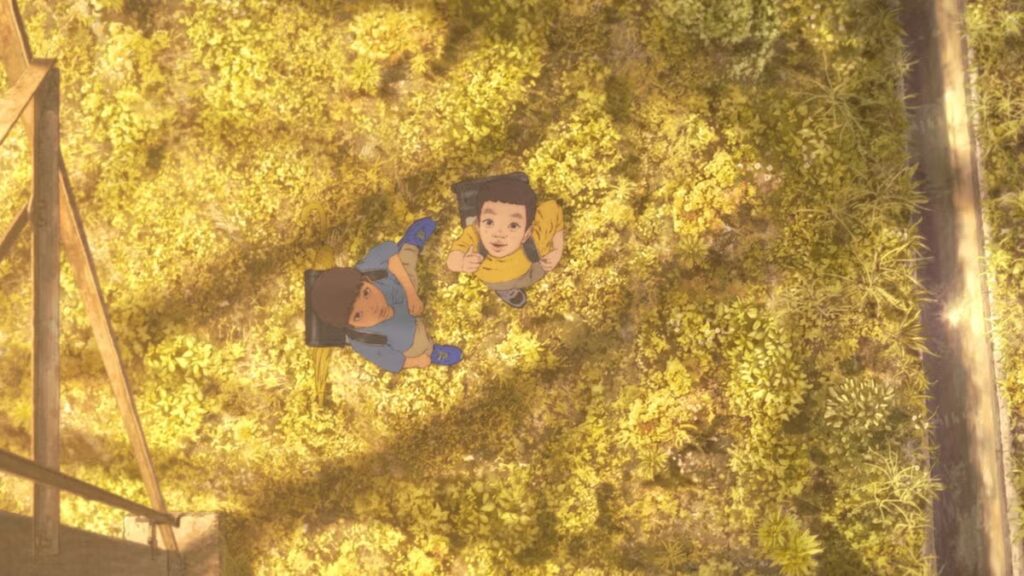
A frequently stunning work of animation that’s also a haunting portrait of isolation, the destructive insidiousness of bullying and our own capacity for cruelty, Kohei Kadowaki’s formidable feature debut “We Are Aliens” is a film of fascinating layers.
On a narrative level, it tells what, at first glance, may seem like a simple coming-of-age story about two young boys, Gyotaro and Tsubasa, growing close and then drifting apart. However, as the film takes larger leaps through time, what could be an overly familiar story is held up to the light to see what beauty and pain lie underneath it. This is where the breathtaking layers of the animation make it something that rivals the technical splendor and meticulous care of the recent classic, “Your Name.” Just as it is infinitely more grim than that, it finds a similar sense of grace in every frame.
In addition to the film showcasing some of the most remarkable use of rotoscope animation (a technique where live-action footage is used as a reference to make the movements of characters more natural) you’ll ever see, there is just so much tactile detail the animation team captures. In each lonely room, bustling city street or even just a simple drain with flower petals used to show the passage of time, it feels like a rich painting in motion. In every visceral moment of pain and vibrant texture of the landscapes explored, an entire wondrous world comes alive before our eyes, just as it is soon at risk of falling completely apart.
Premiering Thursday in the Directors’ Fortnight Sidebar at the Cannes Film Festival, the film opens with a striking yet subtle sequence where we notably don’t see any faces. Instead, we just hear dialogue like that of a parent and child speaking about the moon before we end up in a cab roaming the city streets alone. Even when we get a glimpse of the driver’s face, he is held at a distance from us just as we look out on the world through his eyes.
Though they then begin to drift closed, tired after what has presumably been a long evening shift, a drop of rain gently descending down his windshield is made to resemble a tear. It provides an evocative hint of how, for all the beauty of the animation on display, this is a film that will be centrally about pain. So much so that the entire experience nearly becomes consumed by it.
When we then flashback to meet Gyotaro and Tsubasa, we initially see the world through the eyes of the latter. He’s a profoundly lonely kid, but the film finds moments of authentic humor in moments like when he tries (and hilariously fails) to hide that he was playing video games one night while his mom was out. This is a kid who not only feels authentic in terms of his mannerisms — though that is also critical — but deeper than that, the film perfectly captures the often-overwhelming wonder and anxiety that can exist within a child.
When Tsubasa begins to go out and explore with Gyotaro, doing a silly walk through a tunnel so that they don’t die or just being in the other’s company when nobody else will, there is a genuine joy to all of their interactions. This will only make the subsequent fracturing of their young friendship that much more annihilating. What begins with a small crack soon expands outwards until everything shatters.
What this entails involves a cruel deception that is only fully understood once the film folds back in on itself, showing many of the events from a slightly different perspective. In this regard, “We Are Aliens” ends up feeling most thematically linked to Hirokazu Kore-eda’s “Monster” in how it seeks to complicate and challenge our perspective once it makes its big shift. It’s a little more confined than that, only changing perspectives between two characters as opposed to multiple, but it manages to tap into that same sense of shifting emotional tumult.
While the conflict and eventual schism between the two seems like it comes from one being overly playful, resulting in the breaking of an umbrella, it soon grows more complicated. As days turn to months, years and even decades, the two remain inextricably linked even as they also may end up destroying each other. It’s all quite heavy, often teetering on the very edge of pushing things off a cliff into repetitive despair, but it always manages to pull us back from the brink.
More than anything, the reason the film holds together is because of the formal craft on display. Animation is a uniquely malleable cinematic form, and “We Are Aliens” (a title that is in reference to an anxiety one character has while also speaking to a broader feeling of isolation) makes full use of its potential. The piece not only has many more surreal sequences that simply couldn’t exist with a fraction of the same power if it were attempted in live-action, but it also is willing to throw out the rules it was operating under at the drop of a hat.
In particular, there is one sequence near the end that almost descends into outright horror, blurring the lines between reality and a character’s perception of it with daring, disquieting flair. Even as the film itself is an unrelentingly dark one on a tonal level, the beauty it finds in the light of such animation is a wonder to behold.
The post ‘We Are Aliens’ Review: Agonizing, Astounding Animated Gem Heralds Kohei Kadowaki as an Exciting New Voice appeared first on TheWrap.