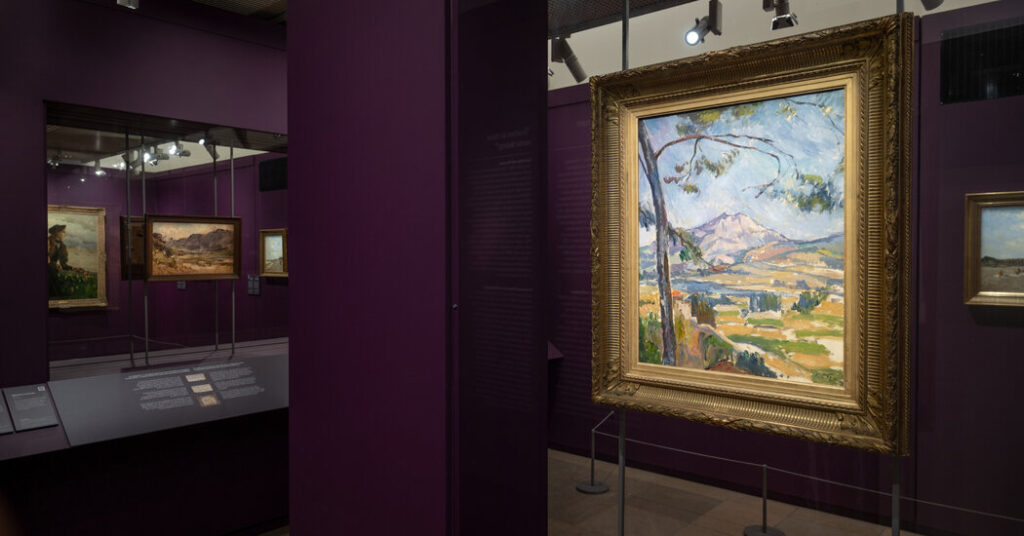
A display that officially opened in the permanent exhibition space of the Musée d’Orsay in Paris last week features paintings by the Impressionist masters Renoir and Degas as well as a sculpture by Rodin. But the primary goal is not to let the public admire them: It’s to find out who their rightful owners are.
The 13 artworks on display were among 225 pieces stolen or sold under duress in France during World War II and then recovered from Germany and Austria at the end of the war. For half a century, they have been under the museum’s custody.
The display underscores how France, after being criticized for being too slow to return looted artworks to their owners, has made progress in on that in recent years. The room also, according to Gideon Taylor, the president of the World Jewish Restitution Organization, “sends a strong message about the commitment of France” three years after the country adopted a law enabling the restitution of goods looted from Jewish families.
David Zivie, the head of a government task force that coordinates the restitution of cultural objects looted during the war, said that the idea of the Musée d’Orsay display was that “at some point one of the works in this room will be taken down, because we’ll have understood where it came from.”
By the end of World War II, about 100,000 art objects were declared stolen in France. With the help of Allied units known as “Monuments Men,” about 60,000 pieces located abroad were returned to France and about 45,000 of them were claimed between 1945 and 1950.
The French state sold most of the others, aside from 2,200 pieces that it entrusted to national museums. Since then, fewer than 200 pieces have been returned, including 15 kept at the Musée d’Orsay.
Sorting looted works from legally acquired ones can be a challenge, said François Blanchetière, a curator in charge of sculpture at the museum. The art market remained active during the war under the Nazi and Vichy regimes, and many pieces changed hands legitimately, he said.
“About 90 percent of the works entrusted to us were acquired by a German or Austrian national under circumstances that are not entirely clear,” he said.
One of the pieces on display, a reproduction by Degas of a work by another artist, Adolph Menzel, belonged to a Jewish collector named Fernand Ochsé who was deported and murdered at Auschwitz, according to the curator. It was given to a Parisian gallery by a French national named Coutot and sold to a museum in Karlsruhe, Germany, before returning to France in 1948, he said.
“What we don’t know,” Mr. Blanchetière said, “is how it goes from Mr. Ochsé to Mr. Coutot: Was it a forced sale? We don’t know.”
Another piece, a painting representing Mont Sainte-Victoire, one of Cèzanne’s favorite landscapes, was sold in 1942 to Hildebrand Gurlitt, an art dealer who bought pieces for Hitler’s planned Führermuseum in Austria. But when it was returned to France the authorities held onto it not because they thought it had been looted, but because they suspected it was a fake, Mr. Blanchetière said.
More recent research found nothing to support that conclusion, he said.
The mountainous landscape now hangs between two panes of glass so that visitors can look at the back of its wooden frame and decipher the stamps and stickers there, all clues that researchers used to determine the painting’s provenance.
Among those visitors this week were Jean Lagnel, 73, who experienced the Nazi occupation firsthand in a town north of Paris.
“I think it’s wonderful that these works were exhibited in the hope that the victims’ families might find or recognize them,” Lagnel said.
For years, little was done in France to accelerate the pace of restitution, until interest in artwork provenance picked up in the 1990s. In 1998, France was among the 44 nations that endorsed the landmark Washington Principles on returning Nazi-confiscated art. The next year, the country established a commission to examine reparation claims made by victims of France’s antisemitic laws during the war.
Then, in 2019, a task force was created to coordinate the restitution of cultural objects stolen between 1933 and 1945.
Museums rekindled their efforts, too. Some showed unclaimed works from the Monuments Men trove in temporary exhibitions, and in 2018 the Louvre added two small rooms to its permanent collection with over 30 of those paintings.
Annick Lemoine the president of the Musée d’Orsay, said its presentation shed light on a violent episode in France’s history. “Behind every painting, every object, often lie broken life stories, lives upended or even destroyed,” she said in a statement.
The idea was put in motion by her predecessor, Sylvain Amic, who was keenly interested in the restitution of looted art, whether it had been taken from France to Nazi Germany, or from Africa to France in colonial times. Before his sudden death last year, he spearheaded the project to show some of these orphaned pieces to the public.
With a donation of 1 million euros, about $1.2 million, from the American Friends of the Musée d’Orsay, a nonprofit, the museum funded the opening of the room as well as a 10-year research project.
There is also hope that new online research tools may help locate the works’ rightful owners, given that firsthand witnesses are increasingly unlikely to come to the museum 80 years after the war’s end.
In the meantime, the museum plans to rotate which pieces are on display so that more of the 225 works in its possession can be seen by the public.
“Certainly there’s lots of artworks that have been lost forever and it’s a shame,” said Frieda Vandegaer, 70, a visitor from Delaware, as she left the room on Tuesday. “But it’s so nice to have this particular piece of history get some attention.”
Elaine Sciolino contributed reporting.
The post Who Owns These Artworks? A Museum Hopes Visitors Can Help Find Out. appeared first on New York Times.