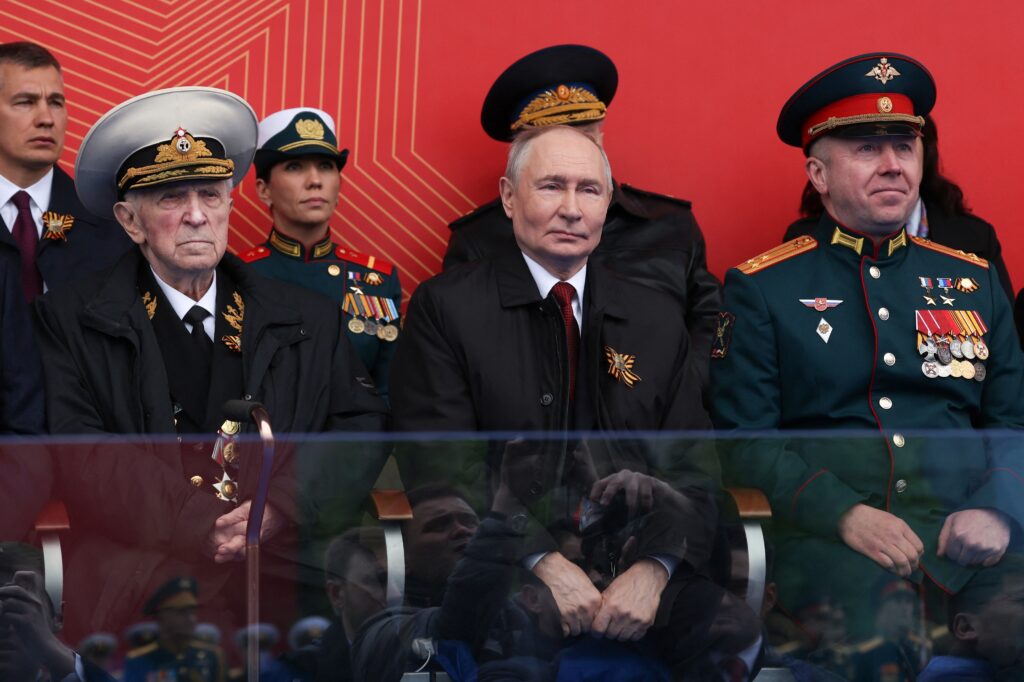
A lone police officer with a megaphone shouted at a confused crowd in central Moscow to disperse — the traditional Victory Day fireworks last weekend having been canceled without warning.
It was a fitting wind-down to the most muted celebration Russia had witnessed in decades. No military hardware rolled across Red Square. Few foreign guests attended. Across the Russian capital, the internet was blacked out, a move driven by fear that Ukraine could disrupt the World War II commemoration with its expanding reach of long-range drone attacks.
The deflated mood in Moscow highlighted how sustaining the war against Ukraine has grown increasingly complicated for President Vladimir Putin, who is under pressure not only from stalemate, stagnation and heavy losses on the battlefield but also from a battered economy, rising public frustration and setbacks for partners worldwide including in Iran, Hungary and Venezuela.
After more than four years of war, Russians do not feel stronger, safer or more prosperous, let alone victorious.
Instead, they are angry over the internet restrictions, inflation and rising taxes, and exhausted by the psychological weight of the war, which in January crossed the 1,418-day mark — surpassing the Soviet Union’s entire involvement in World War II — with no end in sight.
“Why was [this war] necessary if the capital, always festive in the past, seemed empty and uneasy, tense and unsafe, with two sources of risk to people — drones in the sky and police on the ground — and with all communications banned?” asked Andrei Kolesnikov, a Moscow-based political analyst.
The frontline remains largely stalled, with Russia occupying roughly 20 percent of Ukrainian territory but still failing to achieve Putin’s goal of seizing the entire eastern Donbas region.
Russia’s pro-war, ultraconservative right is demanding escalation, voicing deep offense at the level of disruption Ukraine has managed to inflict inside Russia — including the killing of high-ranking officers and far-reaching drone strikes, many against oil facilities and other infrastructure key to Russia’s extraction economy.
The far bigger apolitical majority, which had long accepted the Kremlin’s implicit bargain of staying silent in exchange for the war remaining largely contained to border regions, is reeling from the internet shutdowns and growing economic strain.
In an apparent nod to the public exhaustion, Putin made an unusual remark in a news conference following the May 9 Victory Day parade that seemed to offer a glimmer of hope. “I believe the matter is coming to a close,” he said of the war.
But the Russian leader immediately followed up with his usual accusations against “global Western elite,” which he said is using Ukraine to destroy Russia.
Top Kremlin foreign policy aide Yuri Ushakov said later Sunday that negotiations would be fruitless until Kyiv agreed to a complete Ukrainian withdrawal from Donbas, making clear the Kremlin has not changed its central, maximalist demand.
Putin’s comment was almost certainly geared to his domestic audience rather than President Donald Trump or Ukraine — a sign, analysts said, that the Kremlin is feeling the mounting societal pressure.
“He really didn’t set any time frame. It could be several months, maybe even several years,” a Russian academic with close ties to senior Russian diplomats said of Putin’s comment. “And it could be a reaction to the public demand — people hope that the conflict will be ended, and he may have wanted to cheer them up and confirm that there is hope for ending the conflict.”
Vladimir Pastukhov, Russian political scientist and honorary senior research fellow at University College London, said that Putin faces a quandary: The Russian public is tired of the war but also wants to win.
“This phrase signals that internally they are genuinely entertaining the prospect of ending the war — seriously enough, in enough detail, that they felt it necessary to quietly signal to society that such a scenario is theoretically possible,” Pastukhov said. “It doesn’t mean he intends to end the war on just any terms, or that he’s firmly decided anything.”
In making a decision, however, Putin must confront the conflict in public expectations, he said: “People want the war to end, but they still expect victory.”
According to a report by the Dossier Center, an investigative group founded by exiled Putin opponent Mikhail Khodorkovsky, the Russian administration has begun developing what it calls an “image of victory” — narratives designed to sell Russians on a peace deal despite high casualties and minimal territorial gains.
The initiative boils down to forcing prominent military bloggers to soften their pro-invasion stance, framing battlefield kills as a completed “de-Nazification” mission and insisting Russia never intended to take Kyiv, while offering ordinary Russians something resembling a thaw.
The Dossier Center report does not suggest Putin has decided to end the war but rather reflects contingency planning within the Kremlin’s political bloc.
The diminished parade proceeded last weekend without incident, following a flurry of diplomatic posturing by Moscow that included warning Ukraine of devastating retaliatory strikes on Kyiv, calling up leaders in the U.S., India and China to stress the consequences of any disruption, and advocating for a Trump-brokered three-day ceasefire.
The way the ceasefire came about revealed the absurdist theater of the peace talks, which have been effectively frozen since Trump went to war against Iran.
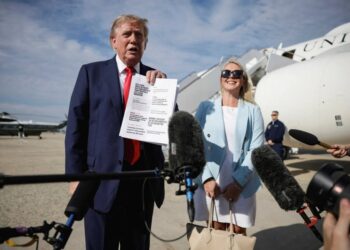
In a phone call roughly a week before Victory Day, Putin floated the idea of a temporary truce to Trump, while also attempting to revive Moscow’s offer to mediate between the U.S. and Iran and to store Iran’s enriched uranium on Russian soil.
Trump rebuffed the proposal, telling Putin to focus on ending the war in Ukraine.
In the days that followed, Russia and Ukraine each proposed ceasefires on different dates without talking to each other. Putin announced one for May 8-9, and Kyiv called for an indefinite truce from May 6 — both of which quickly unraveled, each side blaming the other.
On May 8, Trump announced a ceasefire covering May 9-11, thanking both leaders for agreeing to what he said was his idea.
On the second day of the ceasefire, which failed to stop ground fighting but appeared to halt large-scale aerial attacks, Zelensky taunted Putin, saying Ukraine had pushed him to “finally say he is ready for real meetings” to secure a lasting truce.
“The episode exposed the structural bind Putin is now in,” said Tatyana Stanovaya, a political expert with Carnegie Eurasia Center. “Passivity in the face of mounting Ukrainian strikes erodes his domestic standing; escalation undermines the transactional posture he is trying to maintain with Trump.”
The ceasefire ended Tuesday, and Russians emerged from their long, confusing May holidays with no clearer sense of how the war might end but growing certainty that wartime restrictions, internet controls and economic pressure would remain.
Early Thursday, a wave of drone and missile strikes hit Kyiv, killing at least five people, officials said.
The state-owned pollster VCIOM, which is often criticized for favoring the Kremlin, has recorded a steady decline of Putin’s approval ratings and reported that Russians’ happiness level has fallen to its lowest point in 15 years.
Pastukhov said that Putin, a former KGB agent, faces a choice between emerging factions — political technologists in the presidential administration, who want to manage and manipulate society through a softer approach, and heavy-handed security service operatives, who think society must be tightly controlled at any cost.
“For Putin it is easier to side with the latter; they feel closer to him, more legible,” Pastukhov added. “There’s no good path for them regardless. They’re building a revolutionary situation that doesn’t exist yet. But if they keep behaving like this, they’ll eventually create it.”
The most immediate risk, he added, is losing the passive majority that has tolerated the war — as long as it was kept at a distance — but now feels its strain in daily life.
“They may think, ‘Fine, at least we’ve suppressed the activism,’” Pastukhov said. “And then they’ll discover that activism, like a super-virus, has mutated to a point that no defense works anymore.”
Catherine Belton contributed to this report.
The post Putin remark on war ‘coming to a close’ points to exhaustion, not peace, analysts say appeared first on Washington Post.