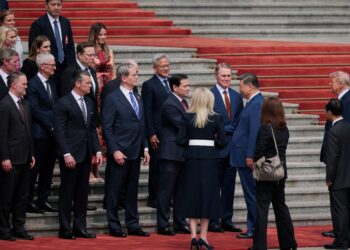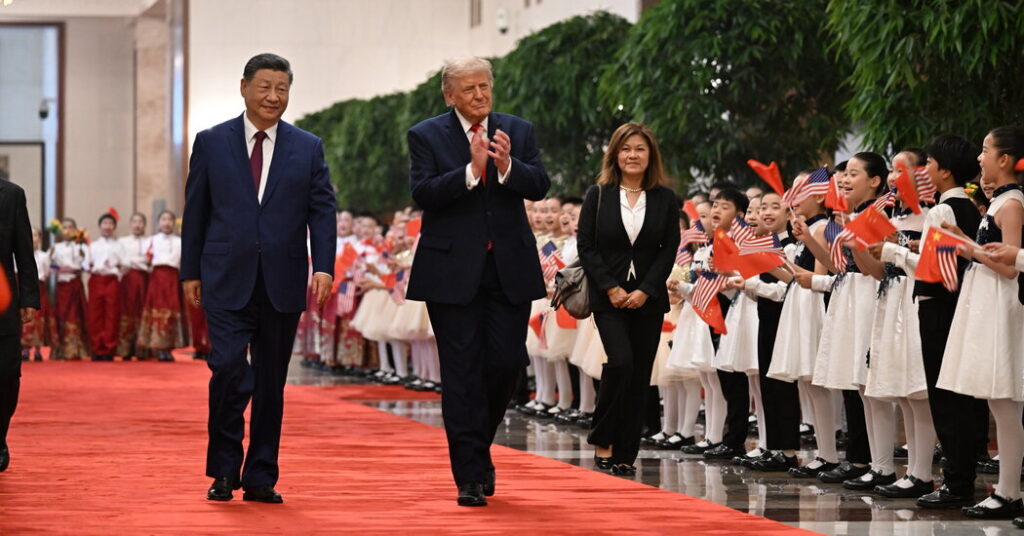
President Trump’s visit to Beijing has been cast by Chinese state media and commentators as a major diplomatic victory for China and a sign of its growing parity with the United States as a global power.
Major state-run news organizations have touted the visit, which includes two days of talks between Mr. Trump and China’s top leader, Xi Jinping, as an opportunity for the United States to accept the “right way” for the two countries to coexist — understood to mean that the Trump administration should refrain from confronting Beijing.
“Most difficulties in bilateral relations have largely stemmed from the fact that some people in the United States cling to the mistaken logic that one side out-competes or thrives at the expense of the other,” an editorial in the Global Times, a Chinese Communist Party tabloid, said on Wednesday.
Media and online commentary in China is tightly controlled. Dissenting views are often quickly scrubbed from social media. But interpreting what messages are permitted offers a window into the party’s priorities and how it wants to present itself to both a domestic and global audience.
When the Global Times says, “economic and trade ties should continue to serve as the ballast and driving force of China-U.S. relations,” for example, it points to Beijing’s continued anxieties about its struggling economy, said Manoj Kewalramani, the head of Indo-Pacific studies at the Takshashila Institution in Bangalore, India, who monitors Chinese media.
Other coverage of the summit suggests a mixture of both triumphalism and caution. State media has not criticized Mr. Trump by name, reflecting Beijing’s reluctance to antagonize the American president so that it can preserve its uneasy truce with Washington following a blistering trade war last year.
China’s ability to survive that fight has been one of the running themes in recent days. It was highlighted by an editorial published on Wednesday by the People’s Daily, the party’s official mouthpiece, titled, “China-U.S. relations cannot return to past, but can move toward better future.”
The piece made no mention of how Beijing’s threats to throttle global supplies of critical minerals required for modern technologies forced the Trump administration to back down in a matter of months. Instead, it stressed China’s “resilience” and noted how dialogue between the two countries now takes place “on a more equitable basis.”
Some nationalistic voices have been more vocal about what they see as a weakened Trump administration, mired in a war in Iran that shows no signs of ending and sinking approval numbers at home.
“At this particular moment, I think Donald Trump needs China far more than China needs Donald Trump,” Zhang Weiwei, the director of the China Institute at Fudan University in Shanghai, said in an interview with the state-owned Beijing Review. “He has so many problems to solve.”
Analysts say Mr. Trump is desperate to go home saying he cut a deal to sell Boeing airplanes, beef and soybeans to China.
“If China can deliver hundreds of billions of dollars worth of goods to the United States in a trade agreement, it would significantly boost Trump’s chances in the midterm elections,” wrote Qiu Zhenhai, a popular commentator and an international relations expert at the Hong Kong University of Science and Technology.
Already on Thursday, Beijing said it would allow hundreds of American slaughterhouses to resume beef shipments to China.
In return, Mr. Qiu wrote, China can ask for the United States to re-evaluate its position on Taiwan, the self-governed island that Beijing claims as its territory.
The fact that Mr. Trump was so eager to visit China despite all his other distractions underscores Beijing’s leverage, said D&C Think Tank, a Beijing-based research firm.
The firm declared in an online post on Wednesday that the “Sino-U.S. rivalry has moved beyond the stage of unilateral pressure and entered a stage of two-way dynamic balance.”
It continued to recommended that Beijing pressure the United States to work out a long-term truce so that China can continue to develop its economy and gather its strength without Washington’s interference.
Perhaps one of the most consistent themes in Chinese coverage of Mr. Trump’s visit has been the emphasis on the importance of “head-of-state diplomacy.” The People’s Daily said it played “an irreplaceable strategic guiding role.”
The attention paid to national leaders burnishes Mr. Xi’s importance as the country’s top decision maker. But it is also a call for Mr. Trump to “reign in other branches of government” in the United States, said Mr. Kewalramani, the expert on Chinese media.
“He must ensure that Congress does not take steps that China perceives are inimical to the broader relationship,” he said. “It’s mirror-imaging from Beijing.”
David Pierson covers Chinese foreign policy and China’s economic and cultural engagement with the world. He has been a journalist for more than two decades.
The post Chinese Media Cast Trump’s Visit as a Sign of Beijing’s Rising Stature appeared first on New York Times.