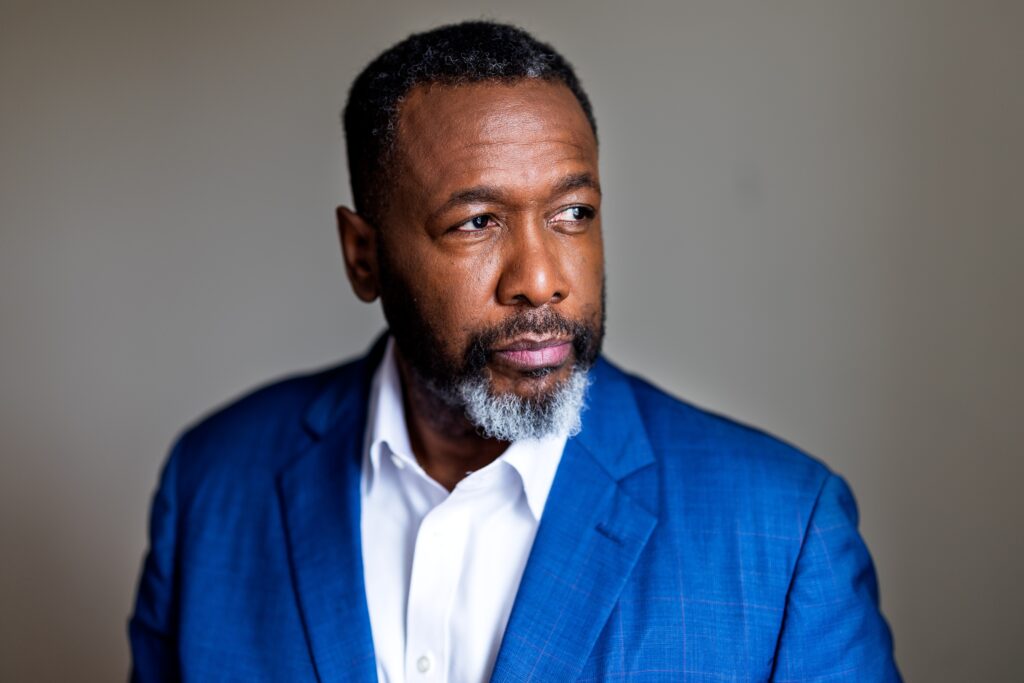
Wendell Pierce can recall the exact evening — the exact moment, in fact — that he unlocked William Shakespeare’s lyrical language.
It was September 1981, and the New Orleans native was a first-year Juilliard student who didn’t exactly see eye to eye with the Bard. “I felt verse was so restrictive,” he says on a late-April morning at a Southeast Washington rehearsal studio, ahead of his starring turn in “Othello” at Shakespeare Theatre Company. “I just wanted to say goodbye.”
But when Pierce popped into the Village Vanguard in New York for an evening with esteemed saxophonist Arthur Blythe, he also discovered a Shakespearean Rosetta stone: Blythe’s freewheeling jazz. “I remember the song,” Pierce says before scatting Blythe’s tune, drumming the beat against his thigh. “And then,” the 62-year-old continues, “he went on a solo.”
Cue Pierce’s best imitation of a saxophone discordantly honking. “I’m like, ‘Well, I don’t understand that.’ But I’m looking around the room, and I’m humming. When he came back to the head, I was right on the tune — right where he was. And I realized in that moment he always knew the form of the song.”
If Blythe could color within the lines of a jazz standard, Pierce reckoned he could do the same with Shakespeare. “That’s when the epiphany happened for me with Shakespeare: It shouldn’t be restrictive — it should be freeing.”
Pierce has long found the artistry in structure, and vice versa. Case in point: his annual aspiration to achieve a “trifecta” of appearing in a TV show, a film and a play.
The self-imposed assignment is working for him. On television, Pierce has portrayed street-smart detective Bunk Moreland on “The Wire,” hustling trombonist Antoine Batiste on “Treme” and, now, principled police captain C.W. Wagner on the CBS procedural “Elsbeth.” His big-screen credits run the gamut from the acclaimed drama of “Malcolm X,” “Ray” and “Selma” to the superhero escapism of “Thunderbolts*” and “Superman.” Pierce netted his first Olivier and Tony award nominations for best actor when he portrayed Willy Loman in the 2019 London and 2022 Broadway productions of “Death of a Salesman.”
“He’s continually wanting to challenge himself and to keep exercising all of those muscles,” says Sharon D. Clarke, the Linda Loman to his Willy in “Death of a Salesman.” “Wendell is a man who’s going to explore every last facet of any way that all of that can be put into his arsenal — not only as a creative but as a human being.”
Now, he’s returning to the stage as the titular Moor in a production of “Othello” from May 19 to June 28 at Shakespeare Theatre’s Harman Hall. After Pierce let his trifecta ambition lapse for a few years, audiences can again see him in all three mediums: “Othello” begins two days before the Season 3 finale of “Elsbeth” airs on CBS and one day before he reprises the role of CIA operative James Greer in the espionage thriller “Jack Ryan: Ghost War” on Prime Video.
“It’s extraordinary to see his range,” says Carrie Preston, who leads “Elsbeth.” “He has impeccable instincts and he accepts jobs because they speak to him, not because, ‘Oh, this is going to make me famous,’ or, ‘Oh, this is going to do something for my career.’ He starts with the work.”
To watch Pierce work is to witness a master class in fierce focus. An hour after our conversation, the personable Pierce has given way to his off-the-handle “Othello” alter ego. Running through a pivotal scene — when the Venetian general spirals over his wife’s purported infidelity — Pierce simmers with incredulity. Staring down Ben Turner, the actor playing the duplicitous ensign Iago, he finds particular fury with each “farewell” in Othello’s famed Act 3 soliloquy.
“Farewell the tranquil mind!” Pierce barks. “Farewell content! Farewell the plumed troops and the big wars!” As director Simon Godwin resets, Pierce promptly retreats to a corner, glances at his script and starts muttering his lines to himself ahead of the next go-round.
“These great, iconic Shakespearean roles always ask so much of the actor playing them, so you’re looking for an actor with this wide repertoire of skills,” says Godwin, the Shakespeare Theatre’s artistic director. “In Wendell, you have the authority of the statesman and the soldier. You have the humanity and depth of the poet, which Othello has great access to. And you have the tenderness of a man in love.”
It’s range rooted in Pierce’s Juilliard training — in particular, the third-year acting class he took from Michael Kahn, Godwin’s predecessor. “It was an intensive class,” Pierce recalls, “and it was a wonderful class.” One of Pierce’s first professional gigs was in the Shakespeare Theatre’s 1987 production of “The Witch of Edmonton,” shortly after Kahn took the reins. Pierce worked with the company again in 2003, when he appeared in its staging of “The Oedipus Plays” at the Athens Festival in Greece. Although Pierce didn’t return to the Shakespeare Theatre before Kahn gave way to Godwin in 2019, his mentor’s lessons endured.
“The class with Michael really was one of those linchpin moments of pushing me a little further as an actor,” Pierce says, “and really trying to demand more of myself and demand more of my work, and go to places that you’re fearful of. I have come to a place where I still want to do that sort of work, especially in this third act of my career.”
It was BBC broadcaster Katty Kay who helped steer Pierce back to the Shakespeare Theatre. Having interviewed Pierce in the fall of 2023, Kay suggested that he connect with Godwin — her fellow D.C.-based English expat — to discuss any onstage ideas. Taking her up on the offer, Pierce got lunch with Godwin and floated “Othello” as the bucket-list role he most wanted to tackle. One promising reading and various backroom discussions later, the production was set as the finale of the company’s 2025-2026 season.
There’s an obvious allure to taking on a Shakespearean giant previously inhabited by the likes of Laurence Fishburne, David Oyelowo and, in last year’s Broadway revival, Denzel Washington. But Pierce sought the role — a tragic juxtaposition of honorable integrity and crippling insecurity — first and foremost because it daunted him.
“You are seldom challenged physically, mentally, emotionally in a very complex way like this,” Pierce says. “It seems very simple at times — it’s an issue of jealousy and revenge. But the complexity of that is the thing I’m learning in the process. It’s devious in that way.”
Lucas Iverson, an actor on HBO Max’s “The Pitt,” signed on as the gallant lieutenant Cassio in “Othello” largely so he could see Pierce wrestle with that beast of a part firsthand. “He has such a titanic body of work,” Iverson says. “Getting to see him tackle what I think is an exceptionally difficult play — and a particularly difficult role within that play — is everything a young actor could hope to be present for.”
Iverson and his co-stars haven’t been disappointed. Olivia Cygan, who plays Othello’s wife, Desdemona, was struck by Pierce’s precision when the cast first gathered to interpret the text. “He is someone who loves that kind of interrogation,” she says, “and also someone who loves community and the magic of being live in a room with people.” The English actor Turner sees the same insatiable curiosity. “He describes himself as a journeyman, which I kind of love,” he says. “He’s a creative soul, and he wants to explore.”
That includes exploring the modern potency of a four-century-old text. When Pierce accepted the Shakespeare Theatre’s Will Award for lifetime achievement at a D.C. gala last month, he emphasized the weight of staging a tragedy about how easily rash emotions can derail conflict resolution. Describing the “American challenge,” he asked: “Will you rise to the experience to be the best of the human experience, and not the worst?” Two weeks later, I follow up on this notion. Considering his words, Pierce takes a deep breath — then doubles down on the resonance of “Othello” as a cautionary tale for a divided America.
“Culture is the intersection between what we do as people and life itself,” Pierce says. “It’s not policy. It’s not laws. Laws can define and restrict and prohibit behavior, but culture — and what we’re doing [in the theater community] — can change people’s hearts and minds and souls.
“Hopefully,” he continues, “this play and this production is a spark of insight and enlightenment, and maybe a call to action for some people who are sitting on the sidelines.”
Pierce is staying busy after “Othello”: He’ll shoot his role as Daily Planet editor Perry White in the Superman sequel “Man of Tomorrow” this summer, then return for Season 4 of “Elsbeth.” In June, audiences also can see him in the fifth and final season of Starz’s “Raising Kanan” and catch his next film — the fact-based, D.C.-set boxing drama “They Fight” — at New York’s Tribeca Festival.
“He has wonder, still, about the work,” Preston says of Pierce. “If you build a career that way, it is inevitable that you will reach the point where you have critical mass and everybody knows about you, and it will feel like it’s happening suddenly. But it’s been a lifetime of accumulations of accolades and straight-up brilliant work.”
“He’s a good man with a big heart and a big talent,” Clarke adds. “The world should be seeing how Wendell Pierce rocks it.”
Although the trifecta tactic has clearly served Pierce well, he’s actually reconsidering it, now that he’s reacquainted himself with the Bard. Yes, a show, a movie and a play will remain his annual goal. But once every couple of years, he now wants to add a Shakespearean endeavor to the rotation.
“My trifecta,” Pierce says with a wry grin, “is now becoming a quartet.”
The post The key to Wendell Pierce’s longevity: Commitment to the acting ‘trifecta’ appeared first on Washington Post.