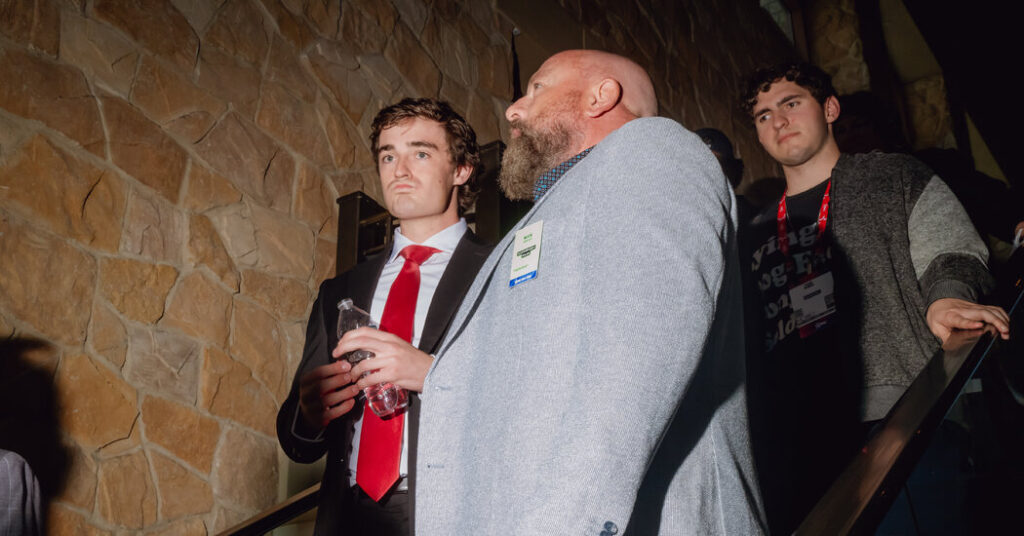
When the online influencer Nick Shirley greeted throngs of fans at the Conservative Political Action Conference in Texas in March, a burly security guard shadowed him and ensured nobody got too close.
Mr. Shirley, 23, became one of right-wing media’s biggest stars in recent months thanks to his videos claiming to uncover fraud at Minnesota day care centers. He has turned that attention into financial gain: sponsorships, merchandise sales and paid subscriptions.
Yet Mr. Shirley did not pay for the body man at CPAC or the security guards who accompanied him on his subsequent investigations of America’s immigrant communities. Instead, his security was paid for by a new charity founded on the idea that safeguarding conservative social media influencers is a public good.
The nonprofit, called the Blackline Guardian Fund, was created after last fall’s assassination of the conservative activist Charlie Kirk. The shooting elevated fears of politically motivated violence against other conservative media figures.
So far, the organization has collected at least $436,000 in donations to pay for executive protection for Mr. Shirley and a handful of other right-wing content creators.
“I just want to help,” said its founder, Brandon Tatum, a police officer turned conservative influencer who is perhaps best known as a co-founder of the Blexit initiative, which encouraged Black people to leave the Democratic Party.
The charity has gained outsize attention thanks to its ties to Mr. Shirley, whose investigations have made him a hero to many on the right. He has used his platform to aggressively promote Blackline, underscoring the idea to his nine million social media followers that MAGA-aligned news influencers are in constant danger and need special protection.
But the effort has raised questions about whether an organization providing free security to select social media influencers should qualify for tax-exempt status. Internal Revenue Service rules, nonprofit experts say, generally do not allow the primary purpose of a charity to be subsidizing separate, profit-seeking enterprises such as influencers, who make money from platforms like YouTube, X and Rumble.
“Why is this a charitable activity?” said Lloyd Hitoshi Mayer, an expert on nonprofits at the University of Notre Dame’s law school. “This is not feeding the poor. Influencers may indeed need the security, but they should pay for it themselves.”
The way Blackline distributes the money has also provoked questions. Until recently, donations to the group were funneled to a for-profit business with a similar name — Blackline Security Operations — also founded and run by Mr. Tatum in Arizona, where he lives. The company then hired licensed security firms to look after influencers affiliated with the nonprofit, charging a 30 percent fee for the service.
Federal tax rules generally prohibit such arrangements on grounds that charities are required to serve public, rather than private, interests.
“Whenever you have for-profit and nonprofit entities together, the question is whether you’re operating the nonprofit solely to benefit the for-profit arm,” said Phil Hackney, a former I.R.S. lawyer who now teaches tax law at the University of Pittsburgh.
Mr. Tatum characterized the Blackline Guardian Fund as an effort to support free speech. He said that as of two weeks ago, on the advice of his lawyers, the charity had stopped sending money through the for-profit company and instead had begun contracting security firms directly. He added that he currently did not take a salary from either entity.
“Without this help, they couldn’t make their videos,” Mr. Tatum said about conservative influencers, noting that he has separate income streams from his podcast, public speaking, a supplement company and several other ventures. “I don’t want people thinking I am getting rich off it.”
Nick Sortor, a Trump supporter with 1.5 million followers on X, said Mr. Tatum had approached him about getting security from Blackline early this year. Mr. Sortor, who is known for first-person videos filmed at politically charged events, has spoken about the threat of violence from what he describes as left-wing terrorists. In March, he testified for the prosecution in a criminal trial of an Oregon woman accused of assaulting him. The woman was acquitted.
Mr. Sortor, who has said he makes most of his money from news aggregation on X, said he had accepted the charity’s free security during one trip to Portland, Ore. But he said that after Blackline had sent him a contract requiring that he work exclusively with the charity for security, he felt uncomfortable with the arrangement.
He also said he had been surprised to discover that Blackline started a fund-raiser in his name on the crowdfunding site GiveSendGo in mid-January. As of late March, the effort had brought in 210 donations, totaling just over $8,600, according to GiveSendGo data.
“I never authorized them to post that,” Mr. Sortor said.
Mr. Tatum said he sent a contract to every influencer Blackline worked with and had never heard any complaints from Mr. Sortor. “He has our phone number,” Mr. Tatum said. “He never called and raised an issue.”
Blackline also set up fund-raisers for Cam Higby and Savannah Craven, two popular YouTube figures who both have said they were subjected to violence while filming. Together the campaigns raised almost $20,000. Another fund-raiser, for a Minnesota man named David Hoch who in December helped Mr. Shirley make his viral video about alleged fraud in day cares run by Somali Americans, collected over $9,000.
Mr. Higby, Ms. Craven and Mr. Hoch did not respond to requests for comment.
Mr. Shirley has attracted, by far, the most donations to pay for security services. Mr. Tatum said he met him at a private event for influencers at the White House in December. Mr. Tatum offered to pay out of pocket for a team of masked security guards to accompany him while filming in Minneapolis.
“Two weeks later, we had the nonprofit up and running,” Mr. Tatum said. “Then Nick launches the video, and it’s mega viral.”
Since then, Mr. Shirley’s profile has skyrocketed. He was nominated for a Congressional Gold Medal in January, and Vice President JD Vance credited him last month with prompting the federal government to combat social services fraud.
On social media, in podcast appearances and during Fox News interviews, he has repeatedly promoted donations to Blackline, saying he needs round-the-clock security because the people he investigates, along with Democrats, are out to hurt him.
“Fraudsters and their supporters are very dangerous,” he wrote in one post.
By March 26, the fund-raiser for Mr. Shirley had brought in 6,175 donations totaling more than $309,000.
Mr. Shirley did not respond to a query about Blackline or how much money he has made from his various endeavors on social media, but in a brief conversation at CPAC in late March, Mr. Shirley said that without the charity’s financial support, “I’d go broke.”
His bodyguard at the time, Shane Keisel, cut off further conversation, but in a subsequent conversation Mr. Keisel said Blackline had hired his Utah-based security firm to provide all of Mr. Shirley’s security.
In addition to CPAC, Mr. Keisel and his employees have traveled with Mr. Shirley to New York, Cuba and California. In a post on X soliciting additional donations to Blackline, Mr. Shirley said the price tag for security on the California trip was $15,391.20.
“It’s been interesting,” Mr. Keisel said. “This is the first time I’ve ever heard of a nonprofit structure for security.”
After The New York Times reached out to Mr. Tatum, all five individual GiveSendGo fund-raisers disappeared from the site and were merged into a single campaign entitled “Security for Investigative Reporters.” Mr. Tatum said his lawyers were concerned that the charity risked running afoul of I.R.S. rules if donors were allowed to designate that their funds benefit a specific influencer.
“You can’t earmark,” he said, adding that he is considering converting the charity to a “for-profit crowdfunding situation” to allow such targeted influencers.
Ademola Bello and Richard Fausset contributed reporting.
Ken Bensinger covers media and politics for The Times.
The post Conservative Influencers Tap a Nonprofit to Pay for Their Security appeared first on New York Times.