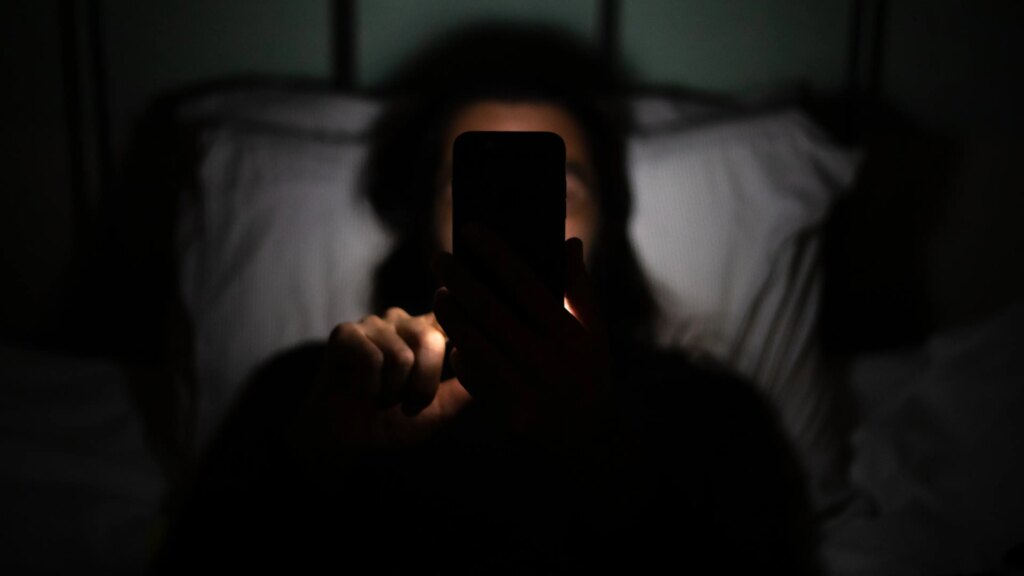
America faces a mental health emergency hiding in plain sight—in our pockets, purses, and hands throughout nearly every waking hour.
Last week, I caught myself mindlessly checking email when I should have been fully focused on the person I was with. As I caught myself, I embarrassingly put my phone away and kept it there for the remainder of the lunch. Not long after, I found myself responding to a text in the middle of a phone call with a dear friend. Neither the email nor the text was critical—and I realized, this is not who I want to be.
If you’re like most Americans, you’ve probably done something similar today. Research shows we now check our phones more than 100 times per day. We’ve become so seamlessly integrated with our devices that we barely notice how our screens have colonized every spare moment of our time, including the most precious ones we’ll never get back.
Before the Internet existed, many of us working to build the Internet dreamed of “democratizing access” to information, ideas, and to one another. In those early days when I was an executive at AOL, only a tiny fraction of the population was online, averaging less than an hour per week. We believed the internet, once mainstreamed, would enhance how people lived, worked, and played. And in many ways, it has.
But today’s reality would shock my younger self and those early colleagues: Nielsen reports that Americans now spend over eight hours per day on screens—the equivalent of a full workday and more hours than many people sleep.
We’re the first species in history to prioritize pixels over paradise. Think this is an exaggeration? Next time you are at a beach or a beautiful natural setting, see if people are looking up and around, or focused on the small glass screen in their hands. We’ve gone from intentional connection to compulsive consumption, from enhancement to entrapment.
The health consequences are deeply troubling and should be a clarion call to all of us that change is needed. Researchers have warned that teen depression rates are rising significantly. And while all researchers recognize numerous factors that contribute to this troubling uptick, a key finding by NIH’s Adolescent Brain Cognitive Development (ABCD) Study is that screen time in late childhood predicts increased depressive symptoms in early adolescence. In adults, excessive screen time correlates with increased stress, anxiety, social isolation, sleep disturbances, and cognitive decline.
We’re experiencing what researcher Linda Stone, a former colleague from the early internet days, calls “continuous partial attention”: always connected but never fully present. Our brains, evolutionarily wired for focused attention and periodic rest, are now trapped in a state of perpetual alert—scanning for the next notification, the next digital demand.
So what to do? It turns out that the antidote has been hiding in plain sight, and it’s accessible to us all.
A groundbreaking Stanford meta-analysis of 449 studies revealed something remarkable: Just 10 to 20 minutes in nature delivers measurable mental health benefits. Not hours. Not expensive retreats. Ten minutes. Researchers also found that cortisol levels drop, heart rate variability improves, and mood elevates, changes you can literally measure in saliva and blood, in people who spend even short periods outdoors. Cognitive benefits are equally striking: a University of Michigan study found that even a short nature walk improved memory and directed attention by roughly 20%, gains that no productivity app has replicated.
Compellingly, people who spend at least two hours weekly in nature report significantly better health and well-being than those who don’t, regardless of whether that time comes in one block or spread across multiple visits. The threshold is surprisingly low, the benefits impressively high.
During my decade as Chairman of National Geographic, I witnessed how nature transforms perspectives globally. But you don’t need to trek through the mountains or rainforests to experience this. Urban parks offer similar stress-reduction benefits to wilderness areas. A patch of grass, a tree-lined street, or sitting on a park bench all deliver measurable improvements.
Yet we’ve inverted our priorities. We treat five-minute social media breaks as rewards while viewing a 10-minute walk as something we “don’t have time for.” We schedule our screen time religiously, meetings, calls, inbox zero, but treat outdoor time as optional, something for weekends, if then.
Unlike complex health interventions requiring expensive equipment, specialized training, or insurance coverage, stepping outside costs nothing. Getting outside requires no app download, no subscription, no password. It’s the ultimate democratized medicine—so simple it seems almost foreign to our technology-solutioned minds.
Here’s my challenge, as someone who helped build this always-connected world and now sees its shadow side: Treat outdoor time with the same intentionality you bring to checking your email or your social media. Make it a priority every day. Take in the fresh air, listen to the sounds of nature, and trade scrolling for strolling.
Then take note of what happens to your stress levels, your mood, and your ability to focus.
The early internet pioneers believed technology would bring us together. But it turns out real connection, the kind that reduces loneliness, builds empathy, and strengthens communities, still happens best when we look up from our screens and step outside.
The irony is striking: We’ve spent decades and billions developing apps to improve our wellbeing, when the most powerful intervention requires no technology at all. Just a door, a decision, and a few minutes of courage to disconnect from our devices and reconnect with the world that’s been waiting for us all along.
The post The Danger of Screens Taking Over Our Lives appeared first on TIME.