In the acqua alta of protests and counterprotests, investigations and resignations, this year’s Venice Biennale has been the most contested edition in decades.
What an irony, then, that the world’s oldest and best-attended exhibition of contemporary art would begin with a call for calm. “Take a deep breath,” reads a text at the start of “In Minor Keys,” the feature presentation of work by some 110 creators. Close your eyes. Tune out the pings of your phone and the throngs of fellow tourists, and follow the artists.
Not bad advice — and not easy to follow. The 61st Venice Biennale began with a vision from one of the world’s leading curators for an “intimate and convivial” show, one that would step back from political conflicts and “shift to a slower gear” of processions and poetry. In the event, it has become almost the opposite: a visual slog and a theater of disputes. From its opening call to inhale and exhale, this show strives to dignify life, health, vigor. But when the crises bite, a healthy pulse is nothing without a cold, clear eye.
When the Venice Biennale named the Cameroonian curator Koyo Kouoh to plan this edition, its organizers had a good sense of who they were getting: a tested museum director and founder of institutions, with a network rooted in one continent (she is the second African to get the job) but global in scope (she worked on two editions of another international mega-exhibition, Documenta). But in May 2025, just a few months after her appointment, Kouoh was diagnosed with liver cancer and died within days.
In the shock of her sudden death, the Biennale decided to go ahead with Kouoh’s plans, and without any delay. The organization entrusted five of her colleagues and assistants (they call themselves her squadra, or team) to realize “In Minor Keys.” Several previous Venice curators have cast doubt on how far along preparations could have been at that stage, and by her team’s own admission, what Kouoh had settled upon was contingent.
Rory Tsapayi, one of the show’s five interpreters, explained that before her death “there was very little,” if any, “top-down curation,” and that Kouoh never said “‘I have selected this artist, and I have selected this work.’” (The other caretakers are Gabe Beckhurst Feijoo, Marie Hélène Pereira, Rasha Salti, and Siddhartha Mitter, a regular New York Times contributor.) If they have honored Kouoh by bringing her last effort to fruition, this posthumous Biennale is lopsided, with familiar themes confronted in familiar styles.
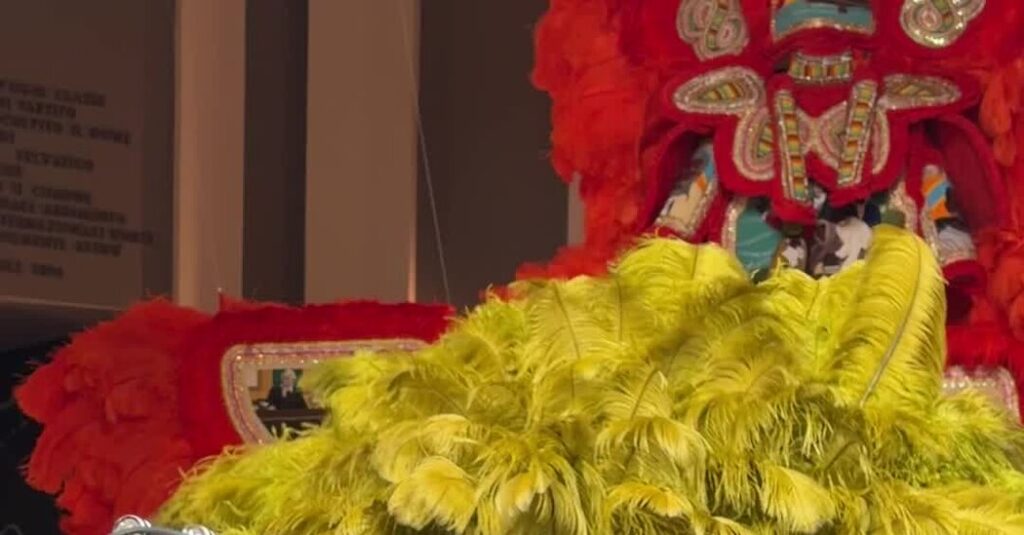
Once again, digital media take a back seat to textiles, ceramics, folklorism and pageantry — a tone set right from the start, with plumed and sequined regalia for Mardi Gras celebrations designed by Big Chief Demond Melancon of New Orleans. Once again, the galleries bulge with chimerical gods and monsters, from realms where disfavored populations are empowered and free. Once again, gardens and plants are co-opted into the cliché promise of “spiritual healing.” And once again, recurring perspectives on the war in Gaza and the Israeli-Palestinian conflict are awkwardly conjoined to invocations, meditations and the music of the spheres.
It is not that this exhibition lacks talent. Rose Salane, a standout in the last Whitney Biennial, has brought an intelligent, engrossing video, “Mercurial New York,” that eavesdrops on (staged) conversations on love or politics across the Big Apple, in English or French or Arabic or Mandarin. Mohammed Z. Rahman, from London, paints a shell, a sock, a lily, a jockstrap on dozens of little matchbooks, arranged in neat rows like Scrabble tiles to spell out some queer cryptogram. These are the two youngest artists in the entire show, swinging easily and winningly from inner to outer concerns. They gave me hope.
Of the Biennale’s two venues, the Arsenale, Venice’s old shipyard, hosts the show’s stronger half. Here the American artist Cauleen Smith has an airtight installation, “The Wanda Coleman Songbook,” whose videos, soundtrack, books and even scents map a bluesy Los Angeles. Alfredo Jaar, soldering a cube of platinum and rare earth metals, and Eric Baudelaire, filming the industrial flower market inside a massive Dutch refrigerated warehouse, explore in different ways the exchange rates between African resources and global commodities.
But the installation in the Arsenale is repetitive. Much of the art is arranged in long alleys: a joyous procession in the curators’ view, but a grind in practice. The rooms are crowded with various alternative geographies and cosmologies, by artists that the labels helpfully identify by their star signs. Bonnie Devine, an Anishinaabe painter in Toronto, proposes formulaic, luridly colored landscapes of North American colonial battle sites. (She is also an Aries.) Tabita Rezaire depicts nourishing mother-goddesses as schematically as corporate logos, and also offers a Palestinian flag made of cowrie shells. (Such Capricorn behavior.)
Things get worse in the Giardini, in whose central pavilion the squadra’s lack of experience at the scale of the Venice Biennale really starts to show. Here are two “shrines” to two of Kouoh’s foundational influences, which ought to establish the show’s argument for a quieter, more modest approach to art making.
One “shrine” is to Beverly Buchanan (1940-2015), who made eroding land art in the American south, and stone anti-monuments in which geological and historical time seem to overlap. The other is to the artist and writer Issa Samb (1945-2017) — a hero of Kouoh’s and also of mine, whose home in Dakar, Senegal hosted an endlessly propagating installation of public and private experiments. Samb’s treatment of found objects as sculptures, his copious note-taking and his blending of art and life have some intriguing parallels with Marcel Duchamp, one of whose “Boîte-en-valise” portable museums is here as an earlier query of the artwork-as-commodity.
But Buchanan’s models and maquettes are shunted into corners. Samb’s paintings and cloth objects are hung sky-high. Both are easy to overlook in a pavilion as overstuffed as a Manhattan Mini Storage locker, crowded with inert ceramics and academic paintings of yet more human-animal hybrids.
Mohammed Joha, born in Gaza, contributes collages and watercolors that are painfully mannered; Uriel Orlow offers a slide show of plants in Jerusalem, one of this show’s many strained projections of history onto flowers. As for María Magdalena Campos-Pons, who literally gives the late curator her flowers in a bombastic, wall-spanning double portrait of Kouoh with Toni Morrison (in yet another garden), I don’t think any mourning justifies that kind of hagiography.
HOWEVER: THIS DOUBLE sanctification, as well as the summoning of Duchamp (a total Leo), raises an issue that sits at the heart of this Biennale and of a lot of today’s cultural confusion. The confusion is this: The every-two-years timetable of big shows like Venice still creates expectations of new achievements in art. Yet for some time now, our culture has been struggling to deliver stylistic novelty. So we have displaced our expectations of aesthetic ambition onto life itself — onto artists’ biographies, friendships, bodies, star signs.
Many of these lives are admittedly compelling: the Mardi Gras celebrant, the Gazan collagist, and Kouoh herself. Her team, to its real credit, has afforded these artists’ lives a full humanity beyond the reified “identities” that got slapped on art like bumper stickers in the last decade (and very badly in Venice two years ago). But listen to the keywords of this year’s Biennale: “assembly,” “embodied gatherings,” “communing in convivial collectivity.” Life comes before art in this show, which is one reason it looks so messy. And an interesting life does not always make for interesting art.
In a fascinating essay in the exhibition catalog, the curator Adrienne Edwards takes up this theme, proposing that both art and politics today are tending away from material or scientific analyses of the world, and toward a “vitalism” that treats human life as something “ecstatic, emotive and mystical.” Edwards traces a vitalistic poetics from the German Romantic tradition to the work of Aimé Césaire and other poets of Negritude, and all the way to Samb’s integration of art and life in Dakar. Edwards also takes care to acknowledges “the Janus face of vitalism,” and how fascist and Nazi ideologies glorified vigor and instinct, too. So you have to be careful. You want to stick up for life against industry or empire. But when vital energy crowds out critical inquiry, things can get ugly fast.
This vitalistic justification of culture — the idea that art matters not for what it looks like or what it means, but for how it indexes its maker’s authentic life — is everywhere these days. Galleries justify the high price tags of young new painters not through formal innovation, but via action shots in the studio and interviews in paint-spattered clothes. Literature and activism went through a turn to “lived experience,” holding that what one lives through (or suffers) is a kind of knowledge. I would add, too, that vitalism also animates much of today’s new right, with its Nietzsche-for-nitwits embrace of heroic exercise and raw eggs.
These vitalistic currents, left and right, artistic and authoritarian, can be traced right back to economic impasses and technological upheaval, just as they could 100 years ago. But is life for life’s sake the only answer? The best show in Venice this year — “Helter Skelter: Arthur Jafa and Richard Prince,” a gritty exhibition of American appropriation at the Fondazione Prada — shows us another way.
Here are two artists who share a distrust of vitality: a disaffection from life that gives them the critical distance to see it clearly. Cribbing pictures from mass media and social media, crossing Jim Crow propaganda with contemporary megachurches, Prince and Jafa apply an alienated gaze to (American) life that pins down the past to the present. Their art’s power comes not from vitality, but from detachment. Through their skepticism, out of fragments, they forge a new image more powerful than any mythical beast.
“I take it for granted that life is more important than art,” wrote James Baldwin in a note from 1965, but then went on: “That is precisely why art is important.” That’s the whole game. Art isn’t a broadcast of life, it’s a method for making life intelligible — and you need both lobes of your brain, your reason as much as your passion, to reveal any truth about life we don’t yet know. Painting and poetry are disciplines, free but rigorous, that establish the very means by which we fathom the lives we’re living. If you do not channel life into form, then all you have produced is a livestream.
Jason Farago, a critic at large for The Times, writes about art and culture in the U.S. and abroad.
The post In Venice, the Passion of Life and the Ghost of Art appeared first on New York Times.