Midsize U.S. cities held steady in population over the past year, even as the national population grew at one of the slowest rates in history, according to new numbers released on Thursday by the Census Bureau.
Across the country, the growth of large cities was outpaced by that of surrounding midsize cities, defined as municipalities with populations ranging from about 25,000 to 70,000. Fort Mill, S.C., was the fastest-growing city, increasing its population by 6.8 percent, to 38,673. Its growth outpaced that of nearby Charlotte, N.C., the nation’s 14th-largest city.
The new census estimates capture changes in the population from July 1, 2024, to July 1, 2025, a period when immigration declined under the tighter border policies imposed toward the end of the Biden administration and the aggressive enforcement under the Trump administration. The figures also reflected the continuing effects of declining birthrates, as the country’s fertility rate fell to a record low.
The nation’s population increased by about 1.8 million over the past year, hitting almost 342 million on July 1. That represents a roughly 0.5 percent growth rate, the lowest since 2021, when the Covid-19 pandemic caused an increase in deaths and a slowdown in migration.
According to the new census estimates, drop-offs in average growth were steepest in the largest cities, especially those in the Northeast. Among the largest cities, average growth rates fell by at least half compared with a year earlier.
“The growth slowdown in bigger cities has a lot to do with the recent downturn in immigration, as immigrants tend to land in these cities,” said William Frey, a demographer at the Brookings Institution. He added that further declines could occur as immigration is curtailed.
Net immigration added almost 1.3 million people to the U.S. population over the period measured, considerably lower than the roughly 2.7 million added in the prior year. If current trends continue, net immigration will fall to about 321,000 for the year ending on June 30, according to an earlier Census Bureau news release.
The new census estimates found that some major hubs even had small population declines, Matt Erickson, a statistician in the bureau’s Population Division, said in a news release.
“In contrast, he added, “midsize cities found a ‘Goldilocks zone’ where domestic and international migration, paired with new housing, helped prevent the sluggish growth seen in small towns and larger metropolitan centers.”
For small towns, defined as places with a population of 5,000 or less, those in the Northeast experienced small population declines, those in the Midwest stayed the same, while those in the South and West saw sluggish growth.
New York City, the nation’s most populous city, lost 12,196 people, the greatest numeric decline in the country but a small percentage of its population. Some incorporated areas on the outskirts of the city, led by Port Chester, N.Y., were among the fastest growing.
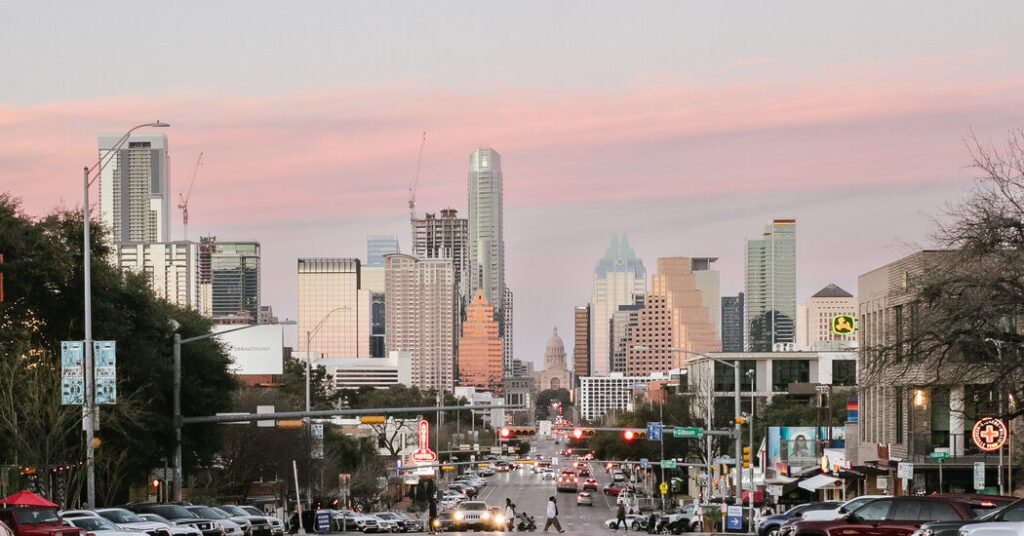
Overall, the fastest growing cities among those with populations over 20,000 were concentrated in Texas. Four of the cities were clustered in the Dallas-Fort Worth metroplex, and the fifth was outside Houston. Austin, Texas, hit one million residents, and Raleigh, N.C., crossed 500,000 people.
Although U.S. population growth slowed, housing growth did not. The total number of housing units reached 148.3 million in 2025, an increase of about 1 percent from the prior year, but still behind what housing experts say is needed to meet the supply shortage. California added the most housing units, followed by Texas and Florida.
Sabrina Tavernise contributed reporting.
Pooja Salhotra covers breaking news across the United States.
The post Midsize Cities Held Steady as U.S. Population Growth Declined appeared first on New York Times.