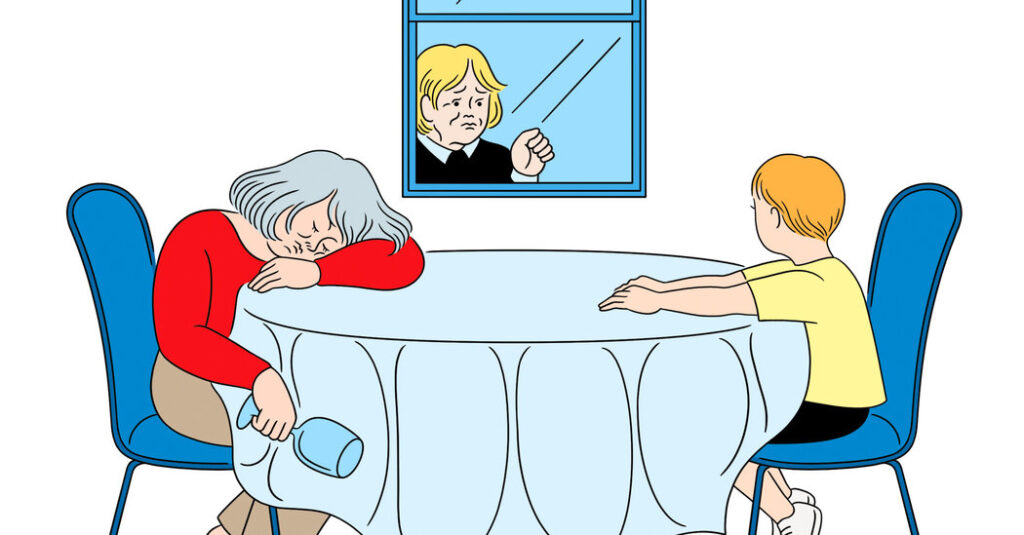
One of my sisters is raising her grandson, who is 5 years old. She is in her early 70s and has had him since he was born; the two of them live alone together and he is thriving.
My sister, however, is a high-functioning alcoholic, and recently I learned that the child has discovered her unconscious on more than one occasion.
Though everyone in the family is aware of her alcohol addiction, I’m unsure of how many know about her passing out. Other family members think that approaching our sister very slowly and carefully is the way to go. Meanwhile, I worry about the child’s safety. The fear is that state intervention will separate them even though he is currently doing very well, and the greater family would be torn apart by dissension with the whistle-blower.
What should I do with this information? I do not have a close relationship with this sister. — Name Withheld
From the Ethicist:
Young children, let’s agree, should not be left in the care of an adult who may become unconscious when they need help. Being asleep is one thing; being passed out is another. A sleeping adult can be roused in an emergency; a passed-out adult may be unresponsive. That’s a serious problem when that adult has been entrusted with the child’s well-being.
You don’t say much about the overall family situation, but given that you’re not close with your sister, I wonder whether there are family members closer to her who could step in immediately and assess what’s really going on. You ought to make sure everyone in the family knows about the incidents you’ve learned about, and then someone needs to discuss them with your sister. The family should also consider getting guidance from an addiction-support organization about how to approach her and how to get her the help she requires. Are there relatives the child already knows and trusts who could help provide a safer backup arrangement, at least in the short term?
The family’s responsibility is to prevent foreseeable harm, not simply to respond to it when it happens. That the child is thriving makes it easy to wave away the red flags; that nobody else is specifically on the hook allows for the diffusion of responsibility, and inertia. But when you’re aware of a pattern that could put a child at risk, doing nothing is a decision — and possibly a consequential one.
The immediate goal should be a concrete, workable plan: another adult checking in regularly, relatives helping with care, the child staying with trusted family members as appropriate, hiring a home caretaker if that’s possible. Although outside intervention may be necessary as a last resort, the family really should be pressed to come up with that plan. The child’s bond with his grandmother is worth protecting, but the priority should be to make sure that he’s kept from danger.
Readers Respond
The previous question was from a letter writer who wondered whether it would be ethical to take a job at a nonprofit whose funding came from a questionable source. He wrote:
Former colleagues of mine have recommended that I apply for a job at a philanthropic organization that does interesting work in my field. … This organization’s funds, however, come from someone who has made, and continues to make, their money in ways that I consider unethical. … While the organization is independent and is recognized for doing quality work, it feels wrong to accept money from such a source, and it feels like I would be helping to burnish the reputation of someone whose actions and public statements, both past and present, I deeply disapprove of. It may be worth noting that I am very satisfied with my current employment status. … How large a role should the source of this organization’s funding play in my decision to apply for a job there? — Name Withheld
In his response, the Ethicist noted:
This is not a new problem. Some of the most famous philanthropies in the country have origins tied to the monopolies and anti-union violence of the Gilded Age (Carnegie, Rockefeller), to the promotion of antisemitism (Ford) and to other affronts. … Still, it’s worth thinking about what social condemnation can and cannot achieve. It won’t eliminate the awful activity; when there’s money to be made, people unconcerned with mainstream moral judgment will pursue it. Laws, in these cases, have to supplement norms. What social condemnation can do, indiscriminately applied, is deter the beneficial activity, in part by keeping people like you from participating in the philanthropic work. Again, wrongdoing that’s widely known is hard to launder away; people aren’t being deceived. The greater risk is that shunning “bad” money could reduce its prospects of doing good.
(Reread the full question and answer here.)
⬥
The pastor of my parents’ church once said that he had decided to accept a donation from a source he considered tainted. The church, he said, could use the money for its good work: “The devil has had it long enough.” That said, the letter writer’s conundrum seems to me to be a no-brainer. He’s happy with his current job, and it supports him and his family well enough. If he thinks that applying for the proposed job may make him complicit in wrongdoing, he should just say no. — Linda
⬥
The letter writer has qualms about serving this organization, and it’s unlikely that he will be able to rationalize away the personal discomfit by focusing on a potential societal good. Knowing that worthy causes may suffer if he doesn’t take this job won’t help him feel better day-to-day if he’s doing something that makes him feel morally compromised. — Kate
⬥
As the director of a nonprofit environmental organization, I accepted funds from corporations that were known polluters. It made a difference to our programs, and we never felt that they asked us to compromise the work we were doing. To reject funding because of its source only hurts the cause to which it could have gone. If the letter writer thinks that he can positively contribute to an important cause by working at the philanthropic organization, then the source of the funding should not be that big a concern. — David
⬥
The Ethicist’s response is excellent for those looking for an overview of ethical thinking on this topic, but it doesn’t seem to address the letter writer’s basic question of what he should do. He’s doubtful he could get past the source of the funding if he took a job there, and if he can’t, that would naturally affect his commitment to the job. Since he hadn’t been thinking of looking for a new position, if it was me, I’d thank my friends for their belief in me and tell them I’m happy in my current situation. He doesn’t have to get into any ethical discussions or judgments. — Emme
⬥
I have always found that it is more beneficial and it makes a bigger impact to make change from the inside of these large organizations rather than just opting out and taking potshots from the outside. I worked in natural-resource management for the federal government for over 40 years, and while there were problems, I and my colleagues always felt we were making a difference and that natural resources were being protected because we were there to do it. — Penny
The post My Sister’s Alcoholism Is Putting Her Grandson at Risk. What Should I Do? appeared first on New York Times.