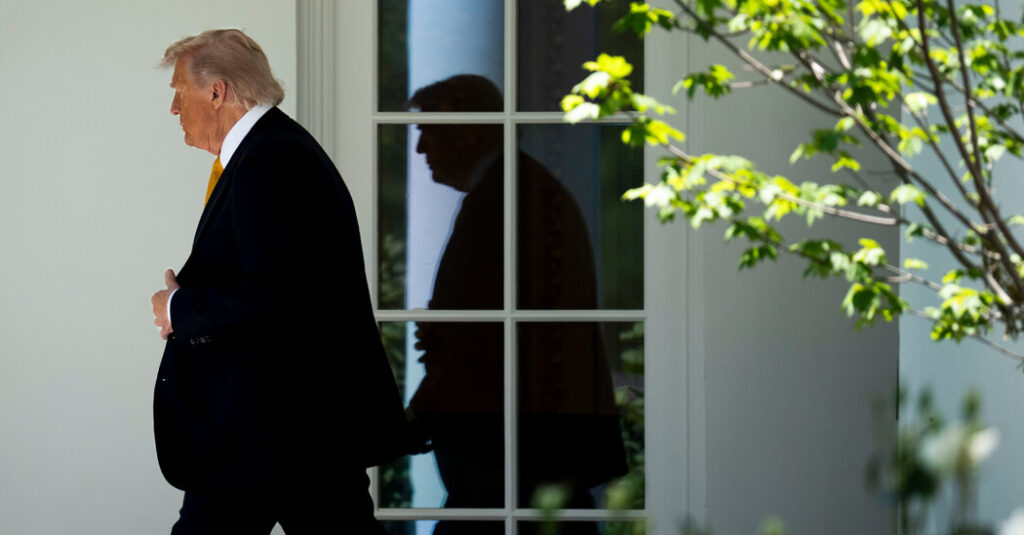
Addressing Americans about Iran last month, President Trump said that “the whole world is watching” the “power, strength and brilliance” of the United States.
Viewed from Beijing, where Mr. Trump arrived on Wednesday, the picture of the United States in its war with Iran is not quite as flattering. Beyond the pageantry, this week’s China summit seems set to underscore the strategic setbacks facing Mr. Trump as he struggles for a way to end the Iran war.
Mr. Trump is entering the summit with the economy at the top of his agenda. Analysts have predicted announcements about agricultural and airplane purchases by China, along with an extension of the trade war truce that President Xi Jinping and Mr. Trump reached last fall. The White House has said the summit will aim to refocus U.S.-China relations on “rebuilding the safety, security and prosperity of Americans.”
But the Iran war means that Mr. Trump has arrived in China at a weakened geopolitical moment, smarting from a shaky cease-fire and Iran’s refusal to ease energy prices by reopening the Strait of Hormuz. And it adds to China’s potential negotiating leverage, given that some analysts see Beijing as having the influence to push Iran toward a deal that would be acceptable to Mr. Trump — if Mr. Xi chooses to play ball.
Evan Medeiros, a former senior adviser on Asia to President Barack Obama, said that Chinese officials were “acutely aware” that Mr. Trump’s desire for an Iran peace deal presented Beijing with “a substantial source of leverage.”
“The question is, is Trump willing to pay whatever price Beijing puts on Chinese cooperation on the Iran issue?” Mr. Medeiros said in a briefing for reporters arranged by the Asia Group consultancy, where he is a senior adviser.
In Beijing, commentators have cast the Iran war as a confounding, unforced error of which China can now take advantage. Interviews with several foreign policy analysts in the Chinese capital on Wednesday showed how the summit is turning into the biggest test yet of the extent to which the Iran war has shifted the United States’ standing in the world.
“You are squandering your hegemony everywhere,” said Sun Chenghao, a specialist in U.S.-China relations at Tsinghua University in Beijing. “The U.S. is damaging its own image, its credibility.”
The balance of power between the United States and China had shifted in Beijing’s favor even before the U.S.-Israeli bombardment of Iran began on Feb. 28. Mr. Trump was quick to start a new trade war with China after he took office last year, but he backed down when China choked off exports of rare earth metals that American carmakers and other companies could not do without.
The Iran war complicated matters further. China’s inability to protect Iran, a close partner, from attack sowed doubt about Beijing’s geopolitical clout and limited its oil imports. But it harmed the United States even more, analysts in Beijing argue, because Mr. Trump has struggled to articulate his war aims and proved unable to stop Iran from causing a global energy crisis by closing the Strait of Hormuz, the main export route for oil from the Persian Gulf.
“Trump made a similar mistake as Putin made,” said Da Wei, the director of Tsinghua’s Center for International Security and Strategy, comparing Mr. Trump’s inflated expectations in bombing Iran to the bungled invasion of Ukraine by President Vladimir V. Putin of Russia. “When can the U.S. declare it won the war? I don’t know what the criteria is.”
China’s relationship with Russia is much closer than its ties to Iran, in part because of Mr. Putin’s role in helping Mr. Xi push back against a Western-led world order. China has enabled Russia’s war on Ukraine by buying energy exports from Russia and selling it key electronics. And China has resisted Western entreaties to pressure Russia to end its invasion.
For Mr. Xi, who has long sought to cement China’s role as a leading global power, the Iran war has presented a new opportunity to present his country as a responsible player. Wang Yi, China’s foreign minister, hosted his Iranian counterpart in Beijing last week and called for a “comprehensive cessation of hostilities.”
But some analysts say that China is not yet exerting all the leverage it has over Iran, which relies on China as the buyer of almost all its oil exports. That is where Taiwan comes in — perhaps the most uncertain of the summit’s agenda items.
Henry Huiyao Wang, the president of the Center for China and Globalization think tank, said China could do more to help Mr. Trump secure a peace deal with Iran if the U.S. president declared that he opposed the independence of Taiwan. The official position of the United States is that it “does not support” Taiwan’s independence, a rhetorical nuance that has long irked Beijing.
“Can they send this message a little stronger?” said Mr. Wang, a former Chinese government official. “I think that can be done if they expect China to do more.” If China is to give an “extra push” to clinch an Iran deal, Mr. Wang added, “it certainly needs more encouragement from the U.S.”
Mr. Medeiros, the former Obama adviser, described China’s relationship with Iran as primarily transactional in nature, meaning that it could figure into the broader negotiations at the summit.
“Some interesting trade space could open up between what Trump wants from China on Iran, and what Beijing wants from the United States on Taiwan,” Mr. Medeiros said.
The White House has dismissed talk that Mr. Trump might be persuaded by Mr. Xi to be more explicit in opposing Taiwanese independence. And other analysts were skeptical that China would be willing to exert much more pressure on Iran than it already has, especially given the sensitivities of being seen as selling out a partner to benefit the United States.
“For China, the cost will be very huge if we abandon Iran,” Mr. Sun, the U.S.-China specialist, said. “It will cause a lot of cascading effects to the other so-called strategic partners of China.”
But the view of an American president on the defensive, battling discontent with the war even within his political base and facing difficult midterm elections, was widely shared.
“He’s really tried all his means to stop this war,” Mr. Wang said, adding: “Now he’s stuck, and he wants to get out, and the midterms are coming.”
Berry Wang contributed reporting from Hong Kong.
Anton Troianovski writes about American foreign policy and national security for The Times from Washington. He was previously a foreign correspondent based in Moscow and Berlin.
The post For Trump, the Iran War Looms Over China Summit appeared first on New York Times.