VivaTech in Paris is ten years old. In 2016, 45,000 attended the first event. This year, at least 180,000 delegates will make the trip to the French capital. One highlight will be a “tech takeover” of the Champs-Élysées, where robots will walk amongst the plane trees. In a world where America and China dominate the technology debate, this is Europe’s moment.
The conversations will be familiar in Hall 7 at the Porte de Versailles, where delegates will gather in June. The productivity and revenue impact of artificial intelligence (where results are mixed), sovereignty and ethics (disputed), sustainability (AI is an energy-suck) and cyber-security and defense (vital and not always understood).
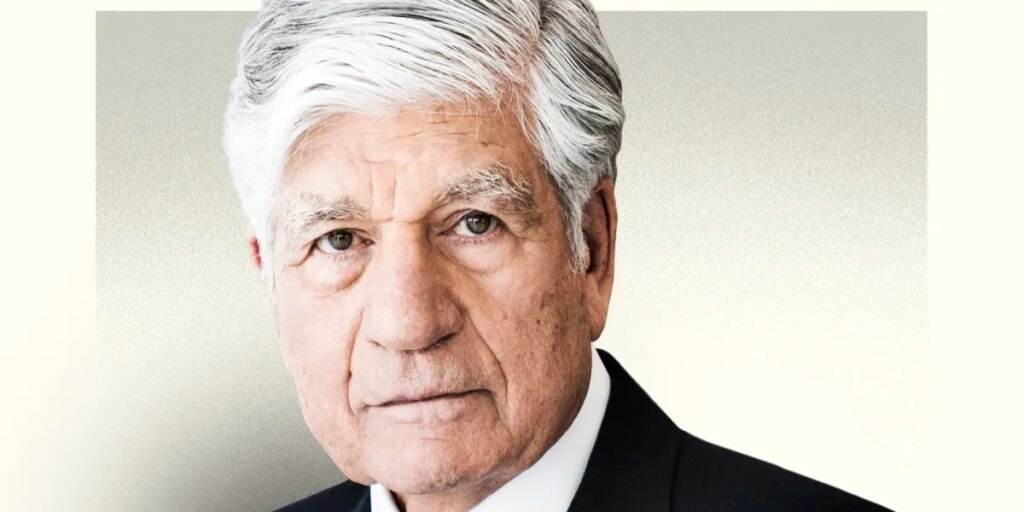
There will also be a familiar face cajoling and encouraging, in the background as well as on the main public stages. Maurice Lévy, who led Publicis for thirty years and is credited with building the group into a global giant, is the man who put France on the technology map. That it happened at all is a surprise, given the country’s testy relationship with the freewheeling chaos of Silicon Valley and “move fast and break things” attitudes. There was once talk of a civilizing “French internet” to keep the barbarians at arm’s length.
“The idea [for VivaTech] started a long, long time ago,” Lévy tells me. “In fact, it started at the turn of the millennium. That is when I started to think about this. We were seeing how buoyant the ecosystem of startups in some countries was. And I thought that what we needed [was] to have something working like a lighthouse, in order that all the people could turn their eyes to Paris, to France, and say there is room for the entrepreneur, there is room for ideas, and we will do something.”
In 2011, the then-president, Nicolas Sarkozy, invited Lévy to “bring together” some people in the technology sector and host a summit in France alongside that year’s G8 meeting of world leaders. This was Lévy’s chance. Six weeks later, he had indeed “brought together a few people” in tech, including Eric Schmidt (then executive chair of Google), John Donahoe (CEO of eBay), Mark Zuckerberg (Facebook), Jeff Bezos (Amazon), Sheryl Sandberg (chief operating officer at Facebook), Paul Jacobs (CEO of Qualcomm) and Jimmy Wales (founder of Wikipedia). The leading brains in the technology world produced a report on the battle over internet regulation (the tech leaders were not keen), which was presented to the G8 leadership, including President Barack Obama, the German Chancellor, Angela Merkel, and the British Prime Minister, David Cameron.
“All the people could turn their eyes to Paris, to France, and say there is room for the entrepreneur, there is room for ideas, and we will do something.”
Maurice Lévy, who led Publicis for thirty years
The event and report were so successful, President Obama asked Lévy for a repeat moment in America the following year. Lévy was unsure–fearing that the White House’s desire for control would cramp the innovative success of 2011.
“Right after the meeting, we had a short break, and Obama asked me to organize the same in the U.S.,” Lévy said. “And I told him: ‘Mr. President, you are asking me something that you don’t want me to do, because if we are to do it, and if I am to do it, I would like to have total freedom. And what you would like is that the head of communications will be leading and this is not how it works. You will not get the freedom of speech if it is led by an institution or the government.”
When the President’s communications team followed up in the way he feared, he politely declined.
“This is what I told President Obama–it’s not going to work,” he said to the communications team. “What you want is an agenda and almost a result before the meeting has taken place. The only way to get those people sitting around the table is to let them have total freedom to speak.”
America may not have worked out, but the kernel of an idea–a Europe-based technology conference–was planted. It would take another four years, and a conversation about something completely different, for the seed to sprout. Publicis was looking for ideas to celebrate its 90th anniversary, and Lévy wanted to be innovative.
“We brought some creative people around the table, some event people,” Lévy said. “And I said, listen, I don’t want the coffee table book. I don’t want a short film ‘telling the story’. I don’t want a celebration in black-tie at the Opéra de Paris. I want something original. And one voice in the room said: ‘Why not, as it is our 90th anniversary and you are very much embedded in the internet world, why don’t we find 90 startups?’ I said: ‘That’s an idea’.”
(Speakers left to right): Arthur Mensch, CEO, MISTRAL AI / Jensen Huang, CEO, NVIDIA / President Emmanuel Macron and Maurice Lévy.VivaTech
A competition was launched to find the candidates, and 6,500 applications rolled in. Lévy decided to invite them all, spoke to the French financial newspaper, Les Echos, which is owned by LVMH, and then to Bernard Arnault, LVMH’s CEO. A decision was taken to create a tech conference in France.
“We did the event without a plan, without a budget, without knowing what we will be spending,” Lévy remembers, laughing. “And the first year was a tremendous success, with close to 45,000 visitors. Everyone came. Obviously, I had to call a lot of people myself and insist that they come. And year on year we have beaten our record year and we got the most important people on the internet planet and the Chinese came. It was a success that I had not anticipated.”
Levy says that VivaTech brings together the entrepreneurialism and start-up culture of WebSummit and the authority of the World Economic Forum at Davos, where global business leaders and politicians meet. Last year, President Macron took to the stage with Jensen Huang, founder of Nvidia. Other prominent attendees included Joseph Tsai, co-founder and chair of Alibaba, Maya Rogers, CEO of Tetris, and Yann LeCun, chief AI scientist at Meta.
“This was something which was not even debatable, because the tech world is a world where we speak English, we don’t speak any other language.”
Maurice Lévy on why the conference is in English
Turning to this year’s themes, Levy sees two particular highlights–AI adoption and digital sovereignty. Last year, a report from MIT revealed that only 5% of AI pilot programs achieve significant and positive revenue results. “We have an issue–and we should make no mistake–and it is that although a lot of companies say: ‘Okay, we are moving into AI’, the reality is that they have not done a lot. You have this report from MIT, which shows that 95% have failed. Why? Simply because implementing AI demands that you transform the company, the way it works, and you transform the people, meaning that you have to train them in a certain way. It is necessary to rewire the people the way they think, they work.”
There is a French phrase Lévy likes, “voir plus grand”, roughly translated as “look for bigger possibilities”, or more simply, “dream bigger”. He would like companies to remember the phrase when it comes to AI transformation. Which, talking of language, brings me to another point. VivaTech, proudly hosted in the capital of France, takes place wholly in English. I ask Lévy whether his pride had been a little bruised by such a “fact of digital life”.
“I had to make it in English. And there was no question about that,” Lévy says. “This was something which was not even debatable, because the tech world is a world where we speak English, we don’t speak any other language.” Explaining that to the Président de la République was not the easiest, one assumes, conversation the organizers of VivaTech had to undertake. But, relax, the Saturday of the conference this year is all in French. “It’s dedicated to the general public, so you see families coming to VivaTech and all the events are in French.”
Alongside the debate over AI adoption, there is the issue of regulation and digital sovereignty. “Globalization is dead,” Lévy argues, so waiting for the world’s “rules-based order” to kick in will be a forlorn one.
“It will be almost impossible to create common regulation,” he says. “The ones who are the most inclined to do regulation is Europe. The problem is that by doing so, we are putting some limits to what we can do at a time where others are moving very fast on innovation without any constraint, and they are putting more distance and being competitive will be more difficult.
“Yes, I believe that there will be exaggeration [by AI products]. I believe there will be people who will break the laws, but I don’t believe that there will be much more in that area than there is in real life. You have drug dealers, you have murderers, you have cheaters. You have lots of bad people on earth, even in government, there are bad people and bad government.
“We have, therefore, to maybe not go for regulation, but go fast for innovation, in order that at least in that race, there is equal weight. Today it’s not equal weight. You have huge advances in the U.S., a big advance in China, and we are lagging behind. So we have to fill the gap before thinking about regulating, even if, by doing so, we have to pay the price of some exaggeration. Otherwise, we will be subservient and there will be such a dependency towards either the U.S. or China that we will be second-tier, second-class countries, and lose the chance of growing in that world of the future.”
Few would hazard a guess at what the world of technology will look like when VivaTech celebrates its 20th birthday. Artificial general intelligence may be with us. Some of the present hyper-scalers may have collapsed and burned, leaving investors bereft. Agentic AI may have, indeed, “solved disease.” Lévy will hope that whatever happens, VivaTech will still be going strong–Europe’s dog in the fight for the technological future.