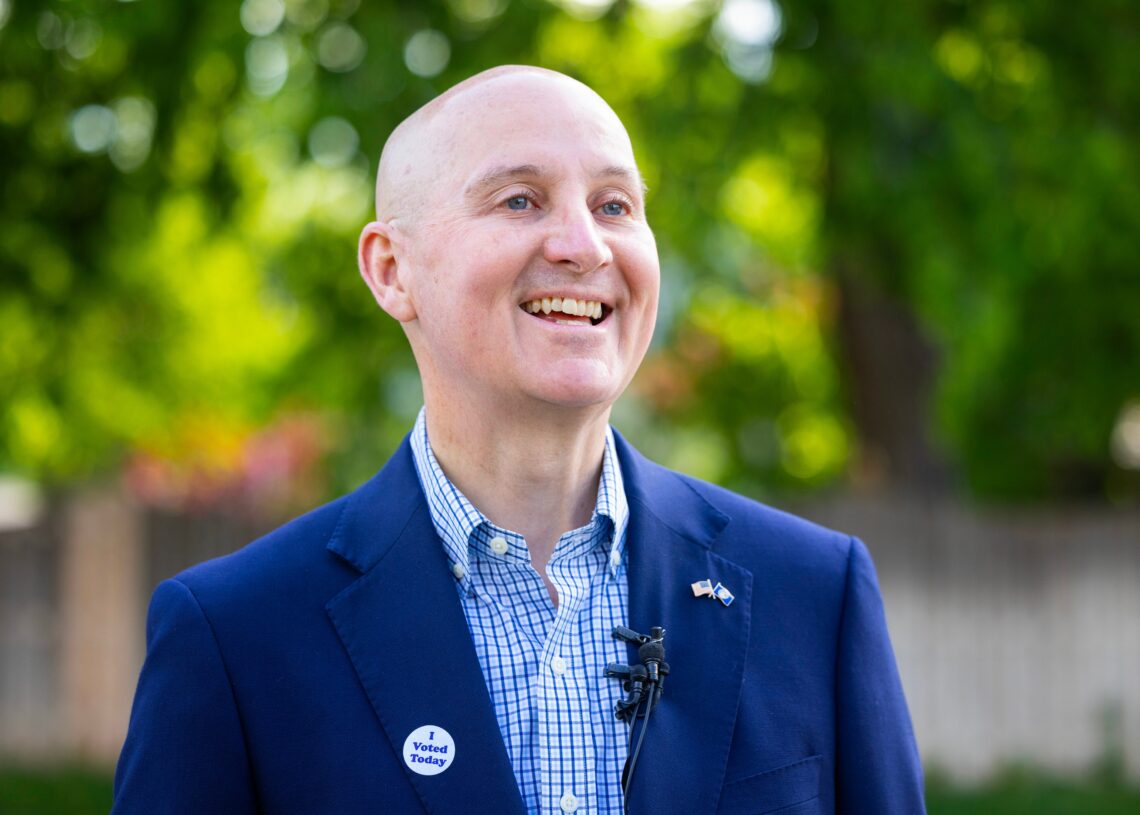
The long-shot path to unseating a Republican senator in Nebraska got slightly less complicated Tuesday night, as primary voters picked a Democratic nominee who promised to drop out and consolidate support behind an independent with the best chance of winning statewide.
Nebraska’s congressional primary races were a maze of plot twists and political gamesmanship.
On the Republican side, the U.S. Senate race and battleground House race were straightforward: Voters coalesced around well-recognized and well-funded candidates.
But for the Democrats eager to boost candidates who can win in deep-red Nebraska, it was weird.
Voters picked the Democratic Senate nominee who plans to drop out.
The Democrats’ circuitous strategy to oust the incumbent, Republican Sen. Pete Ricketts, turned into a Democratic primary full of shenanigans.
The winner Tuesday has no intention to run in November.
Cindy Burbank, a retired pharmacy worker, ran in the primary expressly so she could drop out and clear the field for independent Dan Osborn to take on Ricketts. The state Democratic Party endorsed Osborn, a former labor leader who lost running as an independent in a 2024 Senate race but finished 14 percentage points ahead of Democrat Kamala Harris. Burbank filed to run only because she believes the other Democratic candidate, William Forbes, was a “plant” from Ricketts to foil the party’s consolidation plans. Both men deny the allegations. Forbes is an antiabortion pastor who said he has voted repeatedly for President Donald Trump.
The Republican secretary of state removed Burbank from the ballot earlier this year, citing a Nebraska law against running in bad faith. A judge reinstated her.
Forbes told reporters he is a lifelong Democrat and ran to give voters options.
Toppling Republicans statewide in Nebraska requires a coalition that transcends partisanship: Registered Republicans make up roughly half of voters, while Democrats and independents are about a quarter each.
And for one more added wrinkle, Republicans alleged Democrats planted a sham marijuana-legalization candidate who would also drop out in the general election to help Osborn. Burbank paid the filing fee for Mike Marvin, the late entrant into the Legal Marijuana Now Party’s primary. Both deny he is a plant. As of late Tuesday, Marvin led the race in early returns.
November’s contest will test whether a deep-red prairie state will stick with a well-known and well-resourced Republican in Ricketts or if an independent can pull off an upset by avoiding the Democratic brand unpopular with blue-collar and rural voters.
The race also offers a dramatic contrast. Osborn is a working-class steamfitter, and Ricketts is a wealthy self-funder whose family owns the Chicago Cubs.
Voters were split on risking Nebraska’s ‘blue dot.’
Democrats view the open seat in an Omaha-based district as a top pickup target to flip control of the House. The battle in the district represented by Rep. Don Bacon (R), who decided not to seek reelection, became a costly Democratic fight over something unrelated to serving in Congress: Nebraska’s role in presidential elections.
Voters were split on how to resolve it, leaving the Democratic primary too close to call late Tuesday.
Denise Powell, a political organizer, and state Sen. John Cavanaugh were locked in a tight battle to win a six-way primary, according to unofficial returns.
Brinker Harding, an Omaha City Council member, ran uncontested for the Republican nomination.
More than $5 million in outside spending poured into the Democratic primary, in which candidates sparred over protecting Nebraska’s “blue dot” — a lone presidential electoral vote for Democrats among a sea of red. Rather than the winner-take-all electoral college system used in nearly every state, Nebraska awards some of its electoral college votes according to congressional district.
Republicans have unsuccessfully tried to implement a winner-take-all electoral college system, which would probably cost Democrats one electoral vote in future presidential races. Powell and her allies argued Cavanaugh was too valuable in the state legislature for voters to send him to Washington because a Republican governor could appoint a successor who could vote for that electoral college change.
Powell, who worked behind the scenes in Nebraska politics before running, was backed by Emily’s List and other national political action committees.
Cavanaugh, who was backed by the Congressional Progressive Caucus PAC and comes from a well-known Nebraska political family, has said the blue dot was not in danger because Democratic victories in state legislative races this November would offset his departure.
West Virginia is no longer a battleground.
Once a blue stronghold with a Democratic senator as recently as 2024, West Virginia is now solidly red and is no longer considered competitive.
Sen. Shelley Moore Capito (R-West Virginia), who is seeking a third term, won her primary. She will face lawyer Rachel Anderson, a former Morgantown City Council member who is not currently boosted by national Democrats.
Reps. Carol Miller and Riley Moore, the state’s two Republican House members, won their primaries and are heavily favored to defeat their Democratic opponents in November.
The post Takeaways from the Nebraska election where a winner plans to quit appeared first on Washington Post.