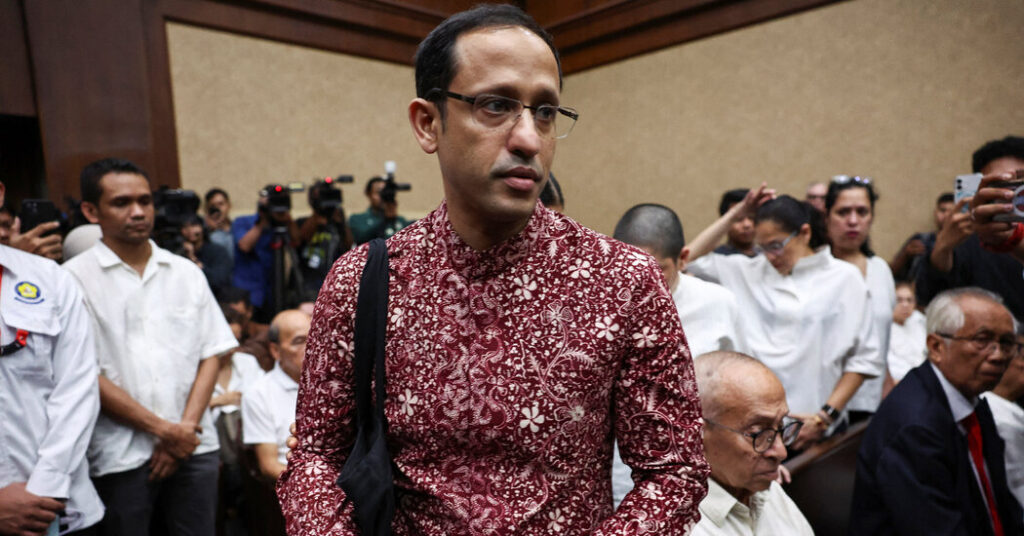
Nadiem Makarim was an Indonesian success story. A Harvard graduate, he built Gojek, the country’s alternative to Uber, into a super app that made him extremely wealthy. Then he joined the president’s cabinet.
Now he risks becoming a cautionary tale, a victim of what many call a political prosecution and the latest sign of an authoritarian tilt in Indonesia, the world’s third-largest democracy.
Prosecutors have accused Mr. Nadiem of corruption over a contract awarded to Google six years ago, during the Covid pandemic, for laptops to be used by students for remote learning. They allege that the contract, which Mr. Nadiem approved as education minister, was quid pro quo for investments Google had made in his companies years earlier.
Prosecutors said the Google Chromebooks were bought at artificially inflated prices and with unnecessary software licenses, costing the state 2.1 trillion rupiah, or $120 million. Many of the laptops could not be used in remote areas, they said. On Wednesday, they asked a court to sentence Mr. Nadiem to 18 years in prison and pay restitution of 5.6 trillion rupiah to the government, as well as a fine of one billion rupiah.
Neither Google nor any of its executives have been charged with crimes in connection with the case, and the company has denied wrongdoing.
Mr. Nadiem has spent months in detention. In an interview, he called the accusations against him “crazy,” adding, “They could not find any money that came to me.”
He said he believed that he had been targeted because “a lot of people did not like me in the upper echelons of power.” He said he feared not just prison but being “impoverished by the state,” which he worried would seize money that he made before joining the government.
Since taking office 18 months ago, President Prabowo Subianto, a former general, has given the military a bigger role in government and moved to centralize control in his own hands, raising concerns that Indonesia’s relatively young democracy was reverting to its authoritarian past.
He has also launched an aggressive anticorruption crackdown, which critics say he has used in part to fund big government expenditures, like a nationwide school lunch program that he championed. On Wednesday, he stood before cameras in front of piles of cash that he said came from fines imposed in corruption cases.
Todung Mulya Lubis, a prominent human rights lawyer, said the antigraft campaign had led to a string of questionable prosecutions and that Mr. Nadiem’s case “should not even have gone to court.”
Prosecutors say Mr. Nadiem approved the order of Google Chromebooks even though he knew they would not work in remote parts of Indonesia with little or no internet access. Mr. Nadiem has said that he gave the go-ahead after his team recommended choosing the Chromebooks because they were cheaper than other laptops.
On Tuesday, the Jakarta Corruption Court sentenced Ibrahim Arief, a technology consultant whom Mr. Nadiem had hired at the education ministry, to four years in prison, saying his actions in connection with the Google contract had resulted in state losses. Last July, the same court sentenced a former trade minister, Thomas Lembong, a prominent critic of former President Joko Widodo, to four and a half years in prison over a 2015 sugar import deal. (Mr. Prabowo pardoned him in August.)
Mr. Todung, the lawyer, said the cases against both Mr. Nadiem and Mr. Lembong were “extremely weak,” adding that it was a bad idea to prosecute former officials for decisions made in office. “If policy can be criminalized, who would want to be a public official?” he said.
Prosecutors did not respond to a request for comment.
Caesar Sengupta, a former Google executive who worked on the Chromebook contract, predicted that Mr. Nadiem’s prosecution would have a chilling effect on foreign investment. “I’m sure a lot of the U.S. tech companies are looking at Indonesia and are probably saying, ‘Not worth the risk,’” he said.
Mr. Nadiem spoke over Zoom last month from a hospital in Jakarta, where he was being treated for a chronic illness. He looked tired, and an I.V. drip inserted into his hand was visible. His eyes welled up when he talked about his four young children. On Tuesday, the court authorized moving Mr. Nadiem from a detention facility to house arrest because of his medical condition.
He became education minister in 2019, at the invitation of Mr. Joko, who was then the president. It was a controversial choice, because Mr. Nadiem had no experience in education.
He shook things up, including by sidelining many senior officials who had poor reputations. The moves “really caused resentment and hatred,” he said.
Three months into his term, he faced a challenge that schools all over the world were grappling with — learning during a pandemic. He approved the Chromebooks order in June 2020. The program had mixed results: Some studies showed that Chromebooks improved students’ literacy and motivation but were less effective in rural areas.
Dino Patti Djalal, a former Indonesian ambassador to the United States, talked about Mr. Nadiem’s case in a video he posted on Instagram two weeks ago. He said it was an example of “legal tyranny, where the law is not a tool of justice but a weapon used to oppress good people.”
In an interview, Mr. Dino said he had been told by Indonesians overseas that Mr. Nadiem’s case had made them nervous about coming home to work for the government. He added: “The rule of law in Indonesia is problematic.”
Rin Hindryati contributed reporting.
Sui-Lee Wee is the Southeast Asia bureau chief for The Times, overseeing coverage of 11 countries in the region.
The post A Tech Tycoon’s Prosecution Raises Fears of Authoritarian Overreach appeared first on New York Times.